
API RP 581 Risk-Based Inspection Methodology, Fourth Edition
API RP 581 4th Edition provides RBI methods for probability and consequence of failure, damage factors, inspection effectiveness and inspection planning.
Wrong edition, wrong file, or a file that won’t open? We replace or refund — contact us within 7 days.
Buy now is for one copy. Buying for a team? Get a quote
About this publication
Product Description
API Recommended Practice 581, Risk-Based Inspection Methodology, Fourth Edition, provides the detailed technical methodology used to perform risk-based inspection assessments for fixed equipment in refining, petrochemical, chemical-process and oil and gas facilities. The recommended practice supplies calculation procedures for evaluating the probability and consequence of equipment failure and using the resulting risk information to establish inspection priorities and inspection plans.
API RP 581 is intended to complement API RP 580. API RP 580 establishes the elements and general framework of a risk-based inspection program, while API RP 581 provides the calculation methodology used to perform the technical risk assessment and determine inspection planning information. Together, the documents support a structured RBI program in which inspection resources can be focused according to equipment risk and the factors driving that risk.
What API RP 581 Covers
The recommended practice provides risk-based inspection methodology for pressurized fixed equipment including pressure vessels, piping, tankage, pressure-relief devices and heat exchanger tube bundles. The pressure boundaries of other equipment can also be evaluated where the methodology is applicable.
The methodology evaluates risk through the combination of probability of failure and consequence of failure. Within the API RP 581 framework, failure is associated with loss of containment from a pressure boundary through leakage or rupture. The calculated risk provides a basis for prioritizing equipment, identifying important risk drivers and determining when and how effectively equipment should be inspected.
Risk-Based Inspection Fundamentals
Risk-based inspection uses risk as a basis for inspection planning rather than applying the same inspection interval, technique or coverage to every equipment item. The methodology is intended to distinguish equipment whose condition, damage mechanisms and potential failure consequences justify greater inspection attention from equipment having comparatively lower calculated risk.
The RBI process does not assume that inspection itself removes deterioration or eliminates risk. Instead, inspection can reduce uncertainty concerning the condition of equipment and provide improved information for reassessing the probability of failure. Results from inspection can therefore be incorporated into subsequent RBI calculations and inspection-planning decisions.
Probability of Failure and Consequence of Failure
The central risk calculation in API RP 581 combines probability of failure, commonly identified as POF, with consequence of failure, commonly identified as COF. These two elements allow equipment risk to be evaluated from both the likelihood of loss of containment and the potential effect of that event.
Probability-of-failure calculations consider equipment type, damage mechanisms, deterioration, inspection history and other factors incorporated into the methodology. Consequence-of-failure calculations evaluate the potential effects associated with release from the pressure boundary. The combination of the two provides the calculated risk used in RBI prioritization and inspection planning.
Five-Part Fourth Edition Structure
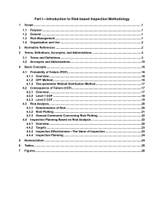
The fourth edition is organized into five major parts that separate the core RBI methodology from probability calculations, consequence calculations, inspection planning and special-equipment methods:
- Part 1 — Risk-Based Inspection Methodology
- Part 2 — Probability of Failure Methodology
- Part 3 — Consequence of Failure Methodology
- Part 4 — Inspection Planning Methodology
- Part 5 — Special Equipment
This organization is a significant feature of the fourth edition and places inspection planning in a dedicated part of the document.
Part 1 — Risk-Based Inspection Methodology
Part 1 establishes the overall RBI methodology and the framework used to develop a risk-based inspection plan. It explains how equipment is evaluated, how risk is determined and how the results of the assessment are used within the inspection-planning process.
The methodology is intended to give owner-users and inspection organizations a consistent technical basis for ranking equipment and identifying the factors that most strongly influence calculated risk. The resulting information can then be considered together with applicable inspection codes, statutory requirements, company requirements and engineering judgment.
Risk Analysis and Risk Drivers
API RP 581 supports identification of the factors responsible for an equipment item's calculated risk. Understanding these risk drivers is important because two equipment items with similar overall risk can require different inspection or risk-management strategies when their probabilities, consequences or active damage mechanisms differ.
Risk Reassessment
RBI is not treated as a one-time calculation. Inspection findings, changes in equipment condition, operating changes and other relevant information can affect subsequent risk calculations. Reassessment allows inspection plans to be updated as the understanding of equipment condition changes.
Part 2 — Probability of Failure Methodology
Part 2 contains the probability-of-failure methodology and supporting damage-factor calculations. This portion of API RP 581 is particularly important for integrity engineers, corrosion specialists and RBI practitioners because it provides the procedures used to characterize deterioration and convert damage information into probability-of-failure inputs.
Management Systems Evaluation
Part 2 includes a Management Systems Workbook used within the probability methodology. Management-system performance is one of the elements considered when evaluating the likelihood of equipment failure within the API RP 581 framework.
Corrosion Rate Determination
Annex 2.B addresses determination of corrosion rates. Corrosion-rate information is a fundamental input for evaluating deterioration mechanisms that reduce pressure-boundary thickness over time.
The methodology provides a structured basis for relating corrosion information to equipment condition and future risk rather than treating measured thickness information as an isolated inspection result.
Internal Stress Corrosion Cracking Susceptibility
Annex 2.C addresses determination of internal stress corrosion cracking susceptibilities. Cracking mechanisms require different assessment and inspection considerations than general wall thinning because damage morphology, detection capability and progression characteristics differ significantly.
External Damage Susceptibility
Annex 2.D addresses external damage susceptibilities. This portion of the methodology supports evaluation of damage affecting the outside surface or external environment of fixed equipment where such deterioration can contribute to loss of containment.
Mechanical and Metallurgical Susceptibilities
Annex 2.E addresses mechanical and metallurgical susceptibilities incorporated into the probability-of-failure methodology. These mechanisms require consideration of equipment materials, operating conditions and the characteristics of the applicable deterioration mechanism.
Damage Factors
Damage factors are an important component of API RP 581 probability calculations. They provide a structured means of representing the effect of equipment deterioration and damage mechanisms on probability of failure.
The fourth edition includes revisions to damage-factor methodologies, with industry reviews of the revision particularly noting updates associated with thinning and cracking modules.
Inspection Effectiveness
Annex 2.F addresses levels of inspection effectiveness. API RP 581 recognizes that inspections differ in their ability to detect, characterize and quantify particular damage mechanisms. Inspection technique, coverage, location and execution therefore influence how much confidence an RBI assessment can place in the inspection results.
Inspection effectiveness categories provide a method for distinguishing inspections that offer different levels of information about equipment condition. The effectiveness of an inspection is evaluated in relation to the damage mechanism being examined rather than assuming that one inspection technique is equally effective for every type of deterioration.
Thinning Inspection Effectiveness
The methodology includes inspection-effectiveness guidance for thinning damage, including both intrusive and nonintrusive examination approaches. Coverage and examination method are important in determining the effectiveness assigned to an inspection.
Cracking Inspection Effectiveness
Cracking mechanisms require inspection methods capable of detecting the relevant crack morphology and locations. The fourth edition continues to connect inspection effectiveness with the particular damage mechanism and the quality of information produced by the inspection activity.
Part 3 — Consequence of Failure Methodology
Part 3 provides the consequence-of-failure methodology used to evaluate the potential results of loss of containment. Consequence calculations form the second major component of the API RP 581 risk equation and are combined with probability-of-failure results when determining risk.
Release and Failure Consequences
Consequence analysis evaluates the potential effect of leakage or rupture from pressurized equipment. The methodology provides a structured calculation framework so that consequence is evaluated consistently rather than solely through qualitative ranking.
Basis for Consequence Methodology
Annex 3.A documents the basis for the consequence methodology and supports understanding of the technical assumptions used in the calculations.
SI and U.S. Customary Units
Annex 3.B provides SI and U.S. customary conversion factors, supporting use of the methodology in facilities and engineering organizations working in either measurement system.
Part 4 — Inspection Planning Methodology
The fourth edition creates a dedicated Part 4 for inspection planning. Material that had previously been distributed elsewhere in the document was reorganized so that development of the inspection strategy is addressed as a distinct step in the RBI methodology.
Inspection planning uses calculated risk, risk drivers, damage mechanisms, inspection effectiveness and risk targets to determine what inspection activity is appropriate and when that activity should be performed.
Risk-Based Inspection Intervals
The methodology allows inspection timing to be informed by the progression of calculated risk toward an established risk target or tolerance. This approach differs from inspection strategies that rely only on fixed calendar intervals.
Inspection Technique Selection
The inspection-planning process considers whether proposed examination methods are capable of effectively detecting the applicable damage mechanisms. An inspection plan therefore involves more than establishing a date; technique and examination effectiveness are also significant.
Inspection Coverage
Inspection coverage influences the amount and quality of information obtained about equipment condition. API RP 581 incorporates coverage considerations into inspection-effectiveness concepts used when planning or evaluating examinations.
Inspection Does Not Directly Reduce Damage
An important RBI concept is that performing an inspection does not itself remove deterioration. The inspection reduces uncertainty and improves knowledge of equipment condition. Physical risk reduction can require repair, replacement, operating changes, mitigation of damage mechanisms or other actions in addition to inspection.
Part 5 — Special Equipment
Part 5 contains methodologies developed for equipment having risk characteristics that require specialized treatment beyond the basic fixed-equipment methods.
Pressure-Relief Devices
The fourth edition revises and restructures the pressure-relief-device methodology. Industry technical reviews of the edition identify corrections and clarifications to probability-of-failure calculations, inspection updating and design-margin treatment.
Pressure-relief devices play a critical role in protecting pressurized systems, and their reliability and inspection history require a different risk-analysis approach from ordinary pressure vessels or piping components.
Heat Exchanger Tube Bundles
API RP 581 includes a specialized methodology for heat exchanger tube bundles. Annex 5.A addresses a Bundle Weibull Approach that provides a statistical framework for evaluating tube-bundle reliability and inspection information.
Steam Equipment
The fourth edition adds methodology for risk analysis of steam equipment. This expands the special-equipment portion of the document beyond the equipment categories addressed in the previous edition.
Pressure Vessels
Pressure vessels are one of the principal fixed-equipment categories covered by the RBI methodology. Probability of failure, applicable damage mechanisms, inspection history and potential consequence of loss of containment can be evaluated to develop a risk-based inspection plan.
Piping Systems
Process piping is another major application of API RP 581. RBI assessment can be used to distinguish piping components and circuits according to calculated risk and to focus examination where deterioration and potential consequence justify greater inspection attention.
Atmospheric Storage Tanks
The methodology includes tankage within its fixed-equipment applications. Tank assessment requires consideration of equipment-specific deterioration, inspection data and consequence characteristics within the RBI framework.
Relationship to API RP 580
API RP 580 and API RP 581 perform related but distinct functions. API RP 580 establishes the basic elements, organizational requirements and general principles for developing, implementing and maintaining an RBI program. API RP 581 provides the detailed technical calculation methodology used to carry out risk analysis and inspection planning.
Organizations implementing RBI commonly use the two documents together: API RP 580 for the program framework and API RP 581 for the technical risk-assessment methodology.
Relationship to Mechanical Integrity Programs
API RP 581 is intended to operate within a broader mechanical-integrity system rather than replace inspection codes, fitness-for-service assessment, corrosion management or engineering evaluation. RBI results can help prioritize inspection resources and identify important risk drivers, while other API and industry standards provide requirements for inspection execution, repair, alteration and fitness-for-service evaluation.
Fourth Edition Technical Revision
The 2025 fourth edition represents a substantial revision and reorganization of the previous third edition, which was published in 2016 and later supplemented by Addendum 1 in 2019 and Addendum 2 in 2020.
Industry technical reviews of the fourth edition identify significant work in the probability-of-failure methodology, particularly thinning and cracking modules, inspection-planning methodology, treatment of clad and weld-overlay construction, coating considerations and special-equipment calculations.
New Dedicated Inspection Planning Part
A major structural change is the creation of Part 4 specifically for Inspection Planning Methodology. Relevant inspection-planning material was reorganized into this dedicated part to provide a clearer progression from risk assessment to inspection strategy.
Updates to Thinning and Cracking Methodology
The fourth edition includes changes focused on damage-factor determination for thinning and cracking mechanisms. These revisions affect the technical calculations used in probability-of-failure assessments.
Cladding and Weld Overlay
The revised methodology provides improved treatment of equipment incorporating cladding or weld overlay where these features affect deterioration assessment and inspection planning.
Coating Considerations
The fourth edition also updates treatment of coatings within applicable damage and probability-of-failure calculations.
Pressure-Relief Device Revisions
Part 5 revisions include restructuring and correction of the pressure-relief-device methodology, including calculation and inspection-updating provisions.
Current Edition Status
API's current Standards Plan identifies API RP 581, Fourth Edition, as published January 30, 2025. It supersedes API RP 581, Third Edition, published in 2016 together with Addendum 1 dated April 2019 and Addendum 2 dated October 2020.
As of September 2026, API's standards-development records show work underway on Addendum 1 to the fourth edition, including a 2026 reballot, and separate development activity for Addendum 2. These development records do not establish that either addendum has been formally published, so they are not incorporated into this listing as issued amendments.
Who Should Use API RP 581
- Risk-based inspection engineers and RBI specialists
- Mechanical integrity engineers
- Pressure-equipment inspectors
- Corrosion and materials engineers
- Fixed-equipment engineers
- Reliability engineers
- Inspection planners
- Asset-integrity professionals
- Refinery and petrochemical plant engineering teams
- Oil and gas production facility personnel
- Pressure-vessel and piping specialists
- Organizations implementing API RP 580 RBI programs
- Consultants developing or validating RBI assessments
Why This Recommended Practice Matters
Traditional inspection programs can allocate inspection resources using fixed intervals or broad equipment categories that do not always reflect the actual combination of deterioration and potential failure consequence. API RP 581 provides a structured methodology for differentiating equipment according to calculated risk and for identifying the damage mechanisms and consequence factors responsible for that risk.
The methodology allows inspection planning to be linked directly to equipment condition, damage susceptibility, inspection history and potential consequence. This can improve understanding of integrity risk and provide a more defensible technical basis for inspection prioritization while retaining the requirements of applicable inspection codes and company practices.
Product Features
- Fourth edition of API Recommended Practice 581
- 692-page risk-based inspection methodology
- Published by the American Petroleum Institute
- Quantitative and semiquantitative calculation methods for RBI assessment
- Combines probability of failure and consequence of failure
- Covers pressure vessels, piping and tankage
- Includes pressure-relief-device methodology
- Includes heat exchanger tube-bundle methodology
- Includes steam-equipment risk methodology
- Provides probability-of-failure calculations and damage factors
- Addresses corrosion-rate determination
- Addresses internal stress corrosion cracking susceptibility
- Addresses external damage susceptibility
- Addresses mechanical and metallurgical susceptibility
- Includes levels of inspection effectiveness
- Provides consequence-of-failure methodology
- Includes a dedicated inspection-planning methodology
- Supports risk-based inspection interval and technique selection
- Reorganizes the methodology into five major parts
- Supersedes the third edition with its 2019 and 2020 addenda
Product Details
- Recommended Practice: API RP 581
- Title: Risk-Based Inspection Methodology
- Publisher: American Petroleum Institute
- Edition: Fourth Edition
- Publication Date: January 30, 2025
- Publication Year: 2025
- Page Count: 692
- Product Code: C58104
- Language: English
- Publication Type: Recommended Practice
- Previous Edition: API RP 581, Third Edition, 2016, including Addendum 1 (2019) and Addendum 2 (2020)
Edition Status Note
API RP 581, Fourth Edition is the current published edition. API's official Standards Plan records the fourth edition with a publication date of January 30, 2025. API currently has additional fourth-edition addendum work in development, but the available API development records do not show those addenda as formally published. This listing therefore represents the issued 2025 fourth edition without unpublished addendum material.