
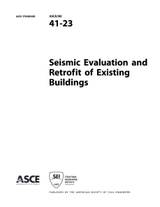
ASCE/SEI 41-23 Seismic Evaluation and Retrofit of Existing Buildings
ASCE/SEI 41-23 covers performance-based seismic evaluation and retrofit, Tier 1-3 procedures, nonlinear analysis, structural systems and seismic hazards.
About this publication
Product Description
ASCE/SEI 41-23, Seismic Evaluation and Retrofit of Existing Buildings, is the current American Society of Civil Engineers standard for performance-based seismic evaluation and retrofit of existing buildings.
Prepared by the Seismic Evaluation and Retrofit of Existing Buildings Committee of the Codes and Standards Activities Division of the Structural Engineering Institute of ASCE, the standard provides procedures for determining whether existing buildings meet defined seismic performance objectives and for developing retrofit measures when deficiencies are identified.
ASCE 41 is specifically written for existing buildings, recognizing that evaluation and rehabilitation of older construction requires different procedures from the prescriptive requirements typically used for new-building design.
Performance-Based Seismic Evaluation
ASCE 41 uses performance-based engineering principles to connect seismic hazard levels with expected structural and nonstructural building performance.
The standard allows users to select an appropriate Performance Objective and then evaluate whether the existing building can meet that objective under the specified seismic hazard.
This framework permits evaluation and retrofit decisions to be based on the actual performance goals of the building rather than simply attempting to make an existing structure comply with every provision applicable to a newly designed building.
Three-Tier Evaluation Process
ASCE 41-23 provides three progressively more detailed approaches to seismic evaluation:
- Tier 1 — Screening
- Tier 2 — Deficiency-Based Evaluation and Retrofit
- Tier 3 — Systematic Evaluation and Retrofit
Each tier involves greater engineering effort but can provide a more detailed and less generalized understanding of actual building performance.
Tier 1 — Screening
Tier 1 is the initial screening level and uses checklists based on building type, seismicity and known characteristics associated with past earthquake performance.
The screening process is intended to identify potential seismic deficiencies requiring additional investigation. It can be particularly useful for preliminary evaluation of individual buildings or portfolios containing numerous structures.
ASCE provides Tier 1 checklists for a range of building types and seismicity levels. Fillable electronic forms are also available separately from ASCE for use with ASCE/SEI 41-23.
Tier 2 — Deficiency-Based Evaluation and Retrofit
Tier 2 evaluates specific potential deficiencies identified through screening or other available information.
The deficiency-based method allows engineers to focus analysis and retrofit efforts on structural and nonstructural conditions known to be of concern for particular building types and configurations rather than performing a complete analytical evaluation of every building component.
This approach can provide an efficient pathway when the building falls within the limitations established for the applicable procedures.
Tier 3 — Systematic Evaluation and Retrofit
Tier 3 provides a comprehensive systematic evaluation of the building.
This procedure can be applied to any building and involves rigorous analysis of the structural system, components, seismic demands, acceptance criteria and applicable nonstructural elements.
Tier 3 is particularly useful for complex structures, unusual configurations or buildings where the simpler Tier 1 and Tier 2 methods are insufficient.
Chapter 1 — General Requirements
Chapter 1 establishes the scope, terminology, notation and general procedures governing seismic evaluation and retrofit.
It includes requirements addressing assignment of Performance Objectives, determination of seismicity, collection of as-built information, selection of evaluation procedures and the overall seismic retrofit process.
As-Built Information
Evaluation of an existing building depends on understanding how the structure was actually constructed.
ASCE 41 therefore requires collection and evaluation of available drawings, specifications, testing information, field observations and other evidence needed to establish structural configuration, materials and condition.
Where existing documentation is incomplete, investigation and testing can be required to obtain sufficient information for analysis.
Chapter 2 — Performance Objectives and Seismic Hazards
Chapter 2 establishes the relationship between seismic hazard levels and building performance objectives.
Performance Objectives combine a selected earthquake hazard with target structural and nonstructural performance levels.
This allows owners, engineers and authorities to establish performance expectations appropriate to the building's occupancy, importance, risk and retrofit program objectives.
Structural Performance
Structural performance levels describe expected behavior of the building's load-resisting systems under earthquake demands.
Performance can range from conditions intended primarily to prevent collapse through higher levels intended to preserve greater structural capacity and reduce damage.
Nonstructural Performance
ASCE 41 also addresses performance of architectural, mechanical and electrical components and systems.
Nonstructural components can present major safety hazards or cause substantial economic and operational losses even where the primary structural system remains stable.
2023 USGS Seismic Hazard Update
One of the major changes in ASCE 41-23 is alignment with the newer U.S. Geological Survey seismic hazard model.
The 2023 edition introduces provisions accommodating multipoint response spectra associated with the updated USGS seismic hazard methodology.
This represents a significant change in the way earthquake ground-motion parameters can be established for evaluation and retrofit projects.
ASCE Hazard Tool
ASCE identifies the ASCE Hazard Tool as a resource for obtaining seismic parameters used with current ASCE standards.
The tool can generate site-specific hazard information and supports application of seismic requirements in ASCE 41 and related standards.
Chapter 3 — Evaluation and Retrofit Requirements
Chapter 3 establishes general requirements governing seismic evaluation and retrofit projects.
These provisions address the use of Tier 1, Tier 2 and Tier 3 procedures and establish how the selected evaluation or retrofit methodology is applied to the building.
Chapter 4 — Tier 1 Screening
Chapter 4 contains the requirements for initial Tier 1 seismic screening.
Engineers use building-type-specific checklists and available information to identify conditions that could represent seismic deficiencies.
Chapter 5 — Tier 2 Deficiency-Based Evaluation and Retrofit
Chapter 5 establishes procedures for detailed evaluation and retrofit of specific deficiencies.
This approach is intended to focus engineering resources on weaknesses that are relevant to the particular building rather than requiring complete analysis where it is not necessary.
Chapter 6 — Tier 3 Systematic Evaluation and Retrofit
Chapter 6 establishes the framework for comprehensive Tier 3 evaluation.
The systematic method evaluates the full structural system using the analysis procedures, component modeling parameters and acceptance criteria contained in or referenced by the standard.
Chapter 7 — Analysis Procedures and Acceptance Criteria
Chapter 7 establishes analytical methods used to determine seismic demands and evaluate structural response.
The standard recognizes multiple analytical approaches ranging from linear methods to nonlinear procedures.
The selected analysis procedure must be appropriate to the structural system, seismic performance objective and complexity of the building.
Linear Analysis
Linear analysis procedures provide an engineering approximation of structural response while applying acceptance criteria calibrated for existing-building evaluation.
These procedures can be suitable where building configuration and anticipated response fall within the limitations defined by the standard.
Nonlinear Analysis
Nonlinear analysis can explicitly model inelastic structural behavior and redistribution of forces and deformations during earthquake response.
ASCE identifies significant revisions to the nonlinear analysis provisions as one of the major updates in ASCE 41-23.
The 2023 edition also revises guidance for developing structural-component modeling parameters and acceptance criteria.
Component Modeling Parameters
Performance-based seismic evaluation requires models that reasonably represent the stiffness, strength and deformation capacity of existing structural components.
ASCE 41-23 provides or references procedures for establishing modeling parameters appropriate to the component type and material.
Acceptance Criteria
Acceptance criteria are used to compare calculated seismic demands with permissible component behavior corresponding to the selected performance objective.
Different criteria apply depending on component type, deformation mode, force-controlled or deformation-controlled behavior and desired performance level.
Chapter 8 — Foundations, Subsurface Soil and Geologic Site Hazards
Chapter 8 addresses foundations, subsurface soil and geologic hazards affecting seismic building performance.
Evaluation can include foundation capacity, soil-foundation interaction, settlement and geologic hazards that influence structural response or building stability.
Geologic Site Hazards
Earthquake performance can be affected by hazards beyond structural shaking alone.
ASCE 41 therefore includes provisions addressing applicable geologic site conditions and hazards that could compromise the building or its foundation system.
Foundation Evaluation
Existing foundations must be evaluated in relation to the demands transferred from the superstructure and the conditions of supporting soils.
Retrofit design can require strengthening, modification or supplemental foundation elements where existing systems cannot satisfy the selected performance objective.
Chapter 9 — Steel and Iron
Chapter 9 addresses structural steel, composite steel-concrete construction, cast iron, wrought iron and cold-formed steel components.
A major change in the 2023 edition is that the structural-steel provisions formerly contained directly within ASCE 41 are now substantially coordinated with and referenced to ANSI/AISC 342-22, Seismic Provisions for Evaluation and Retrofit of Existing Structural Steel Buildings.
ANSI/AISC 342-22
AISC 342-22 was developed specifically for seismic evaluation and retrofit of existing structural steel buildings.
It covers existing and new structural steel, composite steel-concrete, wrought iron and cast iron components used in existing-building seismic evaluation and retrofit.
ASCE 41 establishes global seismic demands while AISC 342 supplies material- and component-specific provisions for applicable steel systems.
Cold-Formed Steel
ASCE 41-23 retains specific provisions addressing cold-formed steel, including material properties, condition assessment and component evaluation.
Chapter 10 — Concrete
Chapter 10 addresses reinforced-concrete components and systems used in existing buildings.
Another major 2023 change is coordination with ACI CODE-369.1-22, Seismic Evaluation and Retrofit of Existing Concrete Buildings — Code and Commentary.
ACI CODE-369.1-22
ACI 369.1 provides concrete-material and component requirements for use within the ASCE 41 framework.
It includes material testing criteria, modeling parameters and acceptance criteria for reinforced-concrete components in existing buildings.
Concrete Wall Revisions
ASCE identifies updated concrete wall provisions as one of the most important technical changes in the 2023 edition.
The provisions received their first substantial modernization in many years and incorporate more recent understanding of the seismic behavior of older reinforced-concrete buildings.
These changes are particularly relevant to jurisdictions evaluating and retrofitting existing concrete buildings.
Existing Reinforced Concrete Buildings
Existing concrete structures can contain details that do not satisfy modern seismic design requirements, including older reinforcement layouts, insufficient confinement and wall or frame configurations developed before current ductile-design practices became standard.
ASCE 41 and ACI 369.1 provide performance-based procedures for evaluating these existing conditions rather than applying new-building requirements without modification.
Chapter 11 — Masonry
Chapter 11 establishes seismic evaluation and retrofit provisions for masonry construction.
The 2023 edition includes significant changes affecting both reinforced masonry and unreinforced masonry.
Unreinforced Masonry
Unreinforced masonry buildings are an important focus of seismic evaluation because older construction can have limited capacity to resist earthquake-induced out-of-plane and in-plane demands.
ASCE 41-23 includes updated procedures and acceptance criteria for evaluating relevant masonry components and deficiencies.
Reinforced Masonry
Reinforced masonry structures combine masonry units and reinforcement to resist gravity and lateral loads.
The 2023 edition includes significant technical revisions intended to reflect improved understanding of the seismic response of existing reinforced masonry systems.
Chapter 12 — Wood
Chapter 12 addresses existing wood structural systems and components.
Evaluation can include wood diaphragms, shear walls, connections, framing and other elements contributing to seismic load resistance.
Chapter 13 — Architectural, Mechanical and Electrical Components
Chapter 13 addresses nonstructural building components and systems.
Examples include architectural elements, mechanical equipment, piping, electrical equipment and other components whose failure could create safety hazards or compromise building function.
Nonstructural Seismic Performance
Nonstructural damage can represent a substantial portion of earthquake losses.
Equipment, ceilings, partitions, cladding and building services can fail even where the primary structural frame remains stable.
ASCE 41 therefore integrates nonstructural performance into the overall Performance Objective.
Chapter 14 — Seismic Isolation
Chapter 14 establishes requirements for seismic isolation systems used in existing-building retrofit.
Isolation systems modify the building's dynamic response by reducing transmission of earthquake motion into the structure.
Evaluation and retrofit design must consider isolator behavior, displacement capacity, restoring characteristics and interaction with the existing building.
Chapter 15 — Supplemental Energy Dissipation
Chapter 15 addresses structures using supplemental energy-dissipation systems.
Energy-dissipation devices can reduce seismic response by absorbing energy that would otherwise be dissipated through structural damage.
The standard provides requirements for analysis and performance of buildings incorporating these systems.
Chapter 16 — System-Specific Performance Procedures
Chapter 16 contains performance procedures developed for specific structural systems.
These procedures provide additional guidance where system behavior requires specialized treatment beyond the general analytical provisions.
Chapter 17 — Tier 1 Checklists
Chapter 17 contains Tier 1 screening checklists used to identify potential seismic deficiencies.
The checklists are organized by building type and seismicity and provide a structured method for documenting observations and determining whether more detailed evaluation is needed.
Fillable Tier 1 Forms
ASCE publishes the Tier 1 screening checklists separately as fillable PDF forms for use with ASCE/SEI 41-23.
These forms can help engineers document screening results in a consistent and repeatable format.
Chapter 18 — Reference Documents
Chapter 18 identifies standards and other documents referenced by ASCE 41-23.
Current evaluation and retrofit practice relies on coordination among multiple structural standards, including documents issued by ASCE, AISC, ACI and other technical organizations.
Appendix A — Guidelines for Deficiency-Based Procedures
Appendix A provides supporting guidelines for application of the deficiency-based evaluation and retrofit procedures.
The appendix assists users in identifying building characteristics and deficiencies relevant to particular structural systems and building types.
Appendix B — Applying ASCE 41 in Codes and Mitigation Programs
Appendix B provides guidance for incorporating ASCE 41 into building codes, regulatory policies and seismic mitigation programs.
This material is particularly relevant to jurisdictions developing mandatory or voluntary retrofit ordinances and to owners managing portfolios of existing buildings.
Appendix C — Summary Data Sheet
Appendix C provides a standardized summary data sheet for documenting information associated with seismic evaluation.
Commentary
The publication includes extensive Commentary accompanying the standard.
The Commentary provides background, explanatory material and technical context supporting the requirements and can assist engineers in understanding the intent and development of individual provisions.
Existing Buildings Versus New Buildings
One of the central principles of ASCE 41 is that existing buildings should not automatically be evaluated as though they were newly designed structures.
Older buildings often contain materials, details and configurations that differ substantially from current code practice. ASCE 41 provides modeling and acceptance procedures calibrated specifically for evaluating those existing conditions.
Performance Objectives
Performance Objectives allow different levels of expected earthquake performance to be selected based on project goals.
A routine commercial building, essential facility, historic property or building subject to a mandatory retrofit ordinance can therefore be evaluated against performance goals appropriate to the project rather than one universal target.
Collapse Risk Reduction
A major application of ASCE 41 is identifying buildings with deficiencies that could lead to collapse or severe damage during earthquakes.
Retrofit programs can then prioritize modifications intended to reduce risk to occupants and surrounding communities.
Seismic Resilience
Higher performance objectives can also be used where owners seek reduced damage, faster recovery or continued operation after earthquakes.
This makes ASCE 41 relevant not only to life-safety retrofit programs but also to broader building-resilience planning.
Condition Assessment
Existing-building evaluation requires understanding the actual condition of structural components.
Deterioration, damage, previous modifications and construction quality can affect seismic capacity and should be considered when establishing material and component properties.
Material Testing
Where reliable existing information is unavailable, testing can be required to establish material properties used in analysis.
The extent of testing depends on available records, building type, evaluation method and the confidence required in the analytical model.
Rehabilitation and Retrofit Measures
Retrofit strategies can involve strengthening existing members, adding new lateral-force-resisting elements, modifying diaphragms or collectors, improving connections, strengthening foundations, reducing seismic demand or installing isolation or energy-dissipation systems.
The selected strategy must be compatible with the building, performance objective, construction constraints and overall load path.
Building Codes and Regulatory Programs
ASCE 41 can be adopted or referenced by jurisdictions for seismic evaluation and retrofit programs.
Local governments can establish mandatory or voluntary programs targeting particular vulnerable building types and use ASCE 41 as a technical basis for evaluation and retrofit.
Portfolio Evaluation
Owners responsible for multiple buildings can use ASCE 41 to establish consistent seismic evaluation criteria across a portfolio.
Tier 1 screening can help identify buildings requiring more detailed investigation and support prioritization of retrofit investments.
Historic and Older Buildings
The performance-based framework can be useful for older or historic buildings where wholesale replacement of existing structural systems may be impractical or undesirable.
Engineering evaluation can focus on deficiencies that materially affect seismic performance while considering project-specific preservation and construction constraints.
Who Should Use ASCE 41-23
- structural engineers;
- seismic design and retrofit specialists;
- civil engineers;
- building officials and plan reviewers;
- architects;
- construction managers;
- building owners and institutional facility managers;
- seismic risk consultants;
- government agencies;
- universities and research organizations;
- engineering firms managing building portfolios;
- professionals implementing mandatory or voluntary seismic retrofit programs.
Major Changes From ASCE 41-17
ASCE identifies several major changes in the 2023 edition:
- alignment with multipoint response spectra in the newer USGS seismic hazard model;
- reference to ANSI/AISC 342 for structural steel provisions;
- reference to ACI 369.1 for reinforced-concrete provisions;
- significant revisions to nonlinear analysis requirements;
- new and revised guidance for development of component modeling parameters;
- revised acceptance criteria;
- major updates to concrete-wall provisions;
- substantial revisions affecting reinforced masonry;
- revisions affecting unreinforced masonry;
- technical updates throughout the evaluation and retrofit procedures.
Relationship to ANSI/AISC 342-22
ANSI/AISC 342-22, Seismic Provisions for Evaluation and Retrofit of Existing Structural Steel Buildings, provides material- and component-specific requirements used with the ASCE 41 framework for structural steel, composite steel-concrete, wrought iron and cast iron components.
This is a major change from ASCE 41-17, where more of the applicable structural-steel material was contained directly within ASCE 41 itself.
Relationship to ACI CODE-369.1-22
ACI CODE-369.1-22 provides requirements for seismic evaluation and retrofit of existing reinforced-concrete buildings within the ASCE 41 framework.
It includes concrete material testing requirements, component modeling parameters and acceptance criteria based on modern research into existing concrete building performance.
Current Edition Status
ASCE/SEI 41-23 is the current published edition as of October 2026 and supersedes ASCE/SEI 41-17.
ASCE's current standards resources continue to identify ASCE 41-23 as the active edition for seismic evaluation and retrofit of existing buildings.
Product Features
- Current 2023 edition of ASCE/SEI 41
- Performance-based seismic evaluation and retrofit standard
- 615-page publication
- Includes extensive Commentary
- Provides three-tier evaluation methodology
- Tier 1 screening procedures and checklists
- Tier 2 deficiency-based evaluation and retrofit
- Tier 3 systematic evaluation and retrofit
- Defines seismic Performance Objectives
- Updated for current USGS multipoint seismic hazard spectra
- Includes linear and nonlinear analysis procedures
- Provides structural component acceptance criteria
- Covers foundations, soil and geologic hazards
- Covers steel, concrete, masonry, wood and cold-formed steel
- Covers architectural, mechanical and electrical components
- Covers seismic isolation systems
- Covers supplemental energy-dissipation systems
- References ANSI/AISC 342-22 for existing structural steel
- References ACI CODE-369.1-22 for reinforced concrete
- Includes revised concrete-wall provisions
- Includes substantial reinforced and unreinforced masonry updates
Product Details
- Standard: ASCE/SEI 41-23
- Title: Seismic Evaluation and Retrofit of Existing Buildings
- Publisher: American Society of Civil Engineers
- Issuing Institute: Structural Engineering Institute
- Edition: 2023 Edition
- Publication Date: November 30, 2023
- Print ISBN: 978-0-7844-1611-2
- Page Count: 615
- DOI: 10.1061/9780784416112
- Previous Edition: ASCE/SEI 41-17
- Language: English
- Publication Type: Seismic Evaluation and Retrofit Standard
Edition Status Note
ASCE/SEI 41-23 remains the current edition as of October 2026 and supersedes ASCE/SEI 41-17. ASCE released the standard on November 30, 2023. The current edition introduces major changes to seismic hazard determination, nonlinear analysis, concrete and masonry evaluation, and coordination with separate AISC and ACI standards for existing structural steel and reinforced-concrete buildings.