
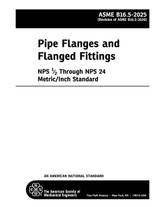
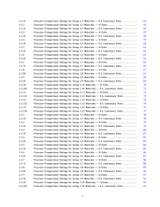
ASME B16.5-2025 Pipe Flanges and Flanged Fittings: NPS 1/2 through NPS 24 Metric/Inch Standard
ASME B16.5-2025 covers NPS 1/2-24 pipe flanges, flanged fittings, pressure-temperature ratings, materials, dimensions, bolting, testing and tolerances.
About this publication
Product Description
ASME B16.5-2025, Pipe Flanges and Flanged Fittings: NPS 1/2 through NPS 24, Metric/Inch Standard, establishes dimensional, material, pressure-temperature, testing and marking requirements for one of the most widely used families of pressure-piping components.
The standard provides standardized requirements that allow compatible flanges, flanged fittings, bolting and gaskets to be specified and assembled in pressure piping and pressure-equipment systems.
Current 2025 Edition
The 2025 edition supersedes ASME B16.5-2020. ASME issued the new edition on May 30, 2025 following approval by the B16 Standards Committee and approval as an American National Standard.
The edition incorporates revised pressure-temperature ratings, updated material assignments, additional bolting and alloy materials, revised minimum-temperature guidance, changes to hydrostatic-test provisions and multiple dimensional and figure revisions.
Scope
ASME B16.5 covers pressure-temperature ratings, materials, dimensions, tolerances, marking, testing and methods of designating openings for pipe flanges and flanged fittings.
The standard is primarily used for metallic piping systems where standardized flange dimensions and pressure classes are required for compatibility among piping components, valves and pressure equipment.
Nominal Pipe Size Range
The primary dimensional scope extends from NPS 1/2 through NPS 24, corresponding approximately to DN 15 through DN 600.
The exact size range available depends on the applicable pressure class and whether the component is a flange or flanged fitting.
Pressure Classes
The standard includes flange requirements for the following pressure rating class designations:
- Class 150
- Class 300
- Class 400
- Class 600
- Class 900
- Class 1500
- Class 2500
Classes 150 through 1500 are covered for flanges through NPS 24, while Class 2500 flange requirements extend through NPS 12.
Flanged Fittings
Flanged fittings in Classes 150 and 300 are covered in sizes NPS 1/2 through NPS 24.
Higher-pressure flanged fittings in Classes 400, 600, 900, 1500 and 2500 are acknowledged in Nonmandatory Appendix E, with applicable dimensional information provided in U.S. Customary units.
Metric and U.S. Customary Units
B16.5 is published as a Metric/Inch Standard. Requirements are provided in both SI and U.S. Customary systems where applicable.
Bolt diameters and flange bolt-hole dimensions continue to be expressed in inch units where specified by the standard.
Pressure-Temperature Ratings
Pressure-temperature ratings establish the maximum allowable working pressure for a flange or flanged fitting at specified temperatures for a particular material group and pressure class.
These ratings are among the most important elements of B16.5 because allowable pressure can decrease as operating temperature increases.
2025 Pressure-Temperature Rating Revisions
The 2025 edition revises pressure-temperature rating tables throughout the standard.
Users transitioning from the 2020 edition should verify current ratings rather than assuming that the previous edition's pressure-temperature values remain unchanged for every material group.
Material Groups
B16.5 organizes materials into groups that share applicable pressure-temperature rating tables.
The material tables include carbon steels, low-alloy steels, stainless steels, nickel alloys and other materials commonly used in industrial pressure piping.
New Duplex Material Group
The 2025 edition adds a new pressure-temperature rating table for Material Group 2.13, providing updated treatment for applicable duplex materials.
This change is important for systems using corrosion-resistant duplex alloys in chemical, offshore, energy and process-service applications.
Additional 2025 Materials
The 2025 edition expands material listings to include additional bolting and specialty-alloy specifications.
Examples added to the material tables include ASTM A320 Grade L7M and selected nickel- and special-alloy materials under ASTM B511, B572 and B637.
Minimum Temperature Considerations
Material suitability depends not only on maximum operating temperature but also on minimum operating temperature and material toughness.
The 2025 edition expands guidance used in determining minimum material temperature and introduces additional supporting information, including a new Nonmandatory Appendix G.
Cast and Forged Components
The standard is principally limited to flanges and flanged fittings made from cast or forged materials.
Blind flanges and certain reducing flanges may also be produced from plate materials when permitted by the applicable requirements.
Flange Types
ASME B16.5 provides dimensional and technical requirements applicable to commonly used flange configurations, including:
- welding neck flanges;
- slip-on flanges;
- socket-welding flanges;
- threaded flanges;
- lap-joint flanges;
- blind flanges;
- reducing flanges where permitted.
Welding Neck Flanges
Welding neck flanges use a tapered hub and butt-welded connection to the pipe. They are frequently selected for higher-pressure, higher-temperature or cyclic-service applications because the hub provides a gradual transition between the flange and pipe.
B16.5 establishes flange dimensions, facing dimensions, bolting patterns and hub geometry necessary for interchangeability and design compatibility.
Slip-On Flanges
Slip-on flanges fit over the outside diameter of pipe and are attached by welding.
The standard controls dimensions and facing geometry so that slip-on flanges of a given nominal size and pressure class can properly mate with corresponding B16.5 components.
Socket-Welding Flanges
Socket-welding flanges incorporate a socket into which the pipe is inserted before welding.
These flanges are commonly used in smaller-bore piping where socket-welded construction is appropriate.
Threaded Flanges
Threaded flanges provide an internally threaded connection for applications where welding is not required or appropriate.
The 2025 edition revises selected threaded flange figures, including details affecting Class 150 and Class 300 configurations.
Lap-Joint Flanges
Lap-joint flanges are generally used with a stub end or similar component and can facilitate flange alignment and disassembly.
The dimensional requirements ensure compatibility with the mating components and applicable bolting patterns.
Blind Flanges
Blind flanges close the end of a piping system, vessel nozzle or flanged opening.
B16.5 provides thickness, bolting, facing and dimensional requirements according to nominal size, material and pressure class.
Flange Facings
Flange-facing geometry is important to gasket seating and joint performance.
The standard includes dimensional requirements applicable to recognized flange facings and coordinates these features with gasket and bolting requirements.
Bolting
B16.5 contains requirements and recommendations concerning flange bolting.
Bolting material selection must account for pressure, temperature, flange material and service conditions. The 2025 edition expands the listed bolting materials and updates associated guidance.
Low-Strength Bolting
The standard identifies certain low-strength bolting materials and establishes limitations on their application.
Users must ensure that bolting selection is compatible with the pressure-temperature rating and flange materials being used.
Gaskets
Flanged joints rely on appropriate gasket selection and compression to establish a leak-resistant seal between mating flange faces.
B16.5 provides requirements and recommendations concerning gasket application but is commonly used together with ASME B16.20, B16.21 and other applicable gasket standards.
Flange Joints
A properly designed flange alone does not guarantee a leak-tight piping joint. Joint performance depends on the combined behavior of the flange pair, gasket, bolting, assembly practices and service conditions.
B16.5 therefore includes requirements and recommendations relevant to complete flange-joint construction.
Dimensions
The dimensional tables establish standardized flange dimensions such as outside diameter, thickness, bolt-circle diameter, bolt-hole quantity and size, hub geometry and facing details.
Standardization allows components manufactured by different suppliers to mate correctly when they conform to the same nominal size, pressure class and applicable facing requirements.
Dimensional Tolerances
B16.5 establishes tolerances for critical dimensions where manufacturing variation could affect fit, alignment or joint performance.
These tolerances are important for manufacturers, inspectors and purchasers verifying conformity of finished components.
2025 Minimum Hub Height Revisions
The 2025 edition revises the method used to determine minimum hub height in several flange figures and dimensional tables.
Organizations maintaining automated design, procurement or inspection systems should verify that calculations and dimensional databases reflect the 2025 requirements.
Marking
Finished components are required to carry identifying markings in accordance with the standard.
Markings support verification of manufacturer, material, pressure class, nominal size and other applicable information needed for material control and field identification.
Testing
B16.5 contains testing requirements applicable to flanged fittings and related components within its scope.
The 2025 edition revises requirements associated with system hydrostatic testing and should be consulted where test conditions or applicability are being established.
Hydrostatic Testing
Hydrostatic testing uses a liquid test medium to verify pressure-boundary integrity under controlled pressure.
The 2025 edition includes revisions to paragraphs addressing system hydrostatic testing, making this an important transition point for users familiar with the 2020 edition.
Ceiling Pressures
The standard includes ceiling-pressure limitations used with applicable flange designs and material groups.
The 2025 edition revises ceiling pressures in supporting appendices as part of the broader pressure-temperature rating update.
Opening Designations
ASME B16.5 includes methods for designating openings in flanged fittings.
Consistent opening designations simplify specification and procurement of reducing and multi-opening fittings.
Relationship to ASME B16.47
ASME B16.5 covers flanges through NPS 24. Larger-diameter steel flanges from NPS 26 through NPS 60 are generally addressed by ASME B16.47.
Correct selection between the two standards depends on nominal pipe size and the applicable flange design.
Relationship to ASME B16.34
ASME B16.34 establishes requirements for valves with flanged, threaded and welding ends.
B16.5 dimensions and pressure classes are commonly coordinated with B16.34 flanged valve connections in industrial piping systems.
Relationship to ASME B31 Piping Codes
B16.5 is frequently referenced by ASME B31 piping codes such as B31.1 Power Piping and B31.3 Process Piping.
The B31 Code establishes piping-system design and construction requirements, while B16.5 supplies standardized component dimensions, materials and pressure-temperature ratings for applicable flanges and flanged fittings.
Relationship to the ASME Boiler and Pressure Vessel Code
B16.5 flanges and flanged fittings are also used in pressure-equipment systems governed by the ASME Boiler and Pressure Vessel Code.
The applicable construction Code determines how B16.5 components can be incorporated into the pressure boundary and what additional material, design, examination or certification requirements apply.
2025 Edition Changes
Important changes identified for ASME B16.5-2025 include:
- revised pressure-temperature ratings throughout the rating tables;
- new Material Group 2.13 for applicable duplex materials;
- expanded bolting and special-alloy material listings;
- new guidance for determination of minimum material temperature;
- addition of Nonmandatory Appendix G;
- revised system hydrostatic-testing provisions;
- revised ceiling pressures;
- revised minimum hub-height determination;
- revisions to selected Class 150 and Class 300 threaded flange figures;
- updated references in Mandatory Appendix II;
- new definitions clarifying use of may, shall and should;
- editorial identification of the applicable system of units in complementary tables.
ANSI Approval
ASME B16.5-2025 was approved by the American National Standards Institute on April 10, 2025.
The standard was subsequently issued by ASME on May 30, 2025.
Stabilized Maintenance
ASME currently identifies B16.5-2025 as being on stabilized maintenance.
The 2025 edition therefore remains in effect while ASME continues to consider requests and recommendations for change from materially affected and interested parties.
Current Amendment and Errata Status
Current ANSI catalog information does not list amendments or corrections issued specifically against ASME B16.5-2025 as of October 2026.
Users should nevertheless review current ASME interpretations and standards-maintenance resources when applying the standard to active engineering work.
Who Should Use ASME B16.5-2025
- piping engineers and designers;
- mechanical engineers;
- process and power piping specialists;
- flange and fitting manufacturers;
- valve manufacturers;
- pressure-equipment manufacturers;
- engineering, procurement and construction contractors;
- piping material engineers;
- procurement and specification personnel;
- quality assurance and quality control professionals;
- inspectors and fabrication personnel;
- maintenance and plant engineering organizations;
- refining, petrochemical, chemical and power-generation facilities.
Why B16.5 Matters
Flanged joints are used throughout industrial piping because they permit pressure-containing equipment and piping components to be connected while remaining removable for inspection or maintenance.
Interchangeability and pressure integrity depend on standardized dimensions, materials, bolting patterns and pressure-temperature ratings. B16.5 provides the common technical framework that allows these components to be specified consistently across manufacturers and projects.
Product Features
- 2025 edition of ASME B16.5
- Current edition
- ANSI approved
- 274 pages
- Covers NPS 1/2 through NPS 24
- Metric and U.S. Customary requirements
- Class 150, 300, 400, 600, 900 and 1500 flanges through NPS 24
- Class 2500 flanges through NPS 12
- Covers applicable flanged fittings
- Includes pressure-temperature rating tables
- Covers cast and forged materials
- Covers blind and certain reducing flanges
- Includes flange dimensions and tolerances
- Covers bolting and gasket considerations
- Includes marking and testing requirements
- Includes revised 2025 pressure-temperature ratings
- Adds updated duplex-material treatment
- Includes revised minimum-temperature guidance
- Includes revised hydrostatic-testing provisions
- On stabilized maintenance
Product Details
- Standard: ASME B16.5-2025
- Title: Pipe Flanges and Flanged Fittings: NPS 1/2 through NPS 24 Metric/Inch Standard
- Publisher: ASME International
- Edition: 2025 Edition
- Publication Date: May 30, 2025
- ANSI Approval Date: April 10, 2025
- Print ISBN: 9780791876855
- Page Count: 274
- ASME Print Order Number: M01525
- Previous Edition: ASME B16.5-2020
- Maintenance Status: Stabilized Maintenance
- Language: English
- Publication Type: Pipe Flange and Flanged Fitting Standard
Edition Status Note
ASME B16.5-2025 is the current edition as of October 2026 and supersedes ASME B16.5-2020. ASME issued the edition on May 30, 2025 and currently identifies it as being on stabilized maintenance. Current ANSI catalog information lists no amendments or corrections issued specifically for B16.5-2025.