
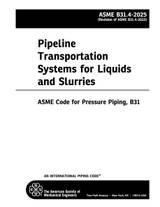
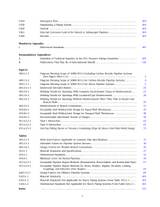
ASME B31.4-2025 Pipeline Transportation Systems for Liquids and Slurries
ASME B31.4-2025 covers liquid, CO2, slurry and process-water pipeline design, materials, welding, testing, operation, maintenance and corrosion control.
About this publication
Product Description
ASME B31.4-2025, Pipeline Transportation Systems for Liquids and Slurries, is the current edition of the ASME Code for Pressure Piping section governing liquid, slurry and process-water pipeline transportation systems.
The Code establishes requirements for design, materials, construction, assembly, inspection, examination, testing, operation, maintenance and corrosion control for pipeline systems transporting a wide range of liquids between production facilities, processing plants, storage locations, pump stations, terminals and other delivery or receiving points.
Current 2025 Edition
ASME issued B31.4-2025 on December 31, 2025. It supersedes ASME B31.4-2022 and was approved as an American National Standard on October 27, 2025.
The Code states that it becomes effective six months after its date of issuance.
Liquids Covered
The Code is intended for pipeline systems transporting liquids including, but not limited to:
- crude oil;
- condensate;
- liquid petroleum products;
- natural gasoline;
- natural gas liquids;
- liquefied petroleum gas;
- supercritical carbon dioxide;
- liquid alcohol;
- liquid anhydrous ammonia;
- produced water;
- injection water;
- brine;
- biofuels;
- aqueous slurries.
Pipeline Facilities Covered
B31.4 applies to liquid pipeline systems between production fields or facilities, tank farms, aboveground or belowground storage facilities, natural gas processing plants, refineries, pump stations, ammonia plants, marine terminals, rail terminals, truck terminals and other delivery and receiving points.
The Code also covers applicable piping within pump stations, tank farms and terminals associated with liquid pipeline systems.
Piping Components Within Scope
Pipeline piping within the B31.4 scope can include pipe, flanges, bolting, gaskets, valves, relief devices, fittings and pressure-containing parts of other piping components.
It also includes hangers, supports and equipment necessary to prevent overstress of pressure-containing components.
Terminal and Station Piping
The Code includes primary and associated auxiliary liquid petroleum and liquid anhydrous ammonia piping at pipeline terminals, tank farms, pump stations, pressure-reducing stations and metering stations.
Applicable equipment can include scraper traps, strainers and prover loops.
Storage and Working Tanks
B31.4 includes storage and working tanks within its stated scope, including pipe-type storage fabricated from pipe and fittings and piping interconnecting applicable facilities.
Chapter I — Scope and Definitions
Chapter I defines the scope of B31.4 and establishes terminology used throughout the Code.
Correct identification of the Code boundary is important because portions of a facility can be subject to other ASME B31 Code sections, pressure-vessel standards, storage-tank standards or regulatory requirements.
Chapter II — Design
Chapter II establishes the engineering-design requirements used to determine whether pipeline components and systems have adequate strength and flexibility for the expected operating and environmental loads.
Design provisions address pressure, weight, thermal effects, settlement, vibration, wind, earthquake, transportation and installation loads and other conditions applicable to pipeline systems.
Pressure Design
Pipeline wall thickness and pressure design are determined from applicable material strength, diameter, design pressure, design factors, joint factors and allowances.
The Code coordinates these requirements with accepted pipe manufacturing specifications and applicable component standards.
Longitudinal Stress
Longitudinal stresses can result from pressure, thermal movement, bending, weight, settlement, restrained movement and other loading.
The 2025 edition revises paragraph 402.6.2 and introduces updated formulas for unrestrained longitudinal stress, making this one of the principal technical calculation changes in the new edition.
Consistent Systems of Units
A major 2025 revision updates the Code's equations so they can be used with any consistent system of units.
This removes unnecessary dependence on individual unit-specific versions of equations and improves use of the Code in international engineering and calculation environments.
Stress Intensification and Flexibility
B31.4 includes criteria for evaluating pipeline flexibility and stresses associated with piping geometry and system movement.
The 2025 edition revises definitions relating to the sustained in-plane moment index, Ii, and sustained out-of-plane moment index, Io, together with related provisions and references.
Loads and Load Combinations
Pipeline systems can be subjected to more than internal pressure alone. The Code requires applicable consideration of live and dead loads, thermal effects, wind, earthquake, soil and support interaction, transportation, installation and other relevant loading.
Pipe-Soil Interaction
Buried pipelines interact structurally with surrounding soil. B31.4 includes design considerations for effects such as settlement, ground movement and restraint that can create stresses in buried piping systems.
Crossings and Special Installations
The Code includes requirements affecting road, railroad, water and other crossings as well as special pipeline assemblies and installations.
Chapter III — Materials
Chapter III establishes requirements for materials used in pipeline construction.
Materials must be suitable for the intended pressure, temperature, service fluid, construction method and environmental conditions.
Low-Temperature Service
Material selection must consider brittle-fracture risk where pipelines operate at low temperatures.
B31.4 coordinates applicable material, welding and toughness requirements with recognized material specifications and other ASME standards.
Chapter IV — Dimensional Requirements
Chapter IV contains dimensional requirements applicable to standard and nonstandard pipeline components.
Components must provide adequate strength and dimensional compatibility for assembly into the pipeline system.
Valves and Components
The Code includes criteria affecting valves, fittings, bends, elbows, branch connections, closures and other pressure-containing components used in pipeline systems.
Overpressure Protection
Pipeline systems must be protected from pressures that exceed the limits permitted by the design.
B31.4 includes requirements affecting pressure control, relief devices and operating conditions intended to prevent excessive pressure.
Chapter V — Construction, Welding and Assembly
Chapter V contains requirements for construction, welding and assembly of pipeline systems.
Subjects include route preparation, handling, installation, bending, welding, joining, backfilling, crossings, valves, pump-station piping and construction quality.
Welding
Pipeline welding procedures and welding personnel must satisfy the applicable qualification requirements.
B31.4 recognizes API 1104 and ASME BPVC Section IX for welding qualification where applicable and requires welding procedure specifications to address additional conditions necessary to produce sound welds.
Weld Examination
Completed welds are subject to applicable examination requirements based on the Code, project conditions and service.
Inspection can include visual and nondestructive examination methods appropriate to the weld and pipeline construction.
Chapter VI — Inspection and Testing
Chapter VI establishes requirements for inspection and pressure testing of completed pipeline systems.
The requirements are intended to verify that the pipeline has been constructed in accordance with the engineering design and applicable Code provisions before normal operation.
Pressure Testing
Newly constructed pipeline systems are subject to applicable pressure testing.
Test medium, pressure, duration and acceptance requirements depend on the system and applicable Code provisions.
Records
The Code requires important construction and test records to be retained for the life of the facility.
Records can include material specifications, as-built route maps and alignment sheets, pipe size and grade, wall thickness, seam information, manufacturer information, coatings, inspection records, examination results and test data.
Chapter VII — Operation and Maintenance
Chapter VII establishes operation and maintenance requirements affecting safety of liquid and slurry pipeline transportation systems.
Operating companies are required to establish written plans, procedures and training programs covering applicable operating and maintenance activities.
Pipeline Operation
Operation requirements address activities needed to maintain pipeline safety and reliability during service.
Applicable programs can include patrolling, valve maintenance, surveillance, leak response, repair, pressure control and maintenance of station and terminal facilities.
Emergency Planning
B31.4 requires emergency planning appropriate to the pipeline system and transported fluid.
Emergency procedures support timely response to leaks, releases, fire, equipment failure and other conditions that could affect the public, operating personnel, property or the environment.
Repair of Pipeline Defects
The Code includes requirements governing assessment and disposition of defects and repair of operating pipelines.
Repair methods must restore adequate integrity while accounting for pipeline material, operating conditions and the nature of the defect.
Higher Operating Pressure
B31.4 provides requirements for qualifying an existing piping system for a higher maximum steady-state operating pressure.
The system must be shown capable of satisfying the applicable design and testing requirements before the increased pressure is permitted.
New 2025 Suspension-of-Operation Requirement
The 2025 edition adds paragraph 457, Suspension of Operation.
Suspending pipeline operation for a period of time is explicitly distinguished from abandonment. Relevant operation and maintenance procedures must continue to be applied while the system remains suspended.
Abandonment
Chapter VII contains requirements for pipelines or facilities being abandoned.
Applicable measures include disconnection from sources of transported liquid, removal or purging of product and appropriate sealing or isolation of the abandoned system.
Chapter VIII — Corrosion Control
Chapter VIII establishes minimum requirements for controlling external and internal corrosion and erosion of exposed, buried and submerged metallic pipelines and components.
The requirements apply both to design and installation of new pipelines and to operation and maintenance of existing systems.
Cathodic Protection
Buried and submerged pipelines commonly require corrosion-control measures including protective coatings and cathodic protection.
B31.4 includes requirements for design, monitoring, testing and maintenance of applicable corrosion-control systems.
Internal Corrosion
The Code addresses internal-corrosion control where transported liquids, contaminants or operating conditions can cause deterioration of the internal pipe surface.
Atmospheric Corrosion
Aboveground or otherwise exposed pipeline components require appropriate protection against atmospheric corrosion.
Corrosion Under Insulation
Chapter VIII includes provisions addressing external corrosion of thermally insulated pipelines where moisture can accumulate beneath insulation systems.
Stress Corrosion and Other Mechanisms
The Code identifies corrosion-related mechanisms including stress corrosion cracking, corrosion fatigue, hydrogen-related cracking, corrosion under insulation and microbiologically influenced corrosion.
Operating companies are expected to investigate and address evidence of such mechanisms when detected.
Arctic and High-Temperature Service
Chapter VIII also includes specialized provisions addressing pipelines in arctic environments and pipelines operating at elevated temperatures.
Chapter IX — Offshore Liquid Pipeline Systems
Chapter IX contains additional requirements for offshore liquid pipeline systems.
It modifies or supplements the general B31.4 provisions for offshore design, materials, construction, installation, testing, operation and corrosion control.
Offshore Design
Offshore pipelines require consideration of seabed conditions, installation stresses, buoyancy, external pressure, waves, currents, bottom stability and other marine environmental effects.
Chapter IX provides specialized requirements addressing these conditions while retaining the applicable general Code requirements.
Chapter X — Carbon Dioxide Pipeline Systems
Chapter X contains specialized requirements for carbon dioxide pipeline systems.
These provisions supplement the general Code with requirements appropriate to CO2 service, including materials, construction, testing, operation, repair and emergency planning.
Supercritical CO2
The B31.4 scope expressly includes supercritical carbon dioxide pipeline transportation.
CO2 pipelines require particular attention to pressure, temperature, decompression behavior, fracture control, leak response and material suitability.
Chapter XI — Slurry and Process Water Pipeline Systems
Chapter XI establishes additional requirements for pipelines transporting aqueous slurries and process water.
The Code defines process water to include water-dominated streams such as flushing water, reclaim water, produced water, injection water and brine.
Aqueous Slurries
Slurry pipelines can transport mixtures containing coal, mineral ores, concentrates and other solid materials suspended in an aqueous phase.
Design and maintenance must account for erosion, solids handling and other characteristics that differ from conventional petroleum-liquid pipelines.
2025 Edition Changes
The principal 2025 changes include:
- revision of all equations for use with any consistent system of units;
- replacement of ambiguous 'and/or' wording with clearer requirements;
- addition of paragraph 457 addressing suspension of operation;
- new formulas in paragraph 402.6.2 for unrestrained longitudinal stress;
- revision of paragraph 461.1.5;
- updated definitions for sustained in-plane and out-of-plane moment indices;
- updated references throughout the Code;
- additional editorial and technical revisions marked as 2025 changes.
ANSI Approval
ASME B31.4-2025 was approved by the American National Standards Institute on October 27, 2025.
Stabilized Maintenance
ASME's current product page identifies B31.4-2025 as being on stabilized maintenance. Requests and recommendations for change from materially affected and interested parties can still be submitted to ASME.
Current Errata and Amendment Status
Current ANSI catalog information lists no amendments or corrections for ASME B31.4-2025 as of October 2026.
Regulatory Adoption
Publication of B31.4-2025 does not automatically make this edition the legally applicable edition in every jurisdiction.
Pipeline operators and engineers should verify the edition incorporated by applicable federal, state, provincial or other regulatory authorities. Regulatory adoption can lag behind the newest ASME edition.
Who Should Use ASME B31.4-2025
- liquid pipeline design engineers;
- pipeline operators and owners;
- pipeline integrity engineers;
- pipeline materials engineers;
- welding engineers and inspectors;
- corrosion-control specialists;
- pipeline construction contractors;
- terminal and tank-farm engineers;
- pump-station personnel;
- CO2 pipeline developers and operators;
- slurry and process-water pipeline engineers;
- pipeline inspectors and regulators;
- engineering, procurement and construction organizations;
- quality assurance and quality control personnel.
Why B31.4 Matters
Liquid pipeline systems can extend hundreds or thousands of miles and transport large quantities of petroleum, chemicals, water, carbon dioxide and other materials under pressure.
Reliable operation requires coordination of pressure design, material selection, welding, construction, inspection, testing, corrosion control, operational procedures, emergency planning and maintenance.
ASME B31.4 provides an integrated technical framework addressing those requirements from initial design through the operating life of the pipeline.
Product Features
- 2025 edition of ASME B31.4
- Current edition
- ANSI approved
- 136 pages
- Part of the ASME B31 Code for Pressure Piping
- Covers liquid petroleum and other liquid pipelines
- Covers liquid anhydrous ammonia pipelines
- Covers supercritical CO2 pipeline systems
- Covers biofuels and alcohol pipelines
- Covers slurry and process-water systems
- Covers pipeline design and stress analysis
- Covers materials and piping components
- Covers welding and pipeline construction
- Covers inspection, examination and pressure testing
- Covers operation and maintenance
- Includes emergency-planning requirements
- Covers external and internal corrosion control
- Includes offshore pipeline requirements
- Includes dedicated CO2 pipeline requirements
- Includes dedicated slurry and process-water requirements
- Adds suspension-of-operation requirements
- Revises unrestrained longitudinal stress equations
Product Details
- Standard: ASME B31.4-2025
- Title: Pipeline Transportation Systems for Liquids and Slurries
- Publisher: ASME International
- Edition: 2025 Edition
- Date of Issuance: December 31, 2025
- ANSI Approval Date: October 27, 2025
- Print ISBN: 9780791877654
- Page Count: 136
- ASME PDF Order Number: A0382T
- ASME Print Order Number: A03825
- Previous Edition: ASME B31.4-2022
- Next Edition Scheduled: 2028
- Language: English
- Publication Type: Liquid and Slurry Pipeline Code
Edition Status Note
ASME B31.4-2025 is the current published edition as of October 2026 and supersedes B31.4-2022. The Code was issued December 31, 2025 and states that it becomes effective six months after issuance. ASME's current catalog identifies the edition as being on stabilized maintenance, while the published Code indicates the next edition is scheduled for 2028. Current ANSI catalog records list no amendments or corrections to B31.4-2025.