

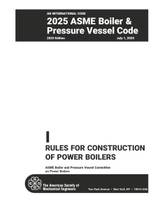
ASME BPVC.I-2025 Section I — Rules for Construction of Power Boilers
ASME BPVC.I-2025 covers power boiler design, materials, welding, fabrication, inspection, testing, pressure relief, HRSGs and ASME certification.
About this publication
Product Description
ASME BPVC.I-2025, Section I — Rules for Construction of Power Boilers is the 2025 edition of the ASME Boiler and Pressure Vessel Code section governing construction of power boilers and associated pressure parts within its defined scope.
Section I establishes requirements for materials, design, fabrication, welding, brazing, examination, inspection, testing, certification and pressure-relief protection for power boilers, electric boilers, miniature boilers, high-temperature water boilers, heat recovery steam generators and certain fired pressure vessels. It also contains specialized requirements for locomotive, portable and traction boilers and for directly connected pressure components such as superheaters and economizers.
Scope of ASME BPVC Section I
Section I applies to boilers in which steam or another vapor is generated at pressures exceeding 15 psig. It also covers high-temperature water boilers intended for operation at pressures exceeding 160 psig and/or temperatures exceeding 250°F.
Superheaters, economizers and other pressure parts connected directly to the boiler without intervening valves are considered within the Section I scope where applicable.
Boiler Types Covered
The Code addresses multiple boiler and pressure-equipment configurations rather than only conventional stationary steam boilers. Its provisions include requirements applicable to:
- power boilers;
- watertube boilers;
- firetube boilers;
- electric boilers;
- miniature boilers;
- high-temperature water boilers;
- heat recovery steam generators;
- locomotive boilers;
- portable and traction boilers;
- organic-fluid vaporizers;
- feedwater economizers;
- feedwater heaters within applicable Section I scope;
- liquid-phase thermal-fluid heaters within applicable requirements.
Part PG — General Requirements for All Methods of Construction
Part PG establishes the general requirements that form the foundation of Section I construction. These provisions are applied together with the specialized Parts corresponding to the boiler type and method of fabrication.
Part PG addresses subjects including scope, service limitations, materials, design, openings, stayed surfaces, boiler external piping limits, pressure-relief provisions, inspection, testing, marking and Manufacturer's Data Reports.
Materials
Section I requires pressure-part materials to comply with applicable specifications and material requirements recognized by the Code. The material provisions work closely with ASME BPVC Section II, which supplies material specifications, allowable stress values and supporting physical-property data.
The manufacturer is responsible for ensuring that materials are correctly identified and suitable for the intended Code construction before fabrication proceeds.
2025 Material Revisions
The 2025 edition contains numerous revisions to the general material provisions in Part PG. These include revisions to PG-5 and related material paragraphs and a new PG-5.7 provision addressing application of nominal pipe size and nominal diameter requirements to other product forms.
Pressure Design
Section I provides design requirements for shells, drums, headers, heads, tubes, piping connections, openings, stayed surfaces and other pressure-retaining parts. The Code coordinates geometry, allowable material stress, temperature, pressure and fabrication method when establishing minimum required dimensions and maximum allowable working pressure.
Shells, Drums and Headers
Power-boiler shells, drums and headers are designed to withstand the applicable internal or external pressure together with other Code-required considerations. Material properties, geometry, openings and fabrication details all affect the permissible design.
Heads and Formed Components
Section I includes design requirements for heads and other pressure-retaining formed components. The Code establishes equations and construction details applicable to specific geometries and fabrication methods.
Openings and Reinforcement
Openings for nozzles, manways, handholes and other connections can reduce the pressure-resisting area of a shell, drum or header. Section I therefore provides rules for openings, reinforcement and ligament efficiency where applicable.
Stayed Surfaces
Boiler construction can include flat or otherwise supported pressure surfaces requiring stays or staybolts. Section I contains requirements governing stayed surfaces, stay spacing, attachment and construction.
The 2025 edition adds a dedicated PG-47.4 provision addressing preparation of holes for threaded and welded stays.
Boiler External Piping
Section I defines jurisdictional limits associated with boiler external piping and coordinates those limits with ASME B31.1 Power Piping. These boundaries are important because they determine where Section I boiler construction requirements transition to the applicable piping-code requirements.
Figures within Section I illustrate Code jurisdictional limits for common boiler, reheater, superheater and associated piping configurations.
Pressure Relief
Overpressure protection is a fundamental requirement of boiler construction. Section I contains requirements affecting pressure-relief devices, relieving capacity, installation and protection of boilers and associated pressure parts against excessive pressure.
Pressure-relief-device requirements are coordinated with other applicable ASME BPVC requirements, including Section XIII where referenced.
Water Level and Boiler Controls
Section I includes requirements for water-level indicators, gage glasses, feedwater connections and related devices needed to support safe boiler operation and Code construction.
Part PW — Boilers Fabricated by Welding
Part PW establishes requirements specifically applicable to boilers and boiler parts fabricated by welding. It is used together with Part PG and the specialized rules for the applicable boiler type.
Part PW addresses welded-joint design, permitted welding processes, welding qualification, fabrication requirements, examination, postweld heat treatment and hydrostatic testing.
Welding Processes
Section I recognizes multiple welding processes and process variations as permitted by its requirements and by the qualification framework of ASME BPVC Section IX. These include commonly used arc-welding processes as well as specialized processes permitted under defined conditions.
The 2025 edition substantially revises PW-27, which governs welding processes, and related qualification and fabrication provisions.
Welding Procedure and Personnel Qualification
Welding procedures, welders and welding operators used for applicable Section I construction are qualified in accordance with Section IX together with the additional requirements imposed by Section I.
This relationship allows Section IX to provide the qualification framework while Section I establishes the construction-specific requirements that apply to power boilers.
Postweld Heat Treatment
Part PW contains detailed postweld heat-treatment requirements for applicable pressure-part materials and weld configurations. Requirements depend on material classification, thickness, welding conditions and any applicable exemptions or alternate heat-treatment provisions.
The 2025 edition revises numerous PWHT paragraphs and supporting tables.
Nondestructive Examination
Section I requires applicable volumetric and surface examinations for Code construction. Examination methods and procedures are coordinated with ASME BPVC Section V where invoked.
Depending on construction and service conditions, examination can include radiographic, ultrasonic, liquid penetrant, magnetic particle or other permitted methods.
Part PR — Boilers Fabricated by Riveting
Part PR contains requirements for boilers and component parts fabricated by riveting. Although riveted boiler construction is now far less common than welded construction, the Code retains requirements for existing applications and specialized construction.
Mandatory Appendix V contains additional rules applicable to riveted construction.
Part PB — Boilers Fabricated by Brazing
Section I includes requirements for boiler components fabricated by brazing. These provisions address materials, joint construction, brazing procedure qualification, personnel qualification and applicable testing and certification requirements.
Part PL — Locomotive Boilers
Part PL provides requirements specifically applicable to locomotive boilers. These requirements supplement the general Section I rules and address the construction details and operating configurations characteristic of locomotive boiler service.
The Part covers both riveted and other permitted locomotive boiler construction within its defined dimensional and service limits.
Part PWT — Watertube Boilers
Part PWT contains specialized requirements for watertube boilers. These rules are applied with Part PG and the applicable fabrication Parts.
Watertube boiler requirements address tubes, pipe, nipples, tube connections and other construction details characteristic of boilers in which water flows through tubes exposed to the furnace or combustion-gas environment.
Part PFT — Firetube Boilers
Part PFT establishes additional requirements for firetube boilers and their pressure parts. Subjects include shells, tubesheets, furnaces, heads, tube attachments and construction details associated with firetube boiler geometry.
The Part is used together with the general design provisions of Part PG and the fabrication requirements applicable to the construction method.
Feedwater Heaters
Section I provides optional requirements for feedwater heaters located within the jurisdictional scope of the boiler. Certain qualifying feedwater heaters can be constructed using Section VIII, Division 1 provisions subject to the additional Section I conditions.
Part PMB — Miniature Boilers
Part PMB establishes requirements for miniature boilers and defines dimensional, volume and pressure limitations applicable to this class of equipment.
The Part covers materials, design, welding, water-level requirements, pressure relief, inspection, testing and other construction considerations appropriate to smaller boiler units.
Part PEB — Electric Boilers
Part PEB establishes requirements for electric boilers and associated pressure parts. Electric boilers generate heat electrically rather than by conventional combustion but remain subject to pressure-boundary and overpressure-protection requirements.
Under defined conditions, the boiler pressure vessel can be constructed under ASME Section VIII, Division 1 requirements together with the additional requirements imposed by Part PEB.
Part PVG — Organic Fluid Vaporizers
Part PVG addresses organic-fluid vaporizers and associated pressure parts. These systems use an organic working fluid rather than water and therefore require specialized construction and pressure-relief considerations.
The Part includes material, design, gage-glass, drainage and pressure-relief provisions that supplement the general Section I requirements.
Part PFE — Feedwater Economizers
Part PFE contains requirements for feedwater economizers. An economizer transfers heat from boiler flue gas to incoming feedwater and can form part of the Section I boiler pressure system depending on its location and connection arrangement.
The Part addresses scope, design, materials, pressure-relief considerations and the relationship between Section I economizers and economizers constructed under Section VIII, Division 1.
Liquid-Phase Thermal Fluid Heaters
Section I contains specialized requirements for liquid-phase thermal-fluid heaters. These provisions address design, materials, controls, pressure relief and operating-temperature protection applicable to systems heating thermal fluids without intentional vapor generation.
Part PHRSG — Heat Recovery Steam Generators
Part PHRSG establishes supplemental requirements for heat recovery steam generators. HRSGs commonly recover energy from high-temperature exhaust streams, particularly in combined-cycle and industrial power-generation systems.
The Part is applied together with Part PG and other applicable fabrication requirements and includes provisions affecting drains, condensate removal, instrumentation, pressure protection and documentation.
Inspection
Section I construction incorporates Authorized Inspection and quality-control responsibilities throughout fabrication rather than relying solely on final inspection. Material identification, fabrication, examinations, heat treatment, pressure testing and certification documentation are subject to applicable verification requirements.
Hydrostatic Testing
Completed boilers and qualifying pressure parts are hydrostatically tested in accordance with the applicable Section I requirements before final certification. Hydrostatic testing provides a controlled method of demonstrating pressure-boundary integrity following fabrication and required examinations.
Manufacturer's Data Reports
Section I requires applicable Manufacturer's Data Report Forms documenting Code construction. These reports provide traceability for the equipment, manufacturer, design conditions, materials, construction method, inspection and certification activities.
The Code also provides Master Data Report requirements for completed boiler units assembled from multiple Code-certified components.
ASME Certification Mark
Section I includes rules associated with application of the ASME Single Certification Mark and applicable certification designators. The Section includes construction requirements associated with the V, A, M, PP, S and E designators.
Possession of the Code book alone does not authorize an organization to apply the ASME Certification Mark. Authorization is granted separately through ASME's certification and conformity-assessment process.
S Designator
The S certification designator is associated with manufacture and assembly of power boilers within the scope authorized by ASME. Organizations pursuing S certification require Section I together with other Code books identified by ASME for their specific certification activities.
PP Designator
The PP designator applies to qualifying pressure-piping construction associated with the Boiler and Pressure Vessel certification program. Section I and ASME B31.1 are among the principal governing references for this work.
M and E Designators
The M designator applies to qualifying miniature-boiler certification activities, while the E designator applies to qualifying electric-boiler construction. The specialized Parts PMB and PEB provide the corresponding Section I construction requirements.
Relationship to ASME BPVC Section II
Section II provides the material specifications and allowable-stress information used throughout Section I. Section I identifies acceptable applications and additional restrictions while Section II supplies detailed material data.
Relationship to ASME BPVC Section V
Section V provides nondestructive examination methods used when Section I invokes radiographic, ultrasonic, penetrant, magnetic-particle or other NDE requirements.
Relationship to ASME BPVC Section IX
Section IX establishes qualification requirements for welding and brazing procedures and personnel used in applicable Section I construction.
Relationship to ASME B31.1
ASME B31.1 Power Piping is closely coordinated with Section I at the boiler external piping boundary. Correct identification of Section I and B31.1 jurisdictional limits is an important part of power-boiler and associated piping design.
Relationship to ASME BPVC Section XIII
Section XIII provides requirements for overpressure protection referenced across the Boiler and Pressure Vessel Code. Section I coordinates applicable boiler pressure-relief requirements with the current BPVC overpressure-protection framework.
2025 Edition Changes
ASME BPVC.I-2025 supersedes the 2023 edition and contains numerous revisions throughout Part PG, Part PW and the specialized boiler Parts and appendices.
The official 2025 Summary of Changes identifies revisions to general material requirements, pressure-part design provisions, welded construction, welding processes, postweld heat treatment, electric-boiler provisions, organic-fluid-vaporizer requirements, feedwater-economizer provisions and supporting mandatory and nonmandatory appendices.
The 2025 edition also adds new paragraphs and revises numerous figures, equations, definitions, cross-references and qualification requirements.
2025 Errata
Five errata records have been published for ASME BPVC.I-2025. One was issued October 21, 2025 and four additional errata records were issued November 10, 2025.
The published corrections affect several areas of the 2025 text, including equations, figures, tables and paragraph language. Users applying the Code should consult the current ASME or authorized standards catalog for all applicable errata in addition to the base publication.
American National Standard Status
ASME BPVC.I-2025 was developed under procedures accredited as meeting the criteria for American National Standards and is identified as an American National Standard.
Who Should Use ASME BPVC Section I
- power boiler manufacturers;
- boiler design engineers;
- power-generation engineering organizations;
- heat recovery steam generator manufacturers;
- electric-boiler manufacturers;
- boiler component manufacturers;
- welding engineers and welding inspectors;
- Authorized Inspectors and Authorized Inspection Agencies;
- quality-control and quality-assurance personnel;
- power-plant engineering organizations;
- boiler erection and assembly contractors;
- pressure-piping organizations;
- ASME Certificate Holders and certification applicants;
- regulators and authorities having jurisdiction;
- engineering consultants and technical libraries supporting boiler construction.
Why Section I Matters
Power boilers operate with substantial stored energy and often at high pressures and temperatures. Safe construction therefore depends on coordinated control of materials, design, welding, fabrication, examination, inspection, testing, pressure relief and certification.
ASME BPVC Section I provides that integrated construction framework. It applies general requirements across multiple boiler technologies while providing specialized Parts for watertube boilers, firetube boilers, electric boilers, miniature boilers, organic-fluid vaporizers, economizers, thermal-fluid heaters and heat recovery steam generators.
Product Features
- 2025 edition of ASME BPVC Section I
- Current Rules for Construction of Power Boilers
- 453-page Code publication
- American National Standard
- Covers power, electric and miniature boilers
- Covers high-temperature water boilers
- Covers heat recovery steam generators
- Covers watertube and firetube boilers
- Includes locomotive, portable and traction boiler requirements
- Covers materials and pressure-part design
- Includes welded and brazed construction requirements
- Covers welding procedures and personnel qualification interfaces
- Includes postweld heat-treatment requirements
- Covers nondestructive examination and Authorized Inspection
- Includes hydrostatic testing requirements
- Covers pressure-relief protection
- Defines boiler external piping interfaces with ASME B31.1
- Includes feedwater-economizer requirements
- Includes organic-fluid-vaporizer requirements
- Includes liquid-phase thermal-fluid-heater requirements
- Includes Manufacturer's and Master Data Report requirements
- Includes requirements associated with ASME V, A, M, PP, S and E certification designators
Product Details
- Standard: ASME BPVC.I-2025
- Section: Section I
- Title: Rules for Construction of Power Boilers
- Publisher: ASME International
- Edition: 2025 Edition
- Date of Issuance: July 1, 2025
- Print ISBN: 9780791877005
- Page Count: 453
- ASME Order Number: 500010
- ANSI Status: American National Standard
- Committee: ASME Boiler and Pressure Vessel Committee on Power Boilers
- Previous Edition: ASME BPVC.I-2023
- Language: English
- Publication Type: Power Boiler Construction Code
Edition Status Note
ASME BPVC.I-2025 is the current edition of Section I and supersedes the 2023 edition. ASME currently identifies the 2025 version as remaining in effect and has placed Section I on stabilized maintenance. Requests and recommendations for future changes can continue to be submitted to ASME.
Five errata records have been issued for the 2025 edition, dated October 21 and November 10, 2025. Users applying Section I should consult the current ASME or authorized standards catalog for applicable errata, Code Cases and other current supplementary information.