
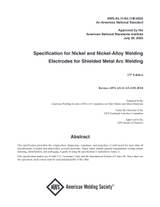

AWS A5.11/A5.11M:2025 Specification for Nickel and Nickel-Alloy Welding Electrodes for Shielded Metal Arc Welding
AWS A5.11/A5.11M:2025 covers nickel-alloy SMAW electrodes, weld metal chemistry, radiography, tension and bend testing, sizes and packaging.
Wrong edition, wrong file, or a file that won’t open? We replace or refund — contact us within 7 days.
Buy now is for one copy. Buying for a team? Get a quote
About this publication
Product Description
AWS A5.11/A5.11M:2025, Specification for Nickel and Nickel-Alloy Welding Electrodes for Shielded Metal Arc Welding, is the 12th edition of the American Welding Society specification covering classification and product requirements for nickel and nickel-alloy covered electrodes used with the shielded metal arc welding process.
The specification addresses more than 40 classifications of nickel and nickel-alloy covered electrodes and establishes requirements for weld metal composition, dimensions, soundness, mechanical properties, testing, manufacturing, electrode identification, packaging and marking. The scope generally includes compositions in which nickel content exceeds that of any other individual element.
Scope
AWS A5.11/A5.11M establishes requirements for classification of nickel and nickel-alloy covered electrodes intended for shielded metal arc welding. Classification provides manufacturers, welding engineers, fabricators, inspectors and purchasing organizations with standardized electrode designations linked to defined technical requirements.
The specification is a welding-consumable classification document rather than a fabrication code. The welding code, construction standard, engineering specification or Welding Procedure Specification applicable to a particular project determines whether a specific electrode classification is appropriate for the service involved.
Nickel and Nickel-Alloy Covered Electrodes
Covered electrodes classified under A5.11/A5.11M are designed for shielded metal arc welding and incorporate both a metallic core and an electrode covering. The combination influences deposited weld metal composition, arc characteristics, slag formation and other welding characteristics associated with the electrode classification.
The standard establishes product requirements so that an electrode represented by an AWS classification can be evaluated against a common set of composition, testing and manufacturing criteria.
Classification Requirements
Clause 3 establishes the classification system used for electrodes covered by the specification. Each AWS classification corresponds to technical requirements defined elsewhere in the document, including applicable chemical-composition and test requirements.
The standardized designation system allows engineering drawings, purchasing documents, Welding Procedure Specifications and filler-metal control programs to reference a recognized electrode classification rather than relying solely on manufacturer trade names.
More Than 40 Electrode Classifications
AWS states that the 2025 specification addresses more than 40 classifications of nickel and nickel-alloy covered electrodes. These classifications accommodate a broad range of nickel-base and nickel-alloy weld metal compositions used in corrosion-resistant, high-temperature and other specialized welding applications.
Selection of the appropriate classification remains dependent on the base materials, service environment, mechanical-property requirements, welding procedure and governing fabrication code.
Chemical Composition of Undiluted Weld Metal
Table 1 establishes chemical composition requirements for undiluted weld metal. Chemical composition is one of the principal technical bases for differentiating the nickel and nickel-alloy electrode classifications covered by the specification.
The chemistry requirements allow manufacturers and users to determine whether deposited weld metal conforms to the composition limits assigned to the claimed AWS classification.
Chemical Analysis
Clause 10 specifies chemical-analysis requirements used to verify weld metal composition. The specification includes a test pad configuration for obtaining undiluted weld metal for chemical analysis.
Controlling the composition of deposited weld metal is particularly important for nickel-alloy filler metals because alloying elements can strongly influence corrosion resistance, elevated-temperature performance and compatibility with the materials being joined.
Summary of Required Tests
Clause 7 and the associated required-tests table establish which classification tests and welding positions apply to the covered electrodes. The required testing framework includes chemical analysis and, as applicable, evaluation of weld metal soundness and mechanical properties.
The test program provides a standardized basis for demonstrating that an electrode satisfies the requirements assigned to its classification.
Retest Requirements
Clause 8 establishes requirements governing retests. Where a classification test does not initially satisfy an applicable requirement, any permitted retesting must be performed according to the provisions of the specification.
This prevents classification compliance from being determined through arbitrary or undocumented repetition of testing.
Weld Test Assemblies
Clause 9 establishes requirements for weld test assemblies used to evaluate covered electrodes. The specification identifies appropriate base metals and test configurations for producing weld metal used in classification testing.
The document includes separate groove-weld test assembly configurations for evaluating mechanical properties and soundness and for performing radiographic soundness testing.
Base Metals for Test Assemblies
The specification contains a table identifying base metals used in required weld test assemblies. Standardizing the test assembly helps reduce variability when electrode classifications are evaluated.
The purpose of these test assemblies is classification testing of the electrode and deposited weld metal, not qualification of a production welding procedure for a specific fabricated component.
Radiographic Soundness Testing
Clause 11 establishes radiographic testing requirements used to evaluate soundness of applicable weld test assemblies. Radiography provides a means of examining deposited weld metal for internal discontinuities under standardized test conditions.
The specification includes radiographic acceptance standards for multiple test-assembly thicknesses, allowing weld soundness to be evaluated against reference criteria appropriate to the required test configuration.
Radiographic Reference Standards
AWS A5.11/A5.11M provides radiographic standards for test assemblies with several thicknesses, including nominal 1/8 in [3 mm], 1/4 in [6 mm], 3/8 in [10 mm], 1/2 in [12 mm] and 3/4 in [20 mm] configurations.
These figures form part of the technical classification-testing system and help provide consistency when interpreting radiographic results.
All-Weld-Metal Tension Testing
Clause 12 covers tension testing. The specification contains all-weld-metal tension-test requirements applicable to classifications for which mechanical-property testing is required.
Tensile testing provides standardized data concerning the mechanical properties of deposited weld metal produced under the prescribed test conditions.
Bend Testing
Clause 13 establishes bend-test requirements. The specification provides dimensions for bend specimens and acceptance requirements applicable to the required test.
Bend testing is used to evaluate the ability of the test weld metal and associated test specimen to withstand prescribed deformation without unacceptable indications under the specified conditions.
Electrode Manufacturing
Clause 14 addresses method of manufacture. Manufacturing controls are important because consistency of the metallic core, covering and finished electrode affects the ability of the product to meet its AWS classification requirements.
The manufacturing provisions work together with requirements for dimensions, exposed core, identification and packaging to define the physical consumable supplied under the specification.
Standard Sizes and Lengths
Clause 15 specifies standard electrode sizes and lengths. Standardization supports compatibility with welding practices, equipment, storage systems and purchasing requirements.
The specification provides dimensional information in both U.S. Customary and SI units while requiring each unit system to be used independently.
Core Wire and Electrode Covering
Clause 16 addresses the core wire and covering of the electrode. The construction of a covered electrode is a fundamental part of its manufacturing and welding characteristics.
Requirements associated with electrode construction help support consistent product performance and identification within the applicable AWS classification.
Exposed Core
Clause 17 addresses exposed core at the electrode ends. Dimensional and construction requirements associated with exposed core support proper electrical contact and practical electrode handling during shielded metal arc welding.
Electrode Identification
Clause 18 establishes requirements for identification of electrodes. Identification allows users to maintain the connection between the physical consumable and its AWS classification after electrodes are removed from their original shipping package.
Reliable identification is particularly important where several similar-looking nickel-alloy electrodes are stored or used within the same fabrication facility.
Packaging
Clause 19 establishes packaging requirements for electrodes supplied under the specification. Packaging supports product protection and provides a controlled means of delivering classified filler metal to the purchaser.
Packaging requirements operate together with package marking and electrode identification to support welding-consumable control and traceability.
Marking of Packages
Clause 20 addresses package marking. Proper marking supplies the information needed to identify the electrode product and AWS classification throughout purchasing, receiving, storage and fabrication operations.
Acceptance and Certification
Clauses 4 and 5 address acceptance and certification. These provisions provide a standardized framework for determining whether electrodes represented as complying with A5.11/A5.11M satisfy the requirements applicable to their classification.
Certification is particularly relevant in controlled fabrication environments where filler-metal specification compliance must be documented as part of quality assurance, welding procedure and material-control programs.
Rounding Procedure
Clause 6 establishes the rounding procedure used when numerical test or analysis results are compared with specification limits. Consistent rounding is important where chemical or mechanical-property values fall near a required maximum or minimum.
Dual U.S. Customary and SI Units
AWS A5.11/A5.11M uses both U.S. Customary Units and the International System of Units. AWS explicitly states that the two systems are not exact equivalents and must therefore be used independently rather than mixing values between systems when referring to material properties.
The A5.11 designation corresponds to U.S. Customary Units, while A5.11M corresponds to SI units. Standard dimensions based on either system can be used for filler-metal sizing and packaging where permitted.
Relationship to ISO 14172
The AWS foreword states that the classifications in A5.11/A5.11M are related to ISO 14172, Welding Consumables — Covered Electrodes for Manual Metal Arc Welding of Nickel and Nickel Alloys — Classification.
This relationship is useful for organizations comparing AWS and international nickel-alloy filler-metal designations, but users should review the requirements of the applicable document rather than assuming that classifications or requirements are automatically interchangeable.
Annex A — Guide to the Specification
Informative Annex A provides a detailed guide to use of the specification. AWS includes this material to help users understand the classification system and apply the nickel and nickel-alloy electrode requirements effectively.
Because Annex A is informative, it should be distinguished from the mandatory requirements contained in Clauses 1 through 20.
Classification Comparison
Annex A includes a comparison of classifications, providing additional context for users working with the nickel and nickel-alloy electrode designation system.
Discontinued Classifications
The annex also identifies discontinued classifications. This information is useful when interpreting older Welding Procedure Specifications, engineering drawings, purchase specifications or maintenance documents referencing historical electrode designations.
Annex B — Official Interpretations
Informative Annex B explains how users can request an official interpretation of an AWS standard. Formal interpretations of technical requirements are issued through the responsible AWS technical committee.
2025 Edition Changes
AWS identifies the 2025 publication as the 12th edition and as a revision of AWS A5.11/A5.11M:2018.
A principal substantive change identified in the official AWS foreword is the addition of an option to classify an electrode using a -G designator. AWS also updated the document to incorporate terminology and wording currently used throughout other AWS A5 filler-metal specifications.
Development History
The first specification for nickel and nickel-alloy covered electrodes was issued in 1954 through cooperative work between ASTM and AWS. Subsequent editions developed the classification system through revisions issued in 1964, 1969, 1976, 1983, 1990, 1997, 2005, 2010 and 2018 before the current 2025 edition.
The development history allows users working with older engineering documents to recognize historical A5.11 designations and determine when a current specification should be consulted.
American National Standard
AWS A5.11/A5.11M:2025 is an American National Standard. The American National Standards Institute approved the 12th edition on July 29, 2025.
Technical Committee
The specification was prepared by the AWS A5 Committee on Filler Metals and Allied Materials under the direction of the AWS Technical Activities Committee.
The publication also identifies the AWS A5E Subcommittee on Nickel and Nickel Alloy Filler Metals as the specialist subcommittee responsible for this filler-metal family.
Who Should Use AWS A5.11/A5.11M:2025
- welding engineers and welding coordinators;
- fabricators using nickel and nickel-alloy covered electrodes;
- materials and metallurgical engineers;
- welding procedure developers;
- quality assurance and quality control personnel;
- Certified Welding Inspectors and inspection organizations;
- filler-metal manufacturers and distributors;
- procurement departments specifying AWS-classified welding consumables;
- testing laboratories performing filler-metal classification tests;
- organizations maintaining approved welding-consumable lists.
Why This Specification Matters
Nickel and nickel-alloy covered electrodes are used in applications where filler-metal chemistry and deposited weld metal properties can be critical to corrosion resistance, mechanical performance and compatibility with the materials being joined. A commercial product name alone does not provide a standardized engineering basis for specifying those characteristics.
AWS A5.11/A5.11M provides that basis by linking recognized electrode classifications to composition requirements, standardized test assemblies, radiographic soundness evaluation, mechanical testing, physical product requirements and identification controls.
Product Features
- 12th edition of AWS A5.11/A5.11M
- American National Standard
- Covers more than 40 nickel and nickel-alloy covered electrode classifications
- Applies to shielded metal arc welding electrodes
- Includes chemical composition requirements for undiluted weld metal
- Includes required tests and welding positions
- Provides standardized weld test assemblies
- Includes chemical-analysis requirements
- Includes radiographic soundness testing
- Provides radiographic reference standards for multiple test thicknesses
- Includes all-weld-metal tension testing
- Includes bend-test requirements
- Covers method of manufacture
- Specifies standard electrode sizes and lengths
- Addresses core wire and electrode covering
- Addresses exposed core dimensions
- Includes electrode identification requirements
- Covers packaging and package marking
- Provides informative classification guidance in Annex A
- Includes comparison and discontinued-classification information
- Relates AWS classifications to ISO 14172
- Adds a -G classification option in the 2025 edition
Product Details
- Standard: AWS A5.11/A5.11M:2025
- Title: Specification for Nickel and Nickel-Alloy Welding Electrodes for Shielded Metal Arc Welding
- Publisher: American Welding Society
- Edition: 12th Edition
- Publication Year: 2025
- Print ISBN: 978-1-64322-384-1
- Page Count: 56
- ANSI Status: American National Standard
- ANSI Approval Date: July 29, 2025
- Technical Committee: AWS A5 Committee on Filler Metals and Allied Materials
- Specialist Subcommittee: AWS A5E Subcommittee on Nickel and Nickel Alloy Filler Metals
- Previous Edition: AWS A5.11/A5.11M:2018
- Language: English
- Publication Type: Specification
Edition Status Note
AWS A5.11/A5.11M:2025 is the current 12th edition of the specification and revises AWS A5.11/A5.11M:2018. AWS continues to list the 2025 edition as its current publication in both printed and PDF formats. ANSI identifies it as the most recent edition and currently lists no amendments or corrections.