
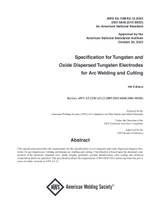

AWS A5.12M/A5.12:2024 (ISO 6848:2015 MOD) Specification for Tungsten and Oxide Dispersed Tungsten Electrodes for Arc Welding and Cutting
AWS A5.12M/A5.12:2024 covers tungsten electrode classification, chemistry, dimensions, color coding, quality, packaging and application guidance.
Wrong edition, wrong file, or a file that won’t open? We replace or refund — contact us within 7 days.
Buy now is for one copy. Buying for a team? Get a quote
About this publication
Product Description
AWS A5.12M/A5.12:2024 (ISO 6848:2015 MOD), Specification for Tungsten and Oxide Dispersed Tungsten Electrodes for Arc Welding and Cutting, is the eighth edition of the American Welding Society specification establishing classification and product requirements for nonconsumable tungsten electrodes.
The specification covers pure tungsten and oxide dispersed tungsten electrodes used for inert-gas-shielded arc welding and for plasma welding, cutting and thermal spraying. Classification is based principally on the chemical composition of the electrode, with additional requirements covering dimensions, tolerances, product quality, identification, packaging and marking.
Scope
The standard prescribes requirements for classification of nonconsumable tungsten electrodes used in gas tungsten arc welding and plasma processes. The covered applications include welding, cutting and thermal spraying where tungsten electrodes are used to establish and sustain the arc rather than being consumed as filler metal.
AWS A5.12M/A5.12 provides a standardized means of identifying electrode compositions and physical characteristics so engineers, welders, manufacturers, inspectors and purchasing organizations can specify tungsten electrodes using recognized AWS classifications rather than relying solely on commercial product names.
Nonconsumable Tungsten Electrodes
Unlike consumable welding electrodes that become part of the deposited weld metal, tungsten electrodes covered by this specification are intended to function primarily as nonconsumable arc electrodes. Their chemical composition and physical condition influence arc starting, arc stability, current-carrying capability and practical welding characteristics.
The specification therefore controls both the electrode composition and the physical characteristics necessary for consistent supply and identification.
Pure Tungsten and Oxide Dispersed Tungsten
The scope includes both pure tungsten electrodes and tungsten electrodes containing dispersed oxides. Oxide additions are used in different tungsten-electrode classifications and produce distinguishable electrode compositions and operating characteristics.
AWS A5.12M/A5.12 provides the classification framework through which those electrode compositions are identified and controlled.
Classification
Clause 3 establishes classification requirements for tungsten electrodes covered by the specification. Classification is based on chemical composition, with the applicable designation corresponding to composition limits established by the standard.
The AWS classification provides a common technical designation that can be referenced in welding procedures, purchasing documents, equipment instructions, engineering specifications and quality-control programs.
Chemical Composition Requirements
Table 1 establishes chemical composition requirements for tungsten electrodes. These composition limits form the technical basis for distinguishing the different electrode classifications included within the specification.
Chemical-composition control is important because changes in tungsten purity and oxide additions can affect electrode behavior and suitability for different welding current types and applications.
Chemical Analysis
Clause 7 establishes requirements for chemical analysis. Analysis is used to determine whether an electrode conforms to the composition limits associated with its claimed AWS classification.
The chemical-analysis requirements operate together with classification, acceptance and certification provisions to provide a consistent basis for product conformity.
Acceptance
Clause 4 addresses acceptance of electrodes supplied under the specification. The acceptance framework provides manufacturers and purchasers with a standardized basis for determining whether a product satisfies the requirements applicable to its classification.
Certification
Clause 5 addresses certification. Certification supports documentation that tungsten electrodes represented as complying with AWS A5.12M/A5.12 meet the applicable specification requirements.
This is useful in controlled fabrication and welding environments where electrode identity and specification compliance must be maintained through purchasing, receiving, storage and use.
Rounding Procedure
Clause 6 establishes the rounding procedure used when numerical analytical or dimensional results are compared with specification requirements. Consistent rounding helps avoid ambiguity where measured values fall close to specified limits.
Retests
Clause 8 establishes requirements governing retesting where applicable. Retest provisions provide a controlled process for handling results that require additional evaluation rather than allowing arbitrary repetition of testing.
Electrode Marking and Identification
Clause 9 addresses marking of tungsten electrodes. Identification requirements help maintain the connection between the physical electrode and its AWS classification even after individual electrodes have been removed from their original package.
Color Coding
Color coding is an important identification method for tungsten electrodes. AWS A5.12M/A5.12 incorporates standardized identification practices that allow users to distinguish electrode classifications visually.
This is especially valuable in welding shops where several tungsten-electrode compositions may be stored and used simultaneously and where selecting the wrong electrode type can affect welding performance.
Standard Sizes and Tolerances
Clause 10 establishes standard electrode sizes and tolerances. Dimensional requirements provide consistent expectations for electrode manufacturers, welding-equipment suppliers and users.
Standard dimensions also improve compatibility with GTAW torches, collets, electrode holders and plasma equipment designed for commonly used tungsten electrode diameters.
Electrode Diameters
The specification establishes standard diameters for tungsten electrodes. Diameter selection is an important practical consideration because current-carrying capability and operating characteristics vary with electrode size.
Electrode Lengths
Standard lengths are specified along with diameters. Standardized electrode lengths simplify procurement, storage and use across common welding and cutting equipment.
Dimensional Tolerances
Dimensional tolerances establish acceptable variation from nominal electrode dimensions and support consistent fit and performance in welding equipment.
Finish
Clause 10.2 establishes requirements for electrode finish. Surface condition is relevant to handling and consistent performance and forms part of the physical product requirements of the specification.
Electrode Straightness
Clause 10.3 addresses electrode straightness. The specification includes a defined measurement procedure for evaluating straightness.
Straightness can affect electrode positioning, torch setup and practical use, particularly where the electrode must fit accurately through a collet or other electrode-holding component.
Electrode Roundness
Clause 10.4 addresses electrode roundness. Dimensional uniformity helps ensure proper engagement with welding equipment and contributes to consistent electrode handling.
Electrode Quality
Clause 11 establishes general electrode-quality requirements. The physical condition of the finished electrode must be suitable for the intended welding or cutting application and comply with the product requirements of the specification.
Packaging
Clause 12 establishes packaging requirements for classified tungsten electrodes. Packaging protects the product and maintains identification during shipment, storage and distribution.
Marking of Packages
Package-marking requirements ensure that users can identify the electrode classification and other required product information before opening or issuing electrodes for use.
Packing
The standard includes requirements for how electrodes are packed and supplied, helping protect the product and preserve classification identity.
Marking of Overpacking
Requirements also address marking of overpacking where multiple packages are contained within larger shipping or distribution packaging.
Warning Label
The packaging provisions include warning-label requirements associated with safe handling and use of welding products.
Gas Tungsten Arc Welding Applications
The specification is directly applicable to nonconsumable tungsten electrodes used for gas tungsten arc welding. GTAW depends on a stable arc between the tungsten electrode and the workpiece, making electrode composition, geometry and condition important process variables.
AWS A5.12M/A5.12 provides the standardized classification framework used when specifying those electrodes.
Plasma Welding and Cutting
The scope also covers nonconsumable tungsten electrodes used for plasma welding and cutting. These applications place their own demands on electrode performance while relying on the same basic need for controlled composition and product quality.
Thermal Spraying
The 2024 scope explicitly includes tungsten electrodes used for plasma thermal spraying. This broadens the practical application of the electrode classifications beyond conventional fusion welding.
Informative Annex A — Conditions of Use
Annex A provides informative guidance concerning conditions of use for tungsten electrodes. This material assists users in applying the classifications to practical welding and cutting operations.
The annex includes information on suitability for different current supply types and approximate current ranges according to electrode diameter.
Current Supply Type
Table A.1 provides guidance on suitability of electrode types for different welding current supply conditions. This assists users in understanding how electrode composition interacts with current type and polarity.
Approximate Current Ranges
Table A.2 provides approximate current ranges according to electrode diameter. These values are informative application guidance rather than substitutes for welding-procedure requirements or equipment-manufacturer recommendations.
Informative Annex B — Guide to the AWS Specification
Annex B provides a broader guide to AWS A5.12M/A5.12 and helps users interpret and apply the tungsten-electrode classification requirements.
The guide supplements the mandatory clauses with practical information concerning tungsten electrodes and their use.
Informative Annex C — Official Interpretations
Annex C explains the procedure for requesting an official interpretation of an AWS standard. Formal interpretations are provided through the responsible AWS technical committee rather than through informal opinions.
Informative Annex D — Deviations From ISO 6848:2015
Annex D identifies deviations between AWS A5.12M/A5.12:2024 and ISO 6848:2015. This annex is particularly useful for organizations working with both AWS and international tungsten-electrode specifications.
Because the AWS document is a modified adoption, users should not assume every provision is identical to ISO 6848:2015 without reviewing the identified deviations.
Relationship to ISO 6848:2015
AWS A5.12M/A5.12:2024 is identified as ISO 6848:2015 MOD. AWS states that this is its second adoption of ISO 6848 and that the 2024 document adopts ISO 6848:2015 while incorporating AWS references and additional informative annexes.
The MOD designation signifies that the AWS publication is a modified rather than identical adoption of the ISO document.
Dual SI and U.S. Customary Units
The specification uses both the International System of Units and U.S. Customary Units. AWS states that the measurements are not exact equivalents and must therefore be used independently rather than combined when referring to material properties.
The designation A5.12M uses SI units, while A5.12 uses U.S. Customary Units. Standard dimensions from either system can be used for electrode sizing or packaging as permitted by the specification.
2024 Edition Changes
The 2024 publication is the eighth edition and the seventh revision of the original AWS/ASTM tungsten-electrode specification first issued in 1955.
It replaces AWS A5.12M/A5.12:2009 (ISO 6848:2004 MOD) and updates the international basis from ISO 6848:2004 to ISO 6848:2015. AWS identifies significant deviations and changes in Annex D.
Edition History
The AWS development history traces the document through the original 1955 tentative specification, subsequent 1965, 1969, 1980, 1992 and 1998 editions, the reaffirmed 1998 edition, the 2009 ISO-based edition and the current 2024 publication.
This history is useful when interpreting older welding procedures, specifications and equipment documentation that reference historical tungsten-electrode designations.
American National Standard
AWS A5.12M/A5.12:2024 is an American National Standard. ANSI approved the eighth edition on October 26, 2023.
Technical Committee
The specification was prepared by the AWS A5 Committee on Filler Metals and Allied Materials under the direction of the AWS Technical Activities Committee.
The publication identifies the AWS A5I Subcommittee on Tungsten Electrodes as the specialist subcommittee responsible for tungsten-electrode subject matter.
Who Should Use AWS A5.12M/A5.12:2024
- welding engineers and welding coordinators;
- GTAW and TIG welding personnel;
- plasma welding and cutting professionals;
- welding procedure developers;
- quality assurance and quality control personnel;
- Certified Welding Inspectors;
- tungsten-electrode manufacturers and distributors;
- procurement departments specifying welding electrodes;
- welding equipment manufacturers and service organizations;
- organizations maintaining welding-consumable and electrode-control programs.
Why This Specification Matters
Tungsten electrodes may appear to be simple components, but electrode composition, dimensions and physical condition can influence arc starting, stability and current-carrying performance. When multiple tungsten compositions are used within the same facility, standardized classification and color coding become particularly important.
AWS A5.12M/A5.12 provides a common technical framework for specifying, identifying and supplying nonconsumable tungsten electrodes. Its combination of chemical-composition limits, dimensional requirements, identification rules and application guidance helps reduce ambiguity throughout purchasing, storage and welding operations.
Product Features
- 8th edition of AWS A5.12M/A5.12
- American National Standard
- Modified adoption of ISO 6848:2015
- Covers pure tungsten and oxide dispersed tungsten electrodes
- Applies to nonconsumable electrodes
- Covers gas tungsten arc welding
- Covers plasma welding and cutting
- Covers plasma thermal spraying
- Classification based on chemical composition
- Includes chemical-analysis requirements
- Includes acceptance and certification provisions
- Covers electrode marking and identification
- Includes standardized color coding
- Specifies electrode diameters and lengths
- Includes dimensional tolerances
- Covers finish, straightness and roundness
- Includes electrode-quality requirements
- Covers package marking, packing and warning labels
- Provides current-supply suitability guidance
- Provides approximate current ranges by electrode diameter
- Includes a guide to the AWS specification
- Identifies deviations from ISO 6848:2015
Product Details
- Standard: AWS A5.12M/A5.12:2024 (ISO 6848:2015 MOD)
- Title: Specification for Tungsten and Oxide Dispersed Tungsten Electrodes for Arc Welding and Cutting
- Publisher: American Welding Society
- Edition: 8th Edition
- Publication Year: 2024
- Print ISBN: 978-1-64322-297-4
- Page Count: 36
- ANSI Status: American National Standard
- ANSI Approval Date: October 26, 2023
- Technical Committee: AWS A5 Committee on Filler Metals and Allied Materials
- Specialist Subcommittee: AWS A5I Subcommittee on Tungsten Electrodes
- Previous Edition: AWS A5.12M/A5.12:2009 (ISO 6848:2004 MOD)
- International Relationship: ISO 6848:2015, modified adoption
- Language: English
- Publication Type: Specification
Edition Status Note
AWS A5.12M/A5.12:2024 (ISO 6848:2015 MOD) is the current eighth edition and supersedes AWS A5.12M/A5.12:2009. AWS continues to list the 2024 edition in both printed and PDF formats, and ANSI identifies it as the most recent edition with no amendments or corrections currently listed.