
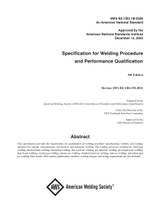

AWS B2.1/B2.1M:2026 Specification for Welding Procedure and Performance Qualification
AWS B2.1/B2.1M:2026 8th Edition covers WPS, PQR, welder and welding operator qualification, hybrid welding and wire-additive manufacturing.
Wrong edition, wrong file, or a file that won’t open? We replace or refund — contact us within 7 days.
Buy now is for one copy. Buying for a team? Get a quote
About this publication
Product Description
AWS B2.1/B2.1M:2026, Specification for Welding Procedure and Performance Qualification, Eighth Edition, establishes requirements for qualification of welding procedures, welders and welding operators across a broad range of manual, semiautomatic, mechanized and automatic welding processes.
The specification provides a common qualification framework that can be invoked by welding codes, specifications, contracts, quality-control manuals, quality-assurance programs and other Referencing Documents.
Current Eighth Edition
AWS B2.1/B2.1M:2026 is the current Eighth Edition and supersedes AWS B2.1/B2.1M:2021 and the corrections associated with that edition.
The 2026 edition was approved as an American National Standard on December 15, 2025 and carries a 2026 AWS copyright and edition designation.
Purpose of AWS B2.1
The central purpose of AWS B2.1 is to establish standardized rules for demonstrating that a welding procedure is capable of producing acceptable welds and that welders and welding operators possess the demonstrated ability to perform welding within defined qualification ranges.
The specification separates procedure qualification from performance qualification, recognizing that proving a welding procedure is technically sound is different from proving that an individual can execute that procedure successfully.
Referencing Documents
AWS B2.1 is designed to be invoked by another governing document, identified in the specification as a Referencing Document.
The Referencing Document can be a code, specification, contract, quality-control manual, quality-assurance manual or other document establishing fabrication requirements for the product being welded.
Requirements imposed by the Referencing Document take precedence where they supplement or modify the qualification requirements of AWS B2.1.
Welding Processes Covered
AWS B2.1/B2.1M:2026 provides qualification requirements for the following welding processes:
- Electron Beam Welding — EBW;
- Electrogas Welding — EGW;
- Electroslag Welding — ESW;
- Flux Cored Arc Welding — FCAW;
- Gas Metal Arc Welding — GMAW;
- Gas Tungsten Arc Welding — GTAW;
- Laser Beam Welding — LBW;
- Oxyfuel Gas Welding — OFW;
- Plasma Arc Welding — PAW;
- Submerged Arc Welding — SAW;
- Shielded Metal Arc Welding — SMAW;
- Arc Stud Welding — SW.
Manual, Semiautomatic, Mechanized and Automatic Welding
The specification covers qualification across different degrees of welding automation.
This allows the qualification framework to be applied not only to manual welding performed directly by a welder but also to semiautomatic, mechanized and automatic systems operated or controlled by welding operators.
Clause 1 — General Requirements
Clause 1 establishes the scope, units of measure and general safety provisions applicable to AWS B2.1.
The scope explains how the specification interacts with Referencing Documents and establishes the employer's responsibility for qualified procedures and qualified welding personnel.
Employer Responsibility
The employer is responsible for welding performed by its organization, including use of qualified Welding Procedure Specifications and properly qualified welders and welding operators.
The employer must also ensure that the WPS satisfies requirements imposed by the applicable Referencing Document.
Clause 2 — Normative References
Clause 2 identifies the standards and technical documents required for application of AWS B2.1.
These references support qualification testing, welding terminology, materials, examination and other technical requirements used throughout the specification.
Clause 3 — Terms and Definitions
Clause 3 establishes terminology used throughout the procedure and performance qualification system.
Definitions support consistent interpretation of concepts such as Employer, Referencing Document, Standard Welding Procedure Specification, test coupon, qualification variables and other qualification terminology.
Hybrid Welding Terminology
The 2026 edition includes terminology supporting hybrid welding, including concepts such as process sequence and process separation.
These definitions support the new procedure qualification requirements added specifically for welding applications in which multiple welding processes operate together as part of the qualified procedure.
Clause 4 — Procedure Qualification
Clause 4 contains the principal requirements for qualification of Welding Procedure Specifications.
It addresses Standard Welding Procedure Specifications, employer-qualified procedures, evaluation of test coupons, qualification thickness limitations, test methods, WPS data and procedure qualification variables.
Welding Procedure Specification
A Welding Procedure Specification, or WPS, provides the instructions and welding variables used to produce a weld.
The WPS defines the controlled conditions under which production welding is to be performed, including variables such as welding process, base metal, filler metal, joint details, electrical characteristics, shielding, temperature controls and other applicable parameters.
Procedure Qualification Record
A Procedure Qualification Record, or PQR, documents the actual variables used and the results obtained when a welding procedure is qualified by testing.
The PQR provides the test evidence supporting the ranges and variables permitted by the resulting qualified WPS.
Standard Welding Procedure Specifications
Clause 4.2 addresses Standard Welding Procedure Specifications, or SWPSs.
AWS publishes SWPS documents developed from qualified procedure data and approved through the AWS consensus process. Subject to the requirements of the Referencing Document and AWS B2.1, qualifying employers can use an applicable SWPS instead of developing a procedure entirely from a new employer-specific procedure qualification test.
Employer-qualified Welding Procedures
Clause 4.3 establishes requirements for welding procedures qualified directly by the employer.
Where an applicable SWPS is not used, the employer can prepare and qualify a WPS by welding test coupons and completing the examinations and tests required by AWS B2.1 and the Referencing Document.
Evaluation of Test Coupons
Clause 4.4 addresses evaluation of procedure qualification test coupons.
Qualification specimens are evaluated using the examination or destructive test methods applicable to the particular procedure and requirements established by the Referencing Document.
Qualification Thickness Limitations
Clause 4.5 establishes the material-thickness ranges qualified by procedure tests.
A procedure test does not automatically qualify unlimited production thickness. The test coupon thickness, weld type and applicable qualification rules determine the range supported by the PQR.
Groove Weld Test Coupons
The specification includes qualification requirements for pipe and plate groove-weld test coupons.
Applicable testing can include tension specimens, bend specimens, fracture-toughness specimens and other examinations required by the qualification program.
Fillet Weld Qualification
Clause 4 includes dedicated fillet-weld test coupon and acceptance requirements.
Fillet qualification can involve break testing, macroetch examination, shear testing or other methods applicable to the material and Referencing Document.
Cladding Qualification
AWS B2.1 contains procedure qualification requirements for weld cladding.
Cladding qualification addresses deposited material applied to a base metal for corrosion resistance, dimensional restoration, surface properties or other engineered purposes.
Hardfacing Qualification
The specification separately addresses hardfacing procedure qualification.
Hardfacing deposits are commonly used to improve resistance to wear, erosion, abrasion or other surface-degradation mechanisms.
Stud Weld Qualification
Clause 4.11 establishes procedure qualification and acceptance requirements for stud welding.
The specification includes test requirements applicable to steel and aluminum stud weld qualification.
Very Thin Material
Clause 4.12 provides qualification acceptance criteria for test coupons less than 1/16 in [1.5 mm] thick.
This provides a dedicated qualification route for very thin materials whose test behavior and specimen preparation can differ from conventional plate and pipe qualification.
WPS Data
Clause 4.13 identifies the information that must be controlled or documented on a Welding Procedure Specification.
The required data supports repeatability and establishes the production-welding conditions supported by the qualification record.
Procedure Qualification Variables
Clause 4.14 establishes procedure qualification variables.
A change beyond the permitted range of a qualification variable can require preparation and testing of an additional procedure qualification before the revised conditions are used in production.
New Hybrid Welding Requirements
A major addition in the 2026 edition is Clause 4.15, Additional Procedure Qualification Variables for Hybrid Welding.
The clause establishes additional qualification controls for procedures combining welding processes in a hybrid welding arrangement.
The new requirements recognize variables unique to combined-process welding, including the relationship and sequencing between the individual welding processes.
Process Sequence in Hybrid Welding
Process sequence identifies the order of the individual welding processes relative to the direction of travel in a hybrid welding procedure.
Because changing that sequence can affect weld-pool behavior, penetration and final weld properties, it is treated as part of the qualification framework.
Process Separation in Hybrid Welding
Process separation describes the distance between individual welding processes used in a hybrid welding arrangement.
The 2026 edition provides terminology and qualification-variable treatment for this characteristic rather than forcing hybrid procedures into a qualification framework developed only for single-process welding.
Clause 5 — Performance Qualification
Clause 5 establishes qualification requirements for welders and welding operators.
Performance qualification determines whether an individual can produce acceptable welds using a particular welding process within defined ranges of position, base metal, filler metal, joint type and other applicable variables.
Qualification by Standard Test
Clause 5.2 provides requirements for qualification using a standard test coupon.
The test is performed under controlled conditions and evaluated using the examination and acceptance criteria required by the specification.
Qualification by Workmanship Test
AWS B2.1 also permits qualification through an applicable workmanship test.
This alternative can use a test configuration representative of the actual production work where the requirements of the specification and Referencing Document permit that approach.
Performance Test Coupons
Clause 5.4 specifies test coupon configurations for performance qualification.
The standard includes plate, pipe, fillet, cladding and hardfacing test configurations together with corresponding test-specimen locations.
Performance Examination and Acceptance
Clause 5.5 establishes examination procedures and acceptance criteria for welder and welding-operator qualification tests.
Tests can include visual examination, guided bends, radiographic examination, macroetch or other methods permitted for the applicable qualification.
Performance Qualification Variables
Clause 5.6 defines variables that control the range of a welder's or welding operator's qualification.
Variables can include welding process, base-metal grouping, filler-metal grouping, position, joint type and other factors capable of materially affecting the individual's demonstrated ability.
Welding Position Qualification
The specification contains detailed illustrations and tables for plate and pipe welding positions.
These provisions establish which production positions are qualified by tests performed in positions such as 1G, 2G, 5G and 6G and applicable fillet-weld positions.
Normative Annex A — Weld Positions and Test Specimens
Normative Annex A contains illustrations for welding positions, test specimens and test fixtures.
The annex includes bend-test fixtures, tension specimens, stud-weld fixtures and other standardized configurations used to perform qualification testing.
Normative Annex B — Filler Metal Grouping
Annex B establishes filler-metal groupings used for procedure and performance qualification.
Grouping compatible filler metals reduces the number of qualification tests required while preserving controls necessary to address meaningful metallurgical and welding-process differences.
Normative Annex C — Base Metal Grouping
Annex C provides AWS base-metal groupings used for procedure and performance qualification.
The annex includes listings for ferrous and nonferrous alloys and assigns applicable M-Numbers used within the AWS qualification system.
M-Numbers
M-Numbers are used by AWS B2.1 to group base metals having sufficiently similar qualification characteristics.
The grouping concept minimizes unnecessary duplicate qualification testing while still requiring separate qualification where material differences are significant.
Normative Annex D — Radiographic Examination
Annex D provides the radiographic examination procedure used where radiography is selected as an allowed qualification examination method.
It includes acceptance criteria for applicable linear and rounded discontinuities.
New Normative Annex E — Wire-Additive Material Manufacturing
The 2026 edition introduces a new Normative Annex E, Wire-Additive Material Manufacturing.
This annex provides a qualification framework for welding procedures used to manufacture material by depositing successive layers of weld metal from wire feedstock.
Wire-Additive Manufacturing WPS and PQR Variables
New Table E.1 establishes variables for Wire-Additive Material Manufacturing WPSs and PQRs.
This brings wire-based additive manufacturing directly into the AWS B2.1 procedure qualification framework rather than relying solely on conventional joint-welding qualification concepts.
Layer Width Qualification
Table E.2 establishes Wire-Additive Material Manufacturing Qualification Layer Width Limits.
Layer geometry is an important qualification consideration because additive manufacturing builds a component progressively rather than creating only a conventional joint between existing pieces of base material.
SWPS Basis
The informative annex addressing the basis for establishing an AWS Standard Welding Procedure Specification explains the technical and consensus foundation supporting AWS-published SWPS documents.
Sample Forms
The specification includes informative sample forms supporting qualification documentation.
These provide examples for documenting performance qualification tests, Welding Procedure Specifications and Procedure Qualification Records.
Macroetch Procedure
An informative annex provides a macroetch procedure useful in evaluating applicable qualification specimens.
Macroetch examination exposes the weld cross section so fusion, penetration and other weld characteristics can be evaluated.
Requesting New Material Adoption
The specification includes guidelines for requesting adoption of new materials under AWS B2.1.
This provides a controlled process for expanding the base-metal qualification system as additional alloys and material specifications enter industrial use.
Relationship to AWS Structural Welding Codes
AWS B2.1 can be referenced by structural welding codes and specifications where qualification under B2.1 is permitted.
The governing structural welding code remains responsible for fabrication, design, inspection and other requirements beyond the qualification framework established by B2.1.
Relationship to ASME Section IX
AWS B2.1 and ASME Boiler and Pressure Vessel Code Section IX are separate qualification systems, although both use concepts such as qualified procedures, performance qualification, grouped base metals and grouped filler metals.
Users should apply the qualification standard required by the governing construction code or Referencing Document rather than assuming qualification under one system automatically satisfies every requirement of another.
Qualification Does Not Replace Production Requirements
AWS B2.1 establishes procedure and personnel qualification requirements. It does not independently establish every fabrication, structural design, material, preheat, postweld heat treatment, nondestructive examination or production acceptance requirement for a finished product.
Those requirements are established by the applicable Referencing Document.
Major 2026 Edition Developments
- Eighth Edition superseding AWS B2.1/B2.1M:2021 and its errata;
- new Clause 4.15 for additional hybrid-welding procedure qualification variables;
- new hybrid-welding terminology including process sequence and process separation;
- new normative Annex E covering Wire-Additive Material Manufacturing;
- new Table E.1 establishing WAM WPS and PQR variables;
- new Table E.2 establishing wire-additive manufacturing qualification layer-width limits;
- updated base-metal and filler-metal qualification framework;
- updated procedure and performance qualification requirements throughout the standard;
- continued support for Standard Welding Procedure Specifications and employer-qualified procedures;
- updated normative and informative annex organization.
Who Should Use AWS B2.1/B2.1M:2026
- welding engineers;
- welding procedure engineers;
- welding supervisors;
- fabrication companies;
- manufacturing organizations;
- quality assurance and quality control personnel;
- welding inspectors;
- welder test facilities;
- welding instructors and technical schools;
- welders and welding operators;
- WPS and PQR administrators;
- code and specification writers;
- contractors and manufacturers;
- organizations using hybrid welding;
- organizations developing wire-additive material manufacturing procedures.
Product Features
- current Eighth Edition;
- ANSI approved;
- 264 pages in supplied/current catalog metadata;
- covers procedure qualification and performance qualification;
- covers manual, semiautomatic, mechanized and automatic welding;
- covers twelve welding processes;
- covers Standard Welding Procedure Specifications;
- covers employer-qualified Welding Procedure Specifications;
- covers PQR requirements;
- covers groove, fillet, cladding, hardfacing and stud qualification;
- covers very thin test coupons;
- defines procedure qualification variables;
- defines welder and welding-operator performance qualification variables;
- includes normative filler-metal grouping;
- includes normative base-metal grouping;
- includes radiographic examination requirements;
- adds dedicated hybrid-welding qualification variables;
- adds normative Wire-Additive Material Manufacturing requirements;
- includes sample qualification forms;
- supersedes AWS B2.1/B2.1M:2021.
Product Details
- Standard: AWS B2.1/B2.1M:2026
- Title: Specification for Welding Procedure and Performance Qualification
- Edition: Eighth Edition
- Publisher: American Welding Society
- Publication Year: 2026
- ANSI Approval: December 15, 2025
- Print ISBN: 978-1-64322-430-5
- PDF ISBN: 978-1-64322-431-2
- Page Count: 264
- Previous Edition: AWS B2.1/B2.1M:2021
- Current Amendments/Corrections: None listed as of October 2026
- Prepared By: AWS B2 Committee on Procedure and Performance Qualification
- Language: English
- Publication Type: Welding Qualification Specification
Edition Status Note
AWS B2.1/B2.1M:2026 is the current Eighth Edition as of October 2026 and supersedes AWS B2.1/B2.1M:2021 and its errata. Current ANSI records list no amendments or corrections for the 2026 edition. Significant new content includes additional procedure qualification variables for hybrid welding and a new normative annex establishing qualification requirements for wire-additive material manufacturing.