
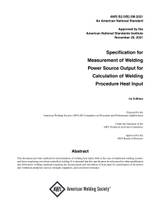

AWS B2.5/B2.5M:2021 Specification for Measurement of Welding Power Source Output for Calculation of Welding Procedure Heat Input
AWS B2.5/B2.5M:2021 covers welding power output measurement and heat-input calculations for traditional and waveform-controlled welding.
Wrong edition, wrong file, or a file that won’t open? We replace or refund — contact us within 7 days.
Buy now is for one copy. Buying for a team? Get a quote
About this publication
Product Description
AWS B2.5/B2.5M:2021, Specification for Measurement of Welding Power Source Output for Calculation of Welding Procedure Heat Input, is the first American Welding Society standard developed specifically to establish consistent methods for measuring welding power source output and calculating welding procedure heat input.
The specification addresses both traditional welding systems and modern waveform-controlled welding systems. Its purpose is to provide a technically consistent method for obtaining the electrical and travel-related information needed to determine heat input when welding qualification or fabrication standards require heat input to be measured, calculated or controlled.
Why Heat Input Measurement Matters
Welding heat input represents the amount of welding energy applied per unit length of weld. It is an important welding procedure variable because changes in heat input can influence thermal cycles, weld and heat-affected-zone behavior, distortion and resulting weldment properties.
AWS specifically identifies strength, toughness and corrosion resistance among the weldment characteristics for which accurate measurement and control of heat input can be important. The standard was developed to improve consistency in the way electrical output and welding travel are measured for these calculations.
Scope
AWS B2.5/B2.5M provides methods for determining welding heat input for conventional welding systems and systems using waveform-controlled welding technology.
The specification is intended to be referenced by welding procedure qualification standards and fabrication standards that require heat-input measurement or calculation. It does not establish a complete welding procedure qualification system by itself; rather, it supplies the measurement and calculation methodology that can be used when another governing document imposes heat-input requirements.
Traditional Welding Systems
For welding systems having relatively conventional and stable current and voltage outputs, heat input can be determined using measured welding voltage, welding current and travel speed. This traditional calculation approach has long been used in welding procedure documentation and production control.
AWS B2.5/B2.5M standardizes the measurement approach so that the values entered into the heat-input calculation are obtained in a consistent manner.
Waveform-Controlled Welding
A major reason for development of B2.5/B2.5M was the increasing use of waveform-controlled welding power sources. These systems intentionally manipulate the electrical output waveform and can rapidly vary current and voltage during the welding cycle.
Examples of waveform-controlled operation can include pulsed and electronically controlled transfer modes in which simple multiplication of independently averaged current and voltage may not accurately represent the actual electrical energy delivered during welding.
The specification therefore provides measurement and calculation approaches capable of accounting for rapidly changing voltage and current waveforms.
Heat Input
Heat input is treated as energy applied per unit length of weld. Calculating it requires both a determination of welding energy or power and a measurement of weld progression, such as welding speed or weld length over a measured time interval.
The standard provides methods that allow organizations to relate measured power source output to the length of weld produced during the measurement period.
Arc Energy and Electrical Output
The electrical energy associated with the welding arc is determined from welding current, voltage and time. Accurate measurement of these variables is fundamental to meaningful heat-input calculations.
B2.5/B2.5M distinguishes between approaches appropriate for traditional electrical output and approaches designed to capture the rapidly changing characteristics of waveform-controlled welding.
Method A — Average Voltage and Current
One calculation approach uses measured average welding voltage and average welding current together with welding speed. This represents the conventional method commonly used for welding systems where the electrical waveform is sufficiently stable for averaged values to provide an appropriate representation of power.
Because separately averaged voltage and current do not necessarily preserve the relationship between instantaneous voltage and instantaneous current, this method can be unsuitable for certain waveform-controlled processes.
Method B — Total Instantaneous Energy
The specification provides a method based on total instantaneous energy for applications in which welding current and voltage vary significantly during the welding cycle.
This approach determines electrical energy using rapidly sampled current and voltage information over the measurement interval. The accumulated energy can then be related to the measured weld length to determine heat input.
Total instantaneous energy is particularly relevant to waveform-controlled welding because it considers the actual interaction between current and voltage throughout the waveform instead of relying only on independently averaged meter readings.
Method C — Average Instantaneous Power
A second waveform-capable approach uses average instantaneous power. Current and voltage are sampled together, their instantaneous products are determined and the resulting power information is averaged over the appropriate interval.
The calculated average instantaneous power is then combined with welding travel information to determine heat input per unit length.
Choosing a Calculation Method
The appropriate method depends on the type of welding power source and the characteristics of its output. Conventional welding systems can be compatible with traditional average-current and average-voltage calculations, while waveform-controlled systems require measurement capable of representing rapidly varying electrical output.
This distinction is one of the most important practical contributions of AWS B2.5/B2.5M because a welding machine's displayed average current and voltage values do not necessarily provide sufficient information for accurate energy calculations under every waveform-controlled condition.
Voltage Measurement
The standard addresses measurement of welding voltage and the importance of obtaining voltage data representative of the actual welding circuit. Measurement location matters because voltage drops in welding leads and connections can cause measurements taken far from the arc to differ from the electrical conditions occurring at the weld.
Proper voltage measurement is therefore part of the overall heat-input measurement procedure rather than simply recording whatever voltage value happens to appear on a welding power source display.
Current Measurement
AWS B2.5/B2.5M also addresses welding-current measurement. Appropriate current-measuring equipment must be capable of measuring the output being used during the welding interval.
For waveform-controlled welding, measurement equipment must capture the changing current waveform with sufficient response and sampling capability to support the selected instantaneous-energy or instantaneous-power calculation method.
Measurement Instrumentation
The specification recognizes both welding power sources with suitable built-in measurement capabilities and external instruments capable of obtaining the required electrical data.
Instrumentation used for waveform-controlled measurements must be capable of sampling voltage and current rapidly enough to characterize the waveform and perform the calculations required by the selected measurement method.
Welding Speed
Travel speed is a critical input in heat-input calculations because welding power or energy alone does not indicate how that energy is distributed along the completed weld.
The specification provides a framework for determining welding speed from the distance welded during a measured time interval. Accurate travel measurement is therefore just as important as accurate electrical measurement when reporting heat input.
Weld Length
Where the selected calculation method uses total energy rather than average power and travel speed, the actual length of weld produced during the measurement interval is used to convert the measured energy into energy per unit length.
Careful definition and measurement of the weld interval help ensure that electrical measurements and physical weld measurements represent the same period of welding.
Multiple Power Sources
Heat-input assessment can become more complex where more than one welding power source contributes energy to a common welding operation. The standard's measurement principles provide a basis for evaluating the relevant electrical contributions rather than assuming that the output of one power source represents the entire welding condition.
Welding Procedure Qualification
AWS B2.5/B2.5M is particularly relevant when a welding procedure qualification standard treats heat input as a procedure variable or requires the value to be documented on a Procedure Qualification Record.
The specification provides a consistent technical basis for determining the recorded heat-input value so that procedure qualification and subsequent production controls use comparable measurement methods.
Production Welding and Procedure Control
The same measurement concepts can be used during production welding where a fabrication code, project specification or quality plan requires heat input to remain within established limits.
Consistency between the measurement method used during procedure qualification and the method used during production monitoring helps prevent apparent differences caused solely by incompatible measurement techniques.
Relationship to Weldment Properties
AWS identifies maintenance of weldment properties such as strength, toughness and corrosion resistance as reasons that welding standards can require heat-input calculation and control.
Heat input affects the thermal cycle surrounding a weld and can influence cooling behavior, microstructure and distortion. B2.5/B2.5M does not itself establish acceptable heat-input ranges for every material or application; those limits must come from the applicable welding procedure, fabrication standard, engineering specification or qualification requirement.
Distortion Control
The standard also recognizes dimensional control and distortion as reasons for managing welding energy. Excessive or inconsistent heat application can affect shrinkage and distortion, particularly in fabrication where dimensional tolerances are important.
Accurate heat-input determination gives welding engineers and fabrication personnel a more reliable parameter for comparing procedures and monitoring welding conditions.
Relationship to AWS B2 Qualification Standards
AWS B2.5/B2.5M is maintained by the AWS B2 Committee on Procedure and Performance Qualification, the same committee family responsible for AWS welding procedure and performance qualification standards.
The document complements procedure-qualification standards by supplying a specialized measurement methodology for heat input rather than duplicating their requirements for procedure qualification, welder qualification or testing.
Not a Welding Procedure Specification
AWS B2.5/B2.5M does not establish a Welding Procedure Specification for a particular welding process, material or joint. It also does not provide universal maximum or minimum heat-input limits.
Its role is to define how welding power source output and welding travel are measured and used when a separate governing document requires a heat-input value.
Dual U.S. Customary and SI Units
The dual designation B2.5/B2.5M reflects the use of U.S. Customary and SI units within the specification. The standard can therefore be applied in welding organizations using either measurement system.
First Edition
AWS B2.5/B2.5M:2021 is the first edition of the specification. ANSI records it as a new American National Standard rather than a revision of an earlier B2.5 publication.
The creation of a dedicated standard reflects the industry's need for a consistent heat-input measurement methodology, particularly as digitally controlled and waveform-controlled welding power sources became more common.
ANSI Status
AWS B2.5/B2.5M:2021 is an American National Standard. ANSI records final approval of the new standard on November 29, 2021.
Technical Committee
The first edition was prepared by the AWS B2 Committee on Procedure and Performance Qualification under the direction of the AWS Technical Activities Committee.
AWS currently also lists a B2H Subcommittee on Arc Energy within the B2 Committee structure, reflecting the specialized technical subject area associated with welding energy and heat-input measurement.
Current Revision Activity
AWS initiated a revision project for B2.5/B2.5M in 2022. ANSI's proposed-standard records continued to list that revision project in 2026.
However, as of October 2026, AWS still lists B2.5/B2.5M:2021 among its published documents and the ANSI Standards Store identifies the 2021 edition as the most recent approved edition. A revision project in development does not supersede the currently published standard.
Who Should Use AWS B2.5/B2.5M:2021
- welding engineers and welding engineering personnel;
- welding procedure qualification personnel;
- Certified Welding Inspectors and quality-control personnel;
- fabricators controlling welding procedure heat input;
- welding power source manufacturers and technical personnel;
- procedure-development laboratories;
- organizations using waveform-controlled welding processes;
- personnel preparing Procedure Qualification Records;
- engineers responsible for weld distortion, toughness or corrosion-resistance requirements;
- standards and specification users who must measure or document welding heat input.
Why This Specification Matters
Traditional heat-input calculations often assume that averaged welding current and voltage adequately represent electrical power. That assumption becomes less reliable when modern power sources intentionally change current and voltage many times during a welding cycle.
AWS B2.5/B2.5M provides a standardized way to address both situations. By distinguishing traditional measurement from instantaneous energy and power methods suitable for waveform-controlled output, the specification helps welding organizations document heat input using measurements that represent the actual welding process more accurately.
Product Features
- First edition of AWS B2.5/B2.5M
- American National Standard
- Provides standardized methods for determining welding procedure heat input
- Covers traditional welding power source output
- Covers waveform-controlled welding systems
- Addresses welding voltage measurement
- Addresses welding current measurement
- Includes conventional average-value heat-input calculation
- Includes total instantaneous energy methodology
- Includes average instantaneous power methodology
- Addresses welding speed and weld-length measurement
- Supports welding procedure qualification and production control
- Provides a common measurement basis for heat-input documentation
- Supports control of distortion and weldment properties
- Relevant to strength, toughness and corrosion-resistance considerations
- Prepared by the AWS B2 Committee on Procedure and Performance Qualification
Product Details
- Standard: AWS B2.5/B2.5M:2021
- Title: Specification for Measurement of Welding Power Source Output for Calculation of Welding Procedure Heat Input
- Publisher: American Welding Society
- Edition: First Edition
- Publication Year: 2021
- Print ISBN: 978-1-64322-217-2
- Page Count: 34
- ANSI Status: American National Standard
- ANSI Approval Date: November 29, 2021
- Technical Committee: AWS B2 Committee on Procedure and Performance Qualification
- Language: English
- Publication Type: Specification
Edition Status Note
AWS B2.5/B2.5M:2021 remains the current approved edition. AWS continues to list the 2021 document among its published B2 standards, and ANSI identifies it as the most recent approved edition with no amendments or corrections currently listed. A revision project was initiated in 2022 and remained listed as a proposed future revision in 2026, but that work has not replaced the 2021 first edition.