
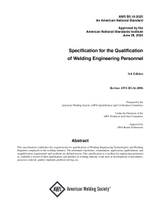

AWS B5.16:2025 Specification for the Qualification of Welding Engineering Personnel
AWS B5.16:2025 covers qualification of Welding Engineering Technologists and Welding Engineers, including experience, exams and competency requirements.
Wrong edition, wrong file, or a file that won’t open? We replace or refund — contact us within 7 days.
Buy now is for one copy. Buying for a team? Get a quote
About this publication
Product Description
AWS B5.16:2025, Specification for the Qualification of Welding Engineering Personnel, establishes minimum qualification requirements for two categories of engineering personnel employed in the welding industry: Welding Engineering Technologists (WET) and Welding Engineers (WE).
The specification defines how qualification may be attained and maintained through combinations of education, relevant experience, credentials and examination. It also establishes bodies of knowledge intended to test comprehension of engineering fundamentals and the ability to apply welding engineering principles in industrial practice.
Third Edition
The 2025 publication is the third edition of AWS B5.16 and revises AWS B5.16:2006. AWS states that the changes are extensive and introduce a competency taxonomy that more clearly distinguishes the responsibilities, knowledge levels and examination expectations of Welding Engineering Technologists and Welding Engineers.
The revised structure aligns qualification expectations more closely with job tasks of graduates from engineering and engineering-technology programs and separates the standard into dedicated qualification paths for WET and WE personnel.
Purpose of the Specification
AWS B5.16 provides a recognized qualification framework through which welding engineering personnel can establish a record of their education, experience, technical knowledge and professional capabilities.
The specification is relevant to personnel involved in welding procedure development, process control, production support, quality standards, troubleshooting, fabrication planning, materials, inspection, testing and other engineering responsibilities associated with welded products.
Scope
The standard establishes qualification requirements for Welding Engineering Technologists and Welding Engineers. It describes how qualification is determined and the manner in which qualification can be attained and maintained.
The specification also defines bodies of knowledge for examinations that evaluate engineering fundamentals and the candidate's ability to understand and apply principles of welding engineering.
Relationship to Employer Requirements
AWS B5.16 is intended to supplement, rather than replace, employer requirements, codes, specifications, contracts or other governing documents.
The standard expressly retains employer responsibility for determining whether an individual who satisfies the B5.16 qualification requirements is capable of performing the specific duties assigned by that employer.
Two Qualification Categories
The third edition formally distinguishes between the Welding Engineering Technologist and Welding Engineer roles. Each category has its own functions, education and experience requirements, bodies of knowledge and examination requirements.
This division is one of the central features of the 2025 edition and provides a more structured way to recognize differing levels of technical responsibility within welding engineering organizations.
Welding Engineering Technologist
The Welding Engineering Technologist is expected to understand, apply and analyze welding and allied technologies in areas that include design, materials, welding processes, quality and economic considerations for defined welding applications.
For advanced applications requiring broader engineering analysis, evaluation or design, the WET may coordinate requirements among engineering, production and fabrication personnel.
WET Technical Responsibilities
The standard identifies a broad range of knowledge and responsibilities relevant to Welding Engineering Technologists. These include familiarity with codes and standards, base materials, filler materials, heat treatment, mechanical properties, welding processes and procedures, equipment, quality systems, inspection methods, acceptance standards, testing and welding qualification requirements.
WET personnel may prepare and review written instructions for producing weldments and must be able to interact effectively with engineers, technicians, inspectors, welders and other personnel involved in fabrication.
Welding Engineer
The Welding Engineer role is defined at a higher level of technical analysis and responsibility. Welding Engineers are expected to understand, apply, analyze and evaluate welding requirements that may be established through codes, contracts, drawings, specifications, purchase orders and other engineering documents.
The Welding Engineer may prepare or review written instructions used for production of welded joints and is expected to exercise professional judgment when evaluating welding engineering requirements.
WE Technical Responsibilities
The Welding Engineer must be familiar with subjects including codes and specifications, base and filler materials, heat treatment, mechanical properties, welding and joining processes, weld joint design, welding equipment, thermal cutting, inspection methods, acceptance criteria, testing, welding qualification requirements and fabrication tolerances.
The role also requires the ability to communicate and coordinate with management, engineers from other disciplines, engineering technologists, welding coordinators, technicians, inspectors, welders and skilled-trade personnel.
Competency Taxonomy
The third edition uses Bloom's taxonomy as a framework for differentiating the cognitive levels expected of Welding Engineering Technologists and Welding Engineers.
The WET competency level emphasizes the ability to remember, understand, apply and analyze. The Welding Engineer role extends those capabilities to include evaluate and create.
Action verbs associated with the taxonomy are used throughout the specification to distinguish job duties, bodies of knowledge and examination structures.
Qualification
Clause 4 establishes the overall qualification categories and identifies the Welding Engineering Technologist and Welding Engineer classifications.
The subsequent portions of the specification then provide separate requirements for each classification rather than applying one common set of education and examination requirements to all engineering personnel.
Part A — Welding Engineering Technologist Requirements
Part A addresses qualification of Welding Engineering Technologists. It contains requirements for functions, education, experience, credentials, body of knowledge, examination and qualification maintenance.
WET Functions
Clause 5 describes the technical functions and responsibilities expected of Welding Engineering Technologists.
The functions reflect practical application and analysis of welding technology and the interface between engineering requirements and production or fabrication activities.
WET Education, Experience and Credential Requirements
Clause 6 establishes education, relevant experience and credential requirements used to determine examination eligibility for WET candidates.
The standard provides multiple qualification pathways so that candidates with different combinations of formal education, welding-industry experience and recognized credentials can be evaluated within the same structured qualification system.
Relevant Experience
The specification defines relevant experience in relation to welding engineering activities. Experience must support development of the technical competencies associated with the qualification being sought.
Relevant work may involve welding processes, metallurgy, fabrication, inspection, procedure development, quality assurance, engineering support or other duties within the body of knowledge established by the standard.
WET Qualification Path Flowchart
The standard includes a flowchart showing the available paths to qualification as a Welding Engineering Technologist. The flowchart helps candidates and employers identify how education, experience and credentials interact with examination requirements.
WET Body of Knowledge
Clause 7 establishes the body of knowledge for Welding Engineering Technologists. Annex A contains the detailed normative body-of-knowledge requirements.
The body of knowledge provides the technical framework against which WET candidates are evaluated and defines the subject areas expected of qualified technologists.
WET Examination Requirements
Clause 8 establishes examination requirements for Welding Engineering Technologists, including the structure of the examinations and provisions affecting candidates holding certain recognized credentials.
Welding Fundamentals Examination
The examination structure includes welding fundamentals. The associated examination table identifies the knowledge domains that form the basis of the qualification assessment.
Welding Code Application Examination
The WET qualification structure also includes a Welding Code Application examination intended to assess the candidate's ability to work with technical requirements contained in welding codes and related documents.
Welding Engineering Technology Examination
The Welding Engineering Technology examination assesses the technical core areas associated with welding engineering technology and evaluates the candidate's understanding, application knowledge and analysis skills.
SCWI Examination Eligibility Provisions
Clause 8.2 contains examination eligibility provisions affecting personnel holding the AWS Senior Certified Welding Inspector credential.
These provisions recognize relevant existing qualifications while maintaining the requirements established for the Welding Engineering Technologist classification.
IIW International Welding Technologist Provisions
Clause 8.3 addresses examination eligibility for personnel holding the International Institute of Welding International Welding Technologist credential.
This provision provides a defined relationship between the AWS WET qualification structure and an internationally recognized welding-technology credential.
WET Qualification Maintenance
Clause 9 addresses maintenance of Welding Engineering Technologist qualification. The standard treats qualification as something that must remain current rather than as a one-time event with no continuing requirements.
Part B — Welding Engineer Requirements
Part B contains the requirements applicable to Welding Engineers. The structure parallels the technologist section but applies education, experience and examination requirements appropriate to the higher engineering competency level.
Welding Engineer Functions
Clause 10 defines Welding Engineer functions and responsibilities. The duties emphasize engineering evaluation, development, technical analysis and the exercise of professional judgment in welding-related work.
The Welding Engineer role may involve developing or reviewing requirements affecting welding procedures, joint design, materials, fabrication methods, inspection, acceptance criteria, testing and quality.
WE Education, Experience and Credential Requirements
Clause 11 establishes minimum education, experience and credential requirements for Welding Engineer examination eligibility.
The standard provides qualification routes that account for formal engineering education, relevant welding engineering experience and applicable credentials.
Relevant Welding Engineering Experience
Relevant experience for the Welding Engineer classification is intended to demonstrate development and application of engineering competencies associated with welded fabrication and welding technology.
Experience requirements work together with education and examination rather than functioning as an isolated criterion.
WE Qualification Path Flowchart
The specification includes a flowchart showing paths to qualification as a Welding Engineer. This provides a visual framework for determining how different education, experience and credential combinations lead to examination eligibility.
Welding Engineer Body of Knowledge
Clause 12 establishes the Welding Engineer body of knowledge, with the detailed normative requirements provided in Annex C.
The body of knowledge reflects the broader evaluation and design responsibilities associated with the Welding Engineer classification.
Technical Core Areas
The Welding Engineering Technology examination used within the Welding Engineer qualification framework evaluates four principal technical core areas:
- welding, joining and allied processes;
- material properties and welding metallurgy;
- welding design and joint configurations;
- quality assurance, quality control and nondestructive examination.
These areas form the technical foundation for evaluating a candidate's ability to apply engineering principles to welding-related work.
Welding Engineer Examination Requirements
Clause 13 establishes the examination structure for Welding Engineers and includes provisions relating to engineering-fundamentals and welding-engineering examinations.
Fundamentals of Engineering Examination
The qualification structure uses the National Council of Examiners for Engineering and Surveying Fundamentals of Engineering examination as one means of demonstrating knowledge of basic and applied engineering sciences.
The standard also provides an AWS-developed Applied Sciences examination option for international candidates who do not have access to the NCEES FE examination.
Welding Engineering Technology Examination
The Welding Engineering Technology portion evaluates understanding, application and analysis within the four technical core areas established by the specification.
The associated examination table allocates examination content among domains and subdomains so that qualification is based on a defined technical knowledge structure.
Welding Engineering Concentration Examination
The Welding Engineer qualification structure includes additional examination requirements intended to demonstrate higher-level engineering competency beyond the technology-focused examination.
NCEES FE Examination Exemptions
Clause 13.2 defines circumstances under which a candidate may qualify for exemption from the NCEES Fundamentals of Engineering examination requirement.
These provisions recognize certain credentials or circumstances while preserving the standard's overall engineering-fundamentals requirement.
Exemption from Welding Engineering Examinations
Clause 13.3 contains provisions for exemption from specified welding engineering examinations where the candidate satisfies applicable requirements defined by the standard.
WE Qualification Maintenance
Clause 14 establishes requirements for maintaining Welding Engineer qualification. Continuing qualification requirements help ensure that the individual's documented status remains aligned with the specification.
Normative Annex A — WET Body of Knowledge
Annex A is normative and contains the detailed Body of Knowledge for Welding Engineering Technologists.
Because the annex is normative, its provisions form part of the qualification requirements rather than serving only as background information.
Normative Annex B — WET Reference Documents
Annex B identifies normative references that provide the technical basis for Welding Engineering Technologist examinations.
The reference list includes welding fundamentals and engineering technology documents used to establish the technical subject matter against which candidates are evaluated.
Normative Annex C — Welding Engineer Body of Knowledge
Annex C provides the normative Body of Knowledge for Welding Engineers. The content reflects the expanded competency expected of the engineer role and supports development of the Welding Engineer examination structure.
Normative Annex D — Welding Engineer Reference Documents
Annex D identifies the normative reference documents used as the technical basis for Welding Engineer examinations.
References include NCEES engineering-fundamentals material along with AWS welding standards and Welding Handbook material relevant to the technical core areas.
Informative Annex E — Official Interpretations
Annex E explains the AWS process for requesting an official interpretation of the standard. Official technical interpretations are handled through the responsible AWS committee rather than through informal verbal opinions.
Informative Annex F — Related AWS Qualification and Certification Documents
Annex F provides a list of AWS documents addressing qualification and certification of welding personnel and facilities.
This helps users understand how B5.16 fits within the broader AWS family of specifications covering inspectors, educators, supervisors, radiographic interpreters, welding fabricators and other welding-industry personnel.
Major Changes from AWS B5.16:2006
AWS states that the changes in the third edition are widespread. The most significant structural change is introduction of the competency taxonomy separating Welding Engineering Technologist and Welding Engineer roles.
The revised standard aligns competencies with job tasks associated with experienced graduates from ABET-accredited engineering and engineering-technology programs and uses Bloom's taxonomy to differentiate required cognitive levels.
The qualification structure, bodies of knowledge and examination requirements were consequently reorganized around the two distinct personnel classifications.
Relationship to Welding Codes and Standards
A qualified Welding Engineering Technologist or Welding Engineer may work with a wide range of welding codes, material specifications and fabrication standards. B5.16 does not replace those technical documents.
Instead, it establishes the competence framework used to qualify personnel who interpret, apply, develop or support welding requirements governed by those other documents.
Current Revision Activity
AWS initiated a future revision project for B5.16 in 2025 to incorporate updated information concerning core competencies of welding engineers. That project remains developmental and does not supersede AWS B5.16:2025.
The 2025 third edition therefore remains the current published American National Standard until a subsequent revision is formally approved and published.
Errata Status
The foreword states AWS policy that significant errata will be published and posted by AWS when identified. As of October 2026, the current AWS and ANSI records do not identify a separately published errata, amendment or correction for AWS B5.16:2025.
Users should continue to check the AWS codes and standards update resources for future errata, amendments or revisions when applying the document.
Who Should Use AWS B5.16:2025
- Welding Engineering Technologists seeking documented qualification;
- Welding Engineers seeking documented qualification;
- employers evaluating welding engineering personnel;
- welding engineering managers and supervisors;
- engineering firms involved in welded fabrication;
- quality assurance and quality control organizations;
- fabricators employing welding engineering personnel;
- educational institutions with welding engineering or engineering-technology programs;
- personnel preparing for AWS welding engineering qualification examinations;
- organizations establishing competency requirements for welding engineering positions.
Why This Specification Matters
Welding engineering work can range from practical production support to advanced engineering analysis, design and technical decision-making. Treating every welding engineering role as having identical competencies can create uncertainty for employers and personnel.
AWS B5.16:2025 provides a structured means of distinguishing Welding Engineering Technologist and Welding Engineer capabilities while establishing recognized qualification pathways for both. The third edition connects education, experience, examinations and job functions through a competency-based framework rather than relying on job titles alone.
Product Features
- Third edition of AWS B5.16
- American National Standard
- Revises AWS B5.16:2006
- Qualifies Welding Engineering Technologists and Welding Engineers
- Establishes separate WET and WE competency structures
- Uses Bloom's taxonomy to distinguish competency levels
- Defines functions and responsibilities for both classifications
- Establishes education and experience requirements
- Provides multiple examination-eligibility pathways
- Defines normative bodies of knowledge
- Includes Welding Fundamentals examination provisions
- Includes Welding Code Application examination provisions
- Includes Welding Engineering Technology examination provisions
- Addresses NCEES Fundamentals of Engineering requirements
- Includes international applied-sciences examination provisions
- Addresses SCWI and IIW IWT eligibility provisions
- Defines qualification-maintenance requirements
- Includes normative examination reference documents
- Provides qualification-path flowcharts for WET and WE candidates
Product Details
- Standard: AWS B5.16:2025
- Title: Specification for the Qualification of Welding Engineering Personnel
- Publisher: American Welding Society
- Edition: 3rd Edition
- Publication Year: 2025
- Print ISBN: 978-1-64322-326-1
- Page Count: 52
- ANSI Status: American National Standard
- ANSI Approval Date: June 28, 2024
- Technical Committee: AWS Qualification and Certification Committee
- Specialist Group: AWS Subcommittee on Welding Engineers
- Previous Edition: AWS B5.16:2006
- Language: English
- Publication Type: Specification
Edition Status Note
AWS B5.16:2025 is the current third edition of Specification for the Qualification of Welding Engineering Personnel and revises AWS B5.16:2006. AWS and ANSI currently identify no separately published amendment or correction for this edition. AWS initiated a future revision project in 2025, but that development work has not superseded the current 2025 standard.