

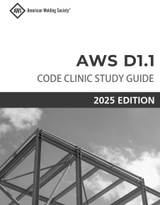
AWS D1.1 CCSG:2025 Code Clinic Study Guide
AWS D1.1 Code Clinic Study Guide 2025, 352 pages, for navigating and applying AWS D1.1/D1.1M:2025 with practice questions and answers.
Wrong edition, wrong file, or a file that won’t open? We replace or refund — contact us within 7 days.
Buy now is for one copy. Buying for a team? Get a quote
About this publication
Product Description
AWS D1.1 CCSG:2025, Code Clinic Study Guide—AWS D1.1, is the current American Welding Society study guide developed to help Certified Welding Inspector candidates and other welding professionals understand, navigate and apply AWS D1.1/D1.1M:2025, Structural Welding Code—Steel.
AWS sells the publication under the designation CCRM:2025 — D1.1 CODE CLINIC, while ANSI catalogs it as AWS D1.1 CCSG:2025. These designations refer to the same current 2025 Code Clinic Study Guide.
Designed for AWS D1.1/D1.1M:2025
This Study Guide is specifically aligned with AWS D1.1/D1.1M:2025, Structural Welding Code—Steel, 25th Edition.
The 25th Edition designation belongs to the underlying D1.1 Structural Welding Code. The Code Clinic itself is properly identified as the 2025 Edition of the Study Guide.
Purpose of the Code Clinic Study Guide
The American Welding Society Education and Training Department developed the D1.1 Code Clinic Study Guide to help welding professionals become more effective at reading, understanding, navigating and applying industrial welding-code requirements.
The emphasis is on practical use of the D1.1 code book rather than memorization of hundreds of individual requirements.
CWI Exam Preparation
AWS specifically identifies CWI exam candidates as a principal audience for this publication.
The Study Guide helps candidates develop the ability to locate applicable D1.1 provisions efficiently and correctly interpret those provisions under exam conditions.
Workplace Code Application
The Code Clinic is not limited to certification preparation.
AWS also designed it for welding professionals who need to navigate and apply D1.1 requirements during actual engineering, fabrication, inspection and quality-control work.
Code Navigation Skills
A central objective of the Study Guide is improving the user's ability to move efficiently through AWS D1.1/D1.1M:2025.
Effective code use requires understanding how clauses, tables, figures, annexes, cross-references and related provisions work together rather than attempting to memorize isolated requirements.
Understanding the Structure of AWS D1.1
The Study Guide is designed around the organization of the 2025 Structural Welding Code—Steel.
Users learn to recognize where different categories of requirements are located so they can narrow a question to the appropriate portion of the Code before searching for the controlling paragraph, table or figure.
General Requirements
The underlying D1.1 Code begins with general requirements defining its scope, responsibilities, limitations and overall application.
Understanding these introductory requirements is important because individual technical clauses cannot always be interpreted correctly without considering the general provisions that govern the entire Code.
Normative References
The Code incorporates other standards through normative references.
The Code Clinic helps users recognize that some technical requirements cannot be resolved from D1.1 alone and may depend on referenced AWS, ASTM or other standards identified by the Code.
Terms and Definitions
Correct application of D1.1 depends on understanding its technical terminology.
Terminology involving weld types, joint configurations, qualification, inspection and structural applications can substantially affect which requirements apply to a particular question or fabrication condition.
Design of Welded Connections
AWS D1.1 contains detailed provisions governing design of welded structural steel connections.
Study of the Code's organization helps users distinguish design requirements from fabrication, qualification and inspection requirements and locate the appropriate design provisions when necessary.
Prequalification of Welding Procedure Specifications
Prequalified Welding Procedure Specifications are an important subject within AWS D1.1.
Users must understand how to locate requirements involving approved welding processes, base metals, filler metals, joint details, preheat, interpass temperature and other conditions necessary for a WPS to qualify for prequalified status.
Procedure Qualification
Where a welding procedure cannot be used as a prequalified WPS, D1.1 provides requirements for qualification through testing.
The Code Clinic supports development of navigation skills needed to work with procedure qualification requirements, qualification ranges, essential variables and applicable test requirements.
Welder and Welding Operator Qualification
AWS D1.1 separately addresses performance qualification of welders and welding operators.
Study of the Code helps users distinguish personnel qualification from procedure qualification and locate requirements governing positions, processes, joint types and other variables affecting qualification ranges.
Fabrication Requirements
The Structural Welding Code contains extensive fabrication requirements addressing preparation, assembly, welding consumables, welding technique, workmanship, preheat, interpass temperature, distortion, repairs and other production considerations.
The Code Clinic helps users understand where these production requirements are located and how they relate to qualification and inspection provisions.
Inspection
Inspection is one of the most important practical areas for Certified Welding Inspector candidates and working welding inspectors.
D1.1 includes requirements for inspector responsibilities, visual acceptance, nondestructive testing and evaluation of completed structural welds.
Visual Acceptance Criteria
Structural weld inspection frequently requires users to locate and correctly apply acceptance criteria contained in tables and accompanying notes.
The Study Guide's code-navigation emphasis helps users develop the habit of reviewing the entire applicable table, including headings, notes and exceptions, before reaching an acceptance decision.
Nondestructive Examination
AWS D1.1 includes requirements associated with nondestructive examination methods used for structural weld inspection.
Code users must be able to distinguish general NDE requirements from method-specific provisions and determine when additional criteria or referenced standards apply.
Stud Welding
The 2025 D1.1 Code includes dedicated requirements for stud welding.
The Study Guide supports navigation of specialized Code subjects such as stud welding that can be easy to overlook when concentrating only on groove and fillet welding.
Tubular Structures
D1.1 contains specialized provisions for tubular structural connections.
These requirements differ in important ways from ordinary nontubular structural steel connections, making recognition of the correct Code section essential when answering application questions.
Strengthening and Repair
The Structural Welding Code also contains provisions for strengthening and repair of existing structures.
Code users must distinguish repair and modification requirements from provisions written primarily for new fabrication.
Practice Questions
AWS states that the Code Clinic Study Guide includes practice questions similar to exam questions.
The questions are intended to help users practice finding applicable requirements and applying them rather than simply recalling information from memory.
Answers Included
Answers are supplied for the practice questions.
This allows candidates and working professionals to check their understanding and identify Code areas requiring additional study.
Using the Guide With the D1.1 Code
The Code Clinic Study Guide is intended to be used together with AWS D1.1/D1.1M:2025.
It is a training and reference publication and does not replace the Structural Welding Code—Steel. The controlling welding requirements remain in D1.1 and the applicable contract documents.
Not an Independent Welding Code
The Code Clinic should not be cited as the governing construction standard for a welded structure.
It explains and reinforces use of AWS D1.1, but it does not independently establish the design, fabrication, qualification or acceptance requirements imposed by the Structural Welding Code.
Useful for Inspectors
Welding inspectors can use the Code Clinic to improve familiarity with the organization and application of D1.1.
Greater familiarity with code structure can reduce the time required to locate acceptance criteria, qualification requirements and fabrication provisions during inspection activities.
Useful for Welding Supervisors
Supervisors responsible for structural welding operations can use the Guide to strengthen their ability to locate requirements governing WPSs, welding personnel, consumables, preheat and production workmanship.
Useful for Engineers
Engineers and managers responsible for welded structural work can use the Code Clinic to improve familiarity with how design, fabrication, qualification and inspection requirements interact within D1.1.
Useful for Quality Professionals
AWS specifically identifies inspectors, supervisors, quality-conscious engineers and managers among the intended users of its Code Clinic materials.
The Study Guide is therefore useful both as certification preparation and as professional development for personnel working within structural steel quality systems.
2025 Edition and the 25th Edition Code
The publication should not be cataloged as the 25th Edition of the Code Clinic.
The correct distinction is:
- Code Clinic Study Guide: 2025 Edition
- Underlying Code: AWS D1.1/D1.1M:2025 Structural Welding Code—Steel, 25th Edition
Current Publication Designations
The current study guide appears in industry catalogs under several equivalent designations.
- AWS CCRM:2025
- AWS D1.1 CCRM:2025
- AWS D1.1 CCSG:2025
- AWS CCSG:2025
- AWS CC-RM:2025
AWS's own online store uses CCRM:2025, while ANSI identifies the document as AWS D1.1 CCSG:2025.
Previous Code Clinic Edition
ANSI's document history identifies the current Study Guide as revising AWS D1.1 CCRM:2010.
The current publication is specifically aligned with the reorganized and substantially updated AWS D1.1/D1.1M:2025 Code rather than the older Code structure used by the historical reference manual.
Current Amendment and Correction Status
Current ANSI catalog information lists no amendments or corrections for AWS D1.1 CCSG:2025.
This amendment status applies to the Study Guide itself and should not be confused with amendment or errata information applicable to the separate AWS D1.1/D1.1M:2025 Structural Welding Code.
352 Pages
The current Code Clinic Study Guide contains 352 pages.
The publication is available from AWS in both printed hard-copy and downloadable PDF formats.
Who Should Use the AWS D1.1 Code Clinic Study Guide
- AWS Certified Welding Inspector candidates;
- welding inspectors;
- structural welding inspectors;
- welding supervisors;
- quality assurance personnel;
- quality control personnel;
- welding engineers;
- structural engineers working with D1.1;
- fabrication managers;
- WPS and qualification administrators;
- welding instructors;
- technical students;
- professionals who need to apply AWS D1.1/D1.1M:2025 in the workplace.
Product Features
- current 2025 AWS D1.1 Code Clinic Study Guide;
- 352 pages;
- published by AWS Education Services;
- aligned with AWS D1.1/D1.1M:2025;
- supports study of the 25th Edition Structural Welding Code—Steel;
- developed for CWI exam candidates and welding professionals;
- focuses on understanding and navigating D1.1;
- develops practical code-application skills;
- includes practice questions similar to exam questions;
- includes answers to practice questions;
- supports examination preparation;
- supports workplace code application;
- available in printed hard copy and PDF from AWS;
- revises the historical AWS D1.1 CCRM:2010 Code Clinic;
- current ANSI records list no amendments or corrections.
Product Details
- AWS Designation: CCRM:2025
- ANSI Catalog Designation: AWS D1.1 CCSG:2025
- Title: Code Clinic Study Guide—AWS D1.1
- Related Code: AWS D1.1/D1.1M:2025 Structural Welding Code—Steel
- Related Code Edition: 25th Edition
- Study Guide Edition: 2025 Edition
- Publisher: American Welding Society
- Publishing Organization: AWS Education Services
- Publication Year: 2025
- Page Count: 352
- Language: English
- Formats: Printed Hard Copy and Download PDF
- Previous Code Clinic: AWS D1.1 CCRM:2010
- Publication Type: Welding Code Study Guide and Professional Reference
Edition Status Note
AWS D1.1 CCSG:2025 / CCRM:2025 is the current AWS D1.1 Code Clinic Study Guide as of October 2026. It is designed specifically for use with AWS D1.1/D1.1M:2025 Structural Welding Code—Steel, 25th Edition. The Study Guide itself should be cataloged as the 2025 Edition, not the 25th Edition. Current ANSI records list no amendments or corrections for the Study Guide.