
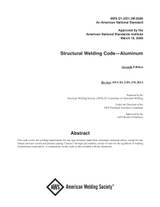

AWS D1.2/D1.2M:2026 Structural Welding Code—Aluminum
AWS D1.2/D1.2M:2026 Seventh Edition covers structural aluminum welding, alloy selection, qualification, fabrication, workmanship and inspection.
Wrong edition, wrong file, or a file that won’t open? We replace or refund — contact us within 7 days.
Buy now is for one copy. Buying for a team? Get a quote
About this publication
Product Description
AWS D1.2/D1.2M:2026, Structural Welding Code—Aluminum, Seventh Edition, establishes requirements for the welding of structures manufactured from aluminum structural alloys.
The Code provides requirements used by engineers, fabricators, welding personnel, inspectors and quality organizations involved in structural aluminum construction. It addresses welding design responsibilities, material and filler-metal selection, qualification, fabrication, workmanship and inspection.
Current Seventh Edition
The 2026 edition is the current AWS D1.2 publication and supersedes AWS D1.2/D1.2M:2014.
This is the first complete edition update in approximately twelve years and incorporates changes reflecting advances in aluminum alloys, welding technology, modern welding equipment, qualification practice and structural fabrication methods.
Scope
AWS D1.2 applies to welded structures made from aluminum structural alloys.
The Code specifically excludes aluminum pressure vessels and pressure piping, which are governed by other applicable codes and standards.
Structural Aluminum Applications
The Code is intended for structural applications where aluminum members and components are joined by welding.
Structural aluminum is used in applications such as buildings, bridges, walkways, transportation structures and other load-bearing assemblies where low weight, corrosion resistance and favorable strength-to-weight performance are important.
Ten-Clause Organization
The 2026 edition contains Clauses 1 through 10, which establish the rules governing welding in aluminum construction.
A Commentary is also included to provide technical background and explanatory information supporting application of the mandatory Code provisions.
Major Structural Reorganization
One of the major 2026 changes is a reorganization of the Code to more closely follow the structure used by other AWS D1 structural welding codes.
Material previously concentrated in the opening clause was separated into dedicated clauses for General Requirements, Normative References, Terms and Definitions and Design.
Clause 1 — General Requirements
Clause 1 establishes the general framework for application of the Code.
Many responsibilities formerly assigned to the Engineer in the opening clause of the 2014 edition were relocated to the dedicated Design clause so that responsibilities and technical design requirements are organized more logically.
Clause 2 — Normative References
A separate Normative References clause was added for the 2026 edition.
This change aligns AWS D1.2 more closely with other current AWS standards and provides clearer identification of external documents that form part of the Code's technical framework.
Clause 3 — Terms and Definitions
The Terms and Definitions clause was expanded substantially.
The new edition emphasizes definitions specific to AWS D1.2 that are not otherwise adequately defined in AWS A3.0, Standard Welding Terms and Definitions.
New or clarified terminology includes concepts such as authority having jurisdiction, contract documents, contractor drawings and smut.
Clause 4 — Design
Clause 4 contains requirements associated with the design of welded aluminum connections.
AWS emphasizes that D1.2 is not intended to serve as a complete structural design manual. Structural design is coordinated with the applicable Aluminum Design Manual Specification for Aluminum Structures.
Alloy Selection — New Paragraph 4.2.2
The 2026 edition adds a dedicated paragraph addressing alloy selection.
Requirements affecting selection of base-metal and filler-metal alloys that previously appeared among the Engineer's responsibilities were reorganized into the Design clause.
This makes alloy compatibility a more explicit design responsibility rather than leaving material selection buried in administrative provisions.
Engineer-specified Filler Alloy
The new edition strengthens control of filler-metal selection by requiring the responsible engineer to identify the filler alloy where required by the Code.
This is intended to prevent arbitrary substitution of filler metals that could produce undesirable mechanical, metallurgical or service-performance characteristics.
Modernized Filler Metal Selection Guidance
The 2026 edition replaces older filler-selection guidance with updated information reflecting current aluminum materials and welding practice.
A new Commentary table provides assistance with base-metal and filler-metal alloy selection. Because it appears in the Commentary, the table is informative rather than a mandatory Code requirement.
Contract Documents
The Design clause now provides clearer requirements for information that must be included in Contract Documents.
This improves communication between engineers, fabricators and inspectors by making project-specific welding requirements easier to identify.
Contractor Drawings
The 2026 edition also clarifies requirements for Contractor Drawings.
Separating contract-document requirements from contractor-produced fabrication information helps define responsibilities among design and fabrication organizations.
Flare Groove Welds
A new paragraph addresses partial joint penetration flare-bevel and flare-V-groove welds.
The provision provides clearer requirements for determining applicable weld size where curved aluminum surfaces or rounded member geometry create flare-groove configurations.
Clause 5 — Qualification
The Qualification clause addresses qualification of welding procedures, welders and welding operators.
The 2026 edition retains the basic qualification framework while introducing revisions intended to improve usability and align the material classifications with current welding qualification standards.
Expanded Base Metal Tables
Base-metal group designations are consolidated into updated tables in the 2026 edition.
The range of listed materials has been expanded to better reflect aluminum alloys used in modern structural fabrication.
Expanded Filler Metal Tables
Filler-metal group designations and associated F-numbers are presented in updated tables.
AWS identifies expanded base- and filler-metal coverage as one of the principal improvements in the Seventh Edition.
F-number Alignment
The 2026 qualification provisions revise treatment of F-numbers to align more closely with AWS B4.0 and current mechanical-testing and qualification practice.
This was an important part of the long-running technical revision of the qualification provisions.
Coordination With ASME Section IX and AWS B2.1
The expanded material listings were developed to more closely reflect newer materials appearing in ASME Boiler and Pressure Vessel Code Section IX and AWS B2.1, Specification for Welding Procedure and Performance Qualification.
This improves consistency for organizations that work across multiple welding qualification systems.
WPS Essential Variables
The 2026 edition revises several Welding Procedure Specification essential variables for clarity.
Essential variables determine when a change to a qualified welding procedure is significant enough to require additional qualification.
Postweld Heat Treatment
A significant new essential variable addresses the addition or deletion of postweld heat treatment when welding heat-treatable aluminum alloys.
This recognizes that thermal treatment can substantially affect the mechanical properties and metallurgical condition of heat-treatable aluminum alloys.
Requirements Removed From Table Footnotes
The 2026 edition moves mandatory requirements out of table footnotes and into the body of the Code.
This change is intended to make requirements easier to find and reduce the risk that important provisions will be overlooked while using qualification tables.
Mandatory Wording
The new edition also revises wording to distinguish mandatory Code requirements more clearly.
Ambiguous wording was reduced, with mandatory provisions expressed using terminology appropriate to enforceable Code requirements.
Clause 6 — Fabrication
The Fabrication clause addresses production requirements affecting preparation, welding, assembly, distortion, cleaning and workmanship of structural aluminum weldments.
AWS identifies updated fabrication guidance as one of the principal improvements in the 2026 edition.
Correction of Welding Distortion
A new provision clarifies requirements for using heat to remove distortion caused by welding.
This is particularly important with aluminum because its thermal properties and heat-treatment condition can make inappropriate heating detrimental to material properties or structural performance.
Cleaning During Welding
The 2026 edition reorganizes cleaning requirements into separate provisions for in-process cleaning and cleaning of completed welds.
Proper cleaning is critical in aluminum welding because oxide, contamination and residue can contribute to discontinuities and poor weld quality.
Aluminum Oxide and Surface Preparation
Aluminum forms a persistent oxide film that behaves differently from the underlying base metal during fusion welding.
Fabrication procedures therefore require appropriate joint preparation, cleaning and control of contamination so welding can produce the required quality.
Welding Procedure Control
Structural aluminum welding must be performed in accordance with welding procedures meeting the applicable qualification requirements of the Code.
The procedure establishes the controlled welding variables needed to produce welds consistent with the qualified conditions.
Welder and Welding Operator Qualification
AWS D1.2 establishes qualification requirements for welding personnel performing structural aluminum work.
The 2026 edition updates the qualification framework to account for current materials, equipment and welding practices while improving navigation and consistency with other AWS standards.
Fabrication Workmanship
The Code establishes workmanship requirements intended to ensure that production welding conforms to the assumptions used in engineering design and procedure qualification.
Fabricators must control joint preparation, fit-up, welding technique, cleaning, distortion and other production variables that affect completed weld quality.
Inspection
Inspection requirements provide the quality-verification portion of the structural welding process.
Inspectors use the Code together with contract documents, qualified welding procedures and applicable project requirements to determine whether structural aluminum welding complies with the specified requirements.
Visual Examination
Visual examination remains a fundamental method for evaluating structural weld workmanship.
Inspectors evaluate applicable weld dimensions, profiles, surface conditions and discontinuities against Code and project acceptance requirements.
Nondestructive Examination
Where required, nondestructive examination supplements visual inspection in evaluating weld quality.
The required examination method and acceptance criteria depend on the Code, contract documents and the structural application.
Base Metal and Filler Metal Compatibility
Aluminum alloy designation and temper have a direct influence on weldability, strength and postweld performance.
The expanded material tables and revised alloy-selection provisions in the 2026 edition therefore represent an important technical update for both designers and welding procedure developers.
Heat-treatable Aluminum Alloys
Heat-treatable aluminum alloys can experience significant changes in mechanical properties within the heat-affected zone during welding.
The new edition's treatment of alloy selection and postweld heat treatment helps ensure that these effects are properly considered in qualification and fabrication.
Non-heat-treatable Aluminum Alloys
Non-heat-treatable aluminum alloys derive properties through composition and mechanical working rather than precipitation heat treatment.
Structural welding procedures must still account for alloy chemistry, temper, filler-metal selection and the effect of welding heat on the finished joint.
Commentary
A Commentary accompanies AWS D1.2/D1.2M:2026.
The Commentary provides background and explanatory material that can assist users in understanding the technical intent of selected requirements. Commentary provisions are informative unless specifically invoked by another requirement.
CWI Aluminum Endorsement
AWS identifies the 2026 edition as the current technical reference for professionals preparing for the AWS Certified Welding Inspector Aluminum Endorsement, subject to the current AWS examination requirements.
Inspectors maintaining aluminum welding expertise should therefore recognize that the 2014 edition has been superseded.
Major Changes From the 2014 Edition
- first complete edition update since 2014;
- reorganized structure aligned with other AWS D1 codes;
- new dedicated Normative References clause;
- expanded Terms and Definitions;
- Engineer responsibilities relocated into the Design clause;
- new alloy-selection requirements;
- clearer Contract Document and Contractor Drawing requirements;
- new flare-groove weld-size provisions;
- expanded base-metal tables;
- expanded filler-metal tables;
- updated F-number treatment;
- closer alignment with AWS B4.0, AWS B2.1 and ASME Section IX material groupings;
- modernized filler-metal selection guidance;
- revised WPS essential variables;
- postweld heat treatment added as an essential variable for applicable heat-treatable alloys;
- mandatory requirements moved from table footnotes into the Code body;
- clearer mandatory wording;
- new guidance on heat correction of welding distortion;
- separate in-process and completed-weld cleaning provisions;
- updated fabrication guidance reflecting current industry practice.
Who Should Use AWS D1.2/D1.2M:2026
- structural engineers;
- welding engineers;
- aluminum structure designers;
- structural aluminum fabricators;
- shop managers and welding supervisors;
- welding procedure developers;
- welders and welding operators;
- AWS Certified Welding Inspectors;
- quality assurance and quality control personnel;
- nondestructive examination personnel;
- contractors and erectors;
- engineering firms and specifiers;
- technical schools and welding training programs;
- candidates preparing for the AWS CWI Aluminum Endorsement.
Product Features
- current Seventh Edition of AWS D1.2;
- 2026 edition;
- ANSI approved;
- 236 pages;
- covers structural aluminum welding;
- excludes aluminum pressure vessels and pressure piping;
- contains ten mandatory clauses;
- includes Commentary;
- updated qualification requirements;
- expanded base-metal coverage;
- expanded filler-metal coverage;
- updated alloy-selection requirements;
- modernized filler-metal selection guidance;
- updated WPS essential variables;
- updated fabrication requirements;
- new flare-groove weld provisions;
- updated distortion-correction requirements;
- revised weld-cleaning requirements;
- reorganized to align with other AWS D1 codes;
- supersedes AWS D1.2/D1.2M:2014.
Product Details
- Standard: AWS D1.2/D1.2M:2026
- Title: Structural Welding Code—Aluminum
- Edition: Seventh Edition
- Publisher: American Welding Society
- Publication Year: 2026
- ANSI Final Action Date: March 16, 2026
- Print ISBN: 978-1-64322-451-0
- Page Count: 236
- Previous Edition: AWS D1.2/D1.2M:2014
- Current Amendments/Corrections: None listed as of October 2026
- Language: English
- Prepared By: AWS D1 Committee on Structural Welding and D1G Subcommittee on Aluminum Structures
- Publication Type: Structural Welding Code
Edition Status Note
AWS D1.2/D1.2M:2026 is the current edition as of October 2026 and supersedes AWS D1.2/D1.2M:2014 and its errata. Current ANSI records list no amendments or corrections for the 2026 edition.