
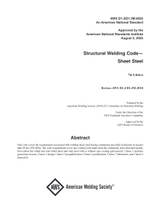

AWS D1.3/D1.3M:2025 Structural Welding Code—Sheet Steel, 7th Edition
AWS D1.3/D1.3M:2025 Seventh Edition with 2026 errata covers structural sheet steel welding, WPS qualification, fabrication, design and inspection.
Wrong edition, wrong file, or a file that won’t open? We replace or refund — contact us within 7 days.
Buy now is for one copy. Buying for a team? Get a quote
About this publication
Product Description
AWS D1.3/D1.3M:2025, Structural Welding Code—Sheet Steel, Seventh Edition, establishes requirements for arc welding structural sheet and strip steels, including cold-formed structural members.
The Code is used for welded sheet steel connections in applications where calculated loads are transferred through the welded joint, including steel deck, panels, storage racks, stud framing, joist framing and related structural systems.
This product includes the AWS Errata Notice dated January 22, 2026, incorporating the currently identified corrections to the Seventh Edition.
Current Seventh Edition
The 2025 publication is the Seventh Edition of AWS D1.3/D1.3M and supersedes AWS D1.3/D1.3M:2018.
The American National Standards Institute approved AWS D1.3/D1.3M:2025 on August 5, 2025.
Scope
The Code covers arc welding of structural sheet and strip steels, including cold-formed members, collectively identified as sheet steel.
Its principal scope includes sheet steel having a nominal thickness equal to or less than 3/16 in [5 mm].
The Code also includes welding of applicable hollow structural sections, or tubular members, having wall thicknesses less than 1/8 in [3 mm].
Sheet Steel Materials
AWS D1.3 applies to welded joints made from commonly used structural-quality low-carbon hot-rolled and cold-rolled sheet and strip steels.
The scope includes applicable steel supplied either uncoated or with a zinc coating, commonly identified as galvanized sheet steel.
Yield Strength Limit
The Code applies to sheet steel having a minimum specified yield point no greater than 80 ksi [550 MPa].
This material limitation is an important part of determining whether a welded structural application falls within AWS D1.3 rather than another AWS structural welding code.
Structural Applications
AWS identifies common D1.3 applications as including:
- steel roof and floor deck;
- structural sheet steel panels;
- storage racks;
- cold-formed steel studs;
- cold-formed steel joists;
- sheet steel framing members;
- other structural sheet steel assemblies transferring calculated loads.
Relationship to AWS D1.1
AWS D1.3 and AWS D1.1 can both apply where thin sheet steel is welded to thicker structural steel products.
The Code contains a dedicated application matrix and a normative Annex A establishing applicable provisions when AWS D1.3 sheet steels are welded to steel product forms governed by AWS D1.1/D1.1M.
Hollow Structural Sections
Welding of qualifying hollow structural sections with wall thicknesses below 1/8 in [3 mm] is included within the D1.3 scope.
However, AWS states that the structural design requirements for HSS member connections themselves are outside the scope of D1.3.
Code Organization
The mandatory body of the Code is organized into eight principal clauses:
- Clause 1 — General Requirements
- Clause 2 — Normative References
- Clause 3 — Terms and Definitions
- Clause 4 — Design of Welded Connections
- Clause 5 — Prequalification of WPSs
- Clause 6 — Qualification
- Clause 7 — Fabrication
- Clause 8 — Inspection
Clause 1 — General Requirements
Clause 1 establishes scope, units, safety provisions, sheet steel base-metal requirements, permitted welding processes, weld-metal requirements and welding-symbol requirements.
The 2025 edition adds requirements and Commentary addressing restrictions on filler metals when used in the as-welded condition.
Filler Metal Requirements
The Seventh Edition adds new language addressing restrictions on filler metals when they are used in the as-welded condition.
The Commentary also adds information concerning filler metals used with the Submerged Arc Welding process.
Welding Through Multiple Sheets
A significant 2025 change explicitly permits welding through multiple sheets as an accepted installation practice for applicable steel deck corner laps.
The revision addresses conditions where four thicknesses of sheet steel are welded to the structural support, reflecting established steel deck construction practice.
Clause 2 — Normative References
Clause 2 identifies referenced standards required for application of AWS D1.3.
These references coordinate D1.3 requirements with related AWS, AISI and other technical standards governing materials, welding procedures, structural design and inspection.
Clause 3 — Terms and Definitions
Clause 3 establishes terminology used throughout the Code.
The 2025 edition adds definitions for Procedure Qualification Record and qualifier, improving consistency in application of the revised qualification requirements.
Clause 4 — Design of Welded Connections
Clause 4 addresses the design details of welded connections in sheet steel.
It includes provisions for base-metal strength, weld-joint strength, HSS connections, square-groove welds, fillet welds, flare-groove welds, arc spot welds, arc seam welds and arc plug welds.
Major Design Change — AISI S100
One of the most important Seventh Edition changes is deletion of the former detailed welded-joint strength provisions from Clause 4.3.
Users are now directed to AISI S100 for welded-joint strength provisions. AWS states that this change reflects the most current research concerning strength of welded joints in sheet steel.
Base Metal Strength
Clause 4 addresses base-metal strength as part of welded connection design.
Designers must evaluate the sheet steel itself as well as the welded connection because failure can occur in the surrounding thin sheet rather than solely through the weld metal.
Square-Groove Welds
The Code includes requirements for square-groove welded joints in sheet steel.
Joint details and applicable qualification requirements depend on the sheet thickness, welding process, joint arrangement and load-transfer requirements.
Fillet Welds
Fillet weld requirements apply to common lap and tee-joint configurations used in structural sheet steel fabrication.
The Code provides dimensional and fabrication requirements appropriate to thin-sheet structural applications.
Flare-Groove Welds
AWS D1.3 includes provisions for flare-bevel-groove and flare-V-groove weld configurations.
These joint types are relevant where rounded or formed sheet steel geometry creates a naturally occurring groove between members.
Arc Spot Welds
Arc spot welding is widely used for attaching sheet steel and steel deck to supporting structural members.
The 2025 edition revises the arc spot weld provisions to permit multiple sheet thicknesses rather than limiting the provisions to double-thickness arrangements.
Arc Seam Welds
The Code provides requirements for arc seam welds used to create elongated welded connections in sheet steel.
These provisions address joint configuration and application in structural sheet steel connections.
Arc Plug Welds
Arc plug weld provisions address welds made through openings in sheet steel to join the sheet to underlying material.
These welds are commonly associated with deck and sheet attachment applications where the underlying support cannot be accessed from both sides.
Clause 5 — Prequalification of WPSs
Clause 5 establishes requirements for prequalified Welding Procedure Specifications.
When all applicable prequalification requirements are satisfied, a WPS can be used without separate procedure qualification testing.
Prequalified Welding Procedures
AWS D1.3 recognizes established welding procedures that have a history of satisfactory performance when used with qualifying materials, welding processes and joint configurations.
Prequalification does not prohibit the use of other procedures; nonprequalified WPSs can be qualified under Clause 6.
Welding Processes
The Code addresses structural sheet steel welding performed using qualifying arc welding processes.
AWS identifies established procedure applications involving processes such as shielded metal arc welding, gas metal arc welding, gas tungsten arc welding, flux cored arc welding and applicable submerged arc welding applications.
Clause 6 — Qualification
Clause 6 was completely revised for the 2025 edition to improve clarity and organization.
The revised clause separates general requirements, welding procedure qualification and welding performance qualification into a more structured framework.
WPS and PQR Requirements
Clause 6 addresses preparation of Welding Procedure Specifications and Procedure Qualification Records.
A PQR documents the actual variables and test results used to demonstrate that a welding procedure produces acceptable results.
Welding Procedure Qualification
Procedures that do not meet the requirements for prequalification must be qualified by testing where required by the Code.
The qualification provisions address test assemblies, examinations and essential variables controlling the range of the qualified WPS.
Welding Procedure Essential Variables
The Seventh Edition reorganizes essential-variable requirements applying to welding procedure qualification.
Changes outside the permitted range of an essential variable can require requalification before the revised procedure is used in production.
Welding Performance Qualification
The Code separately addresses qualification of welders and welding operators.
Performance qualification demonstrates the individual's ability to produce acceptable welds using the applicable welding process, position and joint configuration.
New Welding Performance Essential Variable Table
The 2025 edition consolidates Welding Performance Qualification Essential Variables into a new dedicated table.
This makes it easier to determine which changes affect the qualification range of a welder or welding operator.
Retests — New 2025 Provision
The Seventh Edition adds a dedicated provision for retests.
This clarifies how qualification can proceed when an initial welding procedure or performance qualification test does not satisfy the applicable acceptance requirements.
Qualification Figures
Qualification figures and joint-detail illustrations were revised for the 2025 edition.
AWS specifically identifies updated figures in the qualification tables as improving representation of test-joint details and clarification of Code requirements.
January 22, 2026 Errata — Included
This product includes the AWS D1.3/D1.3M:2025 Errata Notice dated January 22, 2026.
The errata corrects several welding-position designations introduced during publication of the Seventh Edition.
Table 6.1 Errata Correction
In Table 6.1, Welding Procedure Qualification Tests, the errata corrects position designations in the Positions column.
The affected entries are corrected from 2F to 2G, 3F to 3G and 4F to 4G.
Table 6.3 Errata Correction
The January 2026 errata also corrects position designations in Table 6.3, Welding Performance Qualification Tests.
The applicable entries are similarly corrected from 2F to 2G, 3F to 3G and 4F to 4G.
Because these corrections are included with this product, buyers receive the standard together with the currently identified AWS errata applicable to this edition.
Clause 7 — Fabrication
Clause 7 establishes fabrication requirements for structural sheet steel welding.
Topics include preparation of base metal, assembly, permissible deviations from WPS temperature requirements and welding sheet steel to structural steel.
Base Metal Preparation
Sheet steel surfaces must be prepared so welding can be performed without contamination or conditions that prevent acceptable fusion and weld quality.
This is particularly relevant to galvanized and coated materials, where the surface condition can affect welding technique and weld quality.
Assembly
The fabrication provisions address fit-up and assembly requirements prior to welding.
Proper contact and positioning of thin sheet materials are particularly important for spot, seam, plug and other attachment welds because gaps can significantly affect weld formation.
New Preheat and Interpass Requirements
The 2025 edition adds a new Clause 7 provision titled Base Metal Preheat and Interpass Temperature Requirements for Welding Sheet Steel to Structural Steel.
This codifies temperature requirements applying when thin sheet steel is welded to thicker structural steel.
Groove and Fillet Weld Temperature Requirements
The Seventh Edition differentiates preheat and interpass requirements for groove and fillet welds joining sheet steel to structural steel from requirements applying to arc spot, arc seam and arc plug welds.
This improves clarity where D1.3 and D1.1 material forms are joined in the same connection.
Clause 8 — Inspection
Clause 8 establishes production-weld acceptance and inspection responsibilities.
It is divided into acceptance criteria and Contractor responsibilities associated with verification of qualification and completed welding work.
Production Weld Acceptance Criteria
Production welds must satisfy the applicable acceptance criteria established by the Code.
The inspection process verifies workmanship and weld quality consistent with the structural requirements of the connection.
Inspection of WPS and Welder Qualifications
The Contractor is responsible for ensuring that required Welding Procedure Specifications and welding personnel qualifications satisfy the applicable Code requirements.
Qualification documentation provides evidence that the welding procedure and personnel are authorized for the work being performed.
Inspection of Work
Clause 8 addresses inspection of production work to determine compliance with the Code and contract documents.
Inspection complements the qualification and fabrication controls established in Clauses 5 through 7.
Normative Annex A
Annex A is normative and establishes applicable provision requirements when welding D1.3 sheet steels to D1.1 other steel product forms.
The 2025 edition revises Annex A to correspond with the clause numbering and requirements of the current D1.3 and D1.1 structural welding codes.
Code Application Matrix
The Code includes a matrix showing application of D1.3 and D1.1 based on the thickness and product form of the materials being joined.
This is particularly useful for steel deck and cold-formed sheet connections to beams, joists and other thicker structural steel members.
Sample Welding Forms
Informative Annex B provides sample welding forms.
These forms support documentation of Welding Procedure Specifications, Procedure Qualification Records and personnel qualification activities.
Gage Numbers and Equivalent Thicknesses
Informative Annex D provides tables relating sheet steel gage numbers to equivalent thicknesses.
Separate information is provided for hot-rolled and cold-rolled sheet and for galvanized sheet.
Reference Documents
Informative Annex E identifies additional reference documents useful in conjunction with AWS D1.3.
These references provide supporting technical information without becoming mandatory requirements solely by their inclusion in the informative annex.
Commentary
The publication includes a Commentary on the Structural Welding Code—Sheet Steel.
The Commentary provides explanatory information and background intended to assist designers, fabricators, inspectors and other users in understanding the technical intent of selected Code requirements.
Relationship to AISI S100
AISI S100, North American Specification for the Design of Cold-Formed Steel Structural Members, now plays an expanded role in application of AWS D1.3.
The 2025 edition directs users to AISI S100 for welded-joint strength provisions instead of retaining the former D1.3 Clause 4.3 strength equations.
Relationship to AWS D1.1
AWS D1.1 governs welding of commonly used carbon and low-alloy structural steel product forms, while AWS D1.3 focuses on thinner structural sheet steel.
Normative Annex A establishes how the two Codes interact when a thin D1.3 sheet steel member is welded to a D1.1 structural steel product.
Cold-Formed Steel Construction
AWS D1.3 is particularly important in cold-formed steel construction because the behavior of thin sheet steel welded connections differs from conventional plate and structural-shape welding.
Connection performance can be governed by sheet tearing, pullout, local deformation or other thin-sheet limit states rather than weld metal strength alone.
Steel Deck Welding
Steel deck attachment is one of the principal applications addressed by D1.3.
The 2025 allowance for welding through multiple sheets at corner laps directly addresses common deck installation conditions where overlapping sheets are attached to a structural support.
Galvanized Sheet Steel
The Code scope expressly includes applicable sheet and strip steels with zinc coating.
Welding galvanized sheet steel requires suitable procedures, consumables, ventilation and workmanship appropriate to the coating and welding process.
2025 Major Technical Changes
- new filler-metal restrictions and Commentary for the as-welded condition;
- new Commentary for filler metals used with submerged arc welding;
- welding through multiple sheet layers permitted for applicable steel deck corner laps;
- new definitions for Procedure Qualification Record and qualifier;
- former D1.3 welded-joint strength provisions replaced by reference to AISI S100;
- arc spot weld requirements revised to permit multiple sheet thicknesses;
- Clause 6 qualification requirements completely reorganized;
- new retest provisions;
- welding performance essential variables consolidated in a new table;
- qualification figures revised for clearer joint details;
- new base-metal preheat and interpass requirements for welding sheet steel to structural steel;
- groove and fillet weld temperature requirements differentiated from spot, seam and plug weld requirements;
- Annex A updated for the current D1.3 and D1.1 editions;
- January 22, 2026 AWS errata incorporated with this product.
Who Should Use AWS D1.3/D1.3M:2025
- structural engineers;
- welding engineers;
- cold-formed steel designers;
- steel deck designers and installers;
- sheet steel fabricators;
- storage rack manufacturers;
- cold-formed framing manufacturers;
- welding supervisors;
- welders and welding operators;
- AWS Certified Welding Inspectors;
- special inspectors;
- quality assurance and quality control personnel;
- WPS and PQR administrators;
- contractors and erectors;
- engineering and fabrication firms;
- technical schools and welding training programs.
Product Features
- current Seventh Edition of AWS D1.3;
- 2025 edition;
- ANSI approved;
- 96 pages;
- includes January 22, 2026 AWS errata;
- covers structural sheet and strip steel welding;
- covers applicable cold-formed steel members;
- covers sheet steel up to 3/16 in [5 mm] nominal thickness;
- includes qualifying HSS wall thicknesses below 1/8 in [3 mm];
- covers galvanized and uncoated structural sheet steel;
- covers square-groove, fillet and flare-groove welds;
- covers arc spot, arc seam and arc plug welds;
- covers prequalified WPSs;
- covers procedure qualification;
- covers welder and welding-operator qualification;
- contains newly reorganized Clause 6 qualification requirements;
- includes new retest provisions;
- includes preheat and interpass requirements for sheet-to-structural-steel welding;
- coordinates welded-joint strength design with AISI S100;
- coordinates mixed-thickness applications with AWS D1.1 through Annex A;
- includes sample welding forms and Commentary.
Product Details
- Standard: AWS D1.3/D1.3M:2025
- Title: Structural Welding Code—Sheet Steel
- Edition: Seventh Edition
- Publisher: American Welding Society
- Publication Year: 2025
- ANSI Approval: August 5, 2025
- Print ISBN: 978-1-64322-388-9
- Page Count: 96
- Errata: January 22, 2026 — Included
- Previous Edition: AWS D1.3/D1.3M:2018
- Prepared By: AWS D1 Committee on Structural Welding
- Specialized Committee: AWS D1H Subcommittee on Sheet Steel
- Language: English
- Publication Type: Structural Welding Code
Edition Status Note
AWS D1.3/D1.3M:2025 is the current Seventh Edition as of October 2026 and supersedes AWS D1.3/D1.3M:2018. This product includes the AWS Errata Notice dated January 22, 2026, including corrections to the welding-position designations in Tables 6.1 and 6.3. The corrections change applicable 2F, 3F and 4F references to 2G, 3G and 4G.