
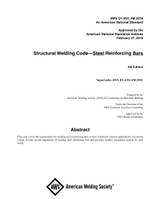

AWS D1.4/D1.4M:2018-AMD1 Structural Welding Code—Steel Reinforcing Bars
AWS D1.4/D1.4M:2018-AMD1 8th Edition covers steel reinforcing bar welding, welded-joint design, WPS qualification, workmanship and inspection.
Wrong edition, wrong file, or a file that won’t open? We replace or refund — contact us within 7 days.
Buy now is for one copy. Buying for a team? Get a quote
About this publication
Product Description
AWS D1.4/D1.4M:2018-AMD1, Structural Welding Code—Steel Reinforcing Bars, Eighth Edition, provides requirements for welding steel reinforcing bars used in most reinforced concrete applications.
The Code establishes technical requirements for welded reinforcing-bar connections and provides acceptance criteria for welds used in reinforced concrete construction. It is intended for engineers, welding engineers, concrete reinforcement contractors, fabricators, inspectors, testing agencies and other professionals responsible for welded reinforcing-steel connections.
Current Edition
AWS D1.4/D1.4M:2018-AMD1 remains the current published edition as of October 2026.
The Eighth Edition supersedes AWS D1.4/D1.4M:2011 and incorporates Amendment 1 in the second printing issued in September 2020.
Scope
The Code applies to welding of:
- steel reinforcing bar to steel reinforcing bar; and
- steel reinforcing bar to carbon or low-alloy structural steel.
When AWS D1.4 is stipulated in contract documents, its applicable provisions become mandatory unless specifically modified or exempted by the Engineer or contract documents.
Reinforcing Bar Welding
Welding reinforcing steel requires considerations that differ from ordinary structural steel welding because reinforcing-bar chemistry, carbon equivalent, bar size, manufacturing process and mechanical properties can significantly affect weldability.
AWS D1.4 provides a dedicated framework for controlling these factors so welded reinforcing-bar connections can achieve the strength and quality assumed by the structural design.
Reinforced Concrete Applications
The Code is intended primarily for reinforcing-steel connections used in reinforced concrete construction.
Applications can include welded bar splices, reinforcing-bar connections to structural steel, anchorage details, precast concrete connections and other welded reinforcing-steel assemblies within the Code scope.
2018 Eighth Edition
The 2018 edition substantially reorganized and updated the previous 2011 Code.
Major changes included new normative-reference and terminology clauses, revised welded-joint design provisions, expanded lap-joint requirements, updated workmanship requirements, addition of GTAW as a prequalified welding process, updated filler-metal specifications, revised qualification provisions and a new Commentary.
Clause 1 — General Requirements
Clause 1 establishes the general scope and application of the Code.
The 2018 edition restructures this clause to provide updated safety and health information, incorporate additional materials and establish the welding processes permitted under the Code.
GTAW Added as a Prequalified Process
A significant Eighth Edition change is recognition of Gas Tungsten Arc Welding, or GTAW, as a prequalified welding process within applicable Code limitations.
This change required corresponding revisions to filler-metal requirements, procedure qualification provisions and sample forms.
Clause 2 — Normative References
The 2018 edition introduces a dedicated Clause 2 listing normative references required for application of AWS D1.4.
This replaces material formerly contained in Subclause 1.9 of the 2011 edition and brings the Code structure into closer alignment with other AWS D1 structural welding codes.
Clause 3 — Terms and Definitions
A dedicated Terms and Definitions clause was introduced in the Eighth Edition.
It provides terminology specifically applicable to steel reinforcing-bar welding and replaces the definitions previously located within the opening clause of the 2011 edition.
Clause 4 — Design of Welded Joints
Clause 4 establishes requirements governing design of welded reinforcing-bar joints.
The 2018 edition removes the former base-metal stress and allowable weld-stress provisions and replaces them with updated design requirements for welded joints.
Design Strength and Allowable Strength
New Table 4.1 establishes design strength and allowable strength of welded joints.
This provides a clearer basis for structural engineers designing welded reinforcing-bar connections using applicable strength-design or allowable-strength approaches.
Effective Weld Areas and Sizes
The design provisions address effective weld areas, lengths, throats and sizes used when calculating welded-joint capacity.
Accurate determination of effective weld dimensions is important because weld geometry can directly control the capacity of a reinforcing-bar connection.
Other Limit States
The Code requires consideration of applicable limit states beyond simple weld-metal strength.
Reinforcing-bar connections must be detailed so the complete connection, including the reinforcing steel and any attached structural-steel component, provides the required structural performance.
Clause 5 — Structural Details
Clause 5 establishes structural detailing requirements for welded reinforcing-bar connections.
The Code addresses transitions between bar sizes, joint types, direct and indirect butt joints, lap joints, anchorage connections and interconnections of precast members.
Direct Butt Joints
Direct butt joints connect reinforcing bars end-to-end through a welded joint.
The Code provides requirements for applicable complete-joint-penetration configurations and associated joint preparation and qualification.
Indirect Butt Joints
Indirect butt joints transfer force between reinforcing bars through an intermediate structural component or connection arrangement.
AWS D1.4 includes specific joint details and qualification provisions for these connections.
Lap Joints
The Eighth Edition expands requirements for welded lap joints.
New material addresses bar-diameter ranges, effects of eccentricity and lap joints used as part of an anchorage.
Eccentricity in Lap Joints
Lap-welded reinforcing bars can create eccentric force paths because the connected bar centerlines do not necessarily coincide.
The 2018 edition explicitly addresses these effects as part of the structural detailing requirements.
Lap Joints in Anchorage
The Code includes dedicated provisions for lap joints used in anchorage arrangements.
These requirements coordinate weld detailing with the transfer of reinforcing-bar force into the anchorage or attached structural component.
Precast Member Connections
AWS D1.4 includes provisions for interconnection of precast concrete members where reinforcing-steel or associated steel components are joined by welding.
These provisions are relevant to precast structural systems in which welded reinforcing details form part of the load-transfer mechanism between individual units.
Clause 6 — Workmanship
Clause 6 establishes workmanship requirements for preparing and producing welded reinforcing-bar joints.
The 2018 edition adds requirements involving foreign materials and coatings and revises provisions governing weld size and acceptable weld profiles.
Foreign Materials and Coatings
Reinforcing bars can contain coatings, rust, scale, concrete residue, oil or other materials capable of affecting weld quality.
The Eighth Edition adds specific content addressing foreign materials and coatings so welding is performed on surfaces suitable for producing acceptable fusion and weld quality.
Weld Profiles
Figure 6.2 was extensively revised for the 2018 edition to provide updated schedules and illustrations for weld profiles.
These requirements assist welders and inspectors in identifying acceptable and unacceptable finished weld geometry.
Clause 7 — Technique
Clause 7 contains technical requirements governing welding methods and production technique.
Topics include filler metals, electrodes, preheat and interpass temperature and other welding variables necessary for reliable reinforcing-bar welding.
GTAW Electrodes and Filler Metals
The addition of GTAW as a prequalified process required new provisions addressing GTAW electrodes and filler metals.
The selected consumable must be compatible with the reinforcing-bar material, attached structural steel and applicable strength requirements.
AWS A5 Filler Metal Specifications
Table 7.1 was revised to include additional AWS A5-series filler-metal specifications.
AWS specifically identifies AWS A5.36 as a notable addition in the 2018 edition.
Preheat and Interpass Temperature
Preheat is particularly important when welding reinforcing steel because the chemistry and carbon equivalent of the bar influence susceptibility to hydrogen-assisted cracking.
AWS D1.4 provides minimum preheat and interpass-temperature requirements based on applicable material and welding conditions.
Carbon Equivalent
Evaluation of reinforcing-bar chemistry and carbon equivalent is a fundamental part of determining appropriate welding conditions.
The use of carbon equivalent in reinforcing-bar welding has been part of the AWS reinforcing-steel welding framework for decades and remains important for establishing preheat requirements and assessing weldability.
Low-hydrogen Welding Practice
Where required by the Code, low-hydrogen electrodes and controlled handling practices help reduce the risk of hydrogen-assisted cracking.
The standard includes requirements affecting electrode storage, atmospheric exposure and use.
Clause 8 — Qualification
Clause 8 establishes requirements for qualification of Welding Procedure Specifications and welding personnel.
The 2018 edition revises procedure qualification provisions to account for GTAW, reinforcing-bar diameter groups and updated filler-metal classifications.
Welding Procedure Specifications
A Welding Procedure Specification defines the variables and instructions used to make production welds.
Where the procedure is not prequalified, qualification testing establishes whether the procedure can produce joints satisfying the Code requirements.
Procedure Qualification Records
A Procedure Qualification Record documents the actual variables and test results used during procedure qualification.
The PQR provides the technical basis supporting the qualified WPS.
Bar Diameter Groups
The Code groups reinforcing bars by diameter for procedure qualification purposes.
The amendment to Table 8.2 explicitly identifies Group A as bar numbers 6 and smaller, Group B as bar numbers 7 through 11 and Group C as bar numbers 14 and 18.
Procedure Qualification Tests
Table 8.3 defines the number and type of tests required for applicable WPS qualification test configurations.
Qualification configurations include direct butt joints, T-joints and indirect butt joints, with tension and macroetch testing specified for the applicable test assemblies.
Amendment 1
The current AMD1 publication incorporates Amendment 1 into the Eighth Edition.
The amendment revises qualification information in Tables 8.2 and 8.3 and modifies associated qualification figures.
Amendment 1 — Table 8.2
Table 8.2 addresses PQR essential-variable changes requiring WPS requalification for SMAW, GMAW, GTAW and FCAW.
The amended table identifies changes involving welding position, joint type, backing and bar-diameter group as applicable essential variables requiring requalification.
Amendment 1 — Table 8.3
Table 8.3 addresses the number and type of tests required for WPS qualification.
The amended table defines qualifying test arrangements and the joint types qualified by direct butt, T-joint and indirect butt qualification specimens.
Amendment 1 — Qualification Figures
Amendment 1 also revises Figures 8.5(A), 8.5(B) and 8.6(A).
The amendment deletes wording that previously stated that the groove used for the qualification specimen had to conform to the groove being qualified, leaving the depicted groove configuration as an illustration rather than imposing that specific configuration requirement.
Second Printing
The amended publication is identified as the Second Printing, September 2020.
AWS announced that the amendment and identified errata would be incorporated into this reprinting, with the resulting document designated AWS D1.4/D1.4M:2018-AMD1.
Clause 9 — Inspection
Clause 9 establishes inspection requirements and acceptance criteria for welded reinforcing-bar connections.
Inspection supports verification that welding procedures, welding personnel, workmanship and completed welds satisfy applicable Code and contract requirements.
Radiographic Examination
A major 2018 inspection change requires radiographic methodology to conform to ASTM E94.
This provides a recognized technical basis for radiographic examination procedures when RT is required for reinforcing-bar welds.
Visual Inspection
Visual inspection is used to evaluate workmanship, weld dimensions, profiles and visible discontinuities.
The Code's acceptance criteria establish whether completed welds are suitable for acceptance or require repair or further evaluation.
Qualification of Welders
AWS D1.4 contains performance qualification requirements for welders making reinforcing-bar welds.
Qualification demonstrates that welding personnel can produce acceptable joints using the applicable process, position, bar size and joint configuration.
Sample Welding Forms
Informative Annex A includes sample forms for documenting Welding Procedure Specifications, Procedure Qualification Records and welder qualification.
The Eighth Edition updated these sample forms to include GTAW.
Nominal Reinforcing Bar Dimensions
Informative Annex B provides nominal dimensions for ASTM standard reinforcing bars.
This reference assists users in relating reinforcing-bar numbers to nominal diameter and related dimensional information used throughout the Code.
Temperature–Moisture Content Charts
Informative Annex C provides temperature and moisture-content information relevant to welding conditions and environmental considerations.
The annex is informative and supplements rather than replaces mandatory Code requirements.
Commentary — New in the Eighth Edition
The 2018 edition adds a Commentary for the first time.
The Commentary provides background and explanatory information intended to help engineers, inspectors and fabricators understand the technical intent of selected requirements.
Relationship to AWS D1.1
AWS D1.1 governs structural welding of commonly used carbon and low-alloy constructional steels, while AWS D1.4 specifically addresses reinforcing-bar welding.
When reinforcing bar is welded to structural steel, application of the two standards must be coordinated according to the contract documents and applicable Code provisions.
Relationship to Reinforced Concrete Codes
AWS D1.4 is frequently referenced by reinforced concrete construction requirements when reinforcing bars are welded.
The structural concrete code establishes the overall reinforced concrete design requirements, while AWS D1.4 supplies the specialized welding requirements for applicable reinforcing-bar connections.
ASTM Reinforcing Bar Specifications
The Code is used with applicable ASTM reinforcing-bar material specifications.
Material identification is particularly important because weldability and required preheat depend on reinforcing-bar chemistry, grade and manufacturing specification.
Welding ASTM A706 Reinforcing Bar
ASTM A706/A706M reinforcing steel is specifically produced with controlled chemical composition and welding applications in mind.
Even with weldable reinforcing steel, AWS D1.4 procedure, qualification, preheat, filler-metal and workmanship requirements remain applicable when the Code is invoked.
Welding Other Reinforcing Bars
Reinforcing bars manufactured to specifications other than ASTM A706 can require closer evaluation of chemistry and carbon equivalent before welding.
Mill test reports and material identification can therefore be critical to establishing suitable welding procedures.
Field Welding
Reinforcing-bar welding frequently occurs under field conditions rather than in a controlled fabrication shop.
Field operations must account for environmental conditions, access, bar preparation, cleanliness, preheat control, electrode handling and inspection.
Precast Construction
The Code includes structural details relevant to welded interconnections of precast members.
This allows reinforcing-bar welding requirements to be coordinated with precast concrete connection systems where welded reinforcement or steel connection components transfer structural loads.
Major Changes From AWS D1.4/D1.4M:2011
- Clause 1 restructured with updated safety and health information;
- additional materials incorporated;
- GTAW permitted as a prequalified welding process;
- new dedicated Normative References clause;
- new dedicated Terms and Definitions clause;
- design provisions reorganized;
- new Table 4.1 covering design strength and allowable strength of welded joints;
- expanded lap-joint requirements;
- new treatment of bar diameter range and joint eccentricity;
- new requirements for lap joints in anchorage applications;
- new workmanship provisions for foreign materials and coatings;
- revised weld-size requirements;
- revised weld-profile schedules;
- new GTAW electrode and filler-metal provisions;
- additional AWS A5 filler-metal specifications including AWS A5.36;
- qualification provisions revised for GTAW and reinforcing-bar diameter groups;
- new Figure 8.8;
- radiographic methodology coordinated with ASTM E94;
- sample forms revised to include GTAW;
- new Commentary included with the Code;
- Amendment 1 revisions to Tables 8.2 and 8.3 and associated qualification figures.
Who Should Use AWS D1.4/D1.4M:2018-AMD1
- structural engineers;
- reinforced concrete engineers;
- welding engineers;
- reinforcing steel fabricators;
- rebar contractors and installers;
- precast concrete manufacturers;
- welding supervisors;
- welders and welding operators;
- AWS Certified Welding Inspectors;
- special inspectors;
- quality assurance and quality control personnel;
- WPS and PQR administrators;
- construction testing agencies;
- general contractors;
- engineering and construction firms.
Product Features
- current AWS D1.4 reinforcing-bar welding code;
- Eighth Edition;
- second printing, September 2020;
- incorporates Amendment 1;
- 104 pages in current AMD1 distribution metadata;
- ANSI approved;
- covers reinforcing bar to reinforcing bar welding;
- covers reinforcing bar to carbon or low-alloy structural steel;
- covers design of welded joints;
- covers direct and indirect butt joints;
- covers lap joints and anchorage connections;
- covers precast-member interconnections;
- covers workmanship and weld profiles;
- covers filler metals and preheat;
- includes GTAW as a prequalified process;
- covers WPS and PQR qualification;
- covers welder performance qualification;
- covers inspection and radiographic examination;
- includes sample welding forms;
- includes Commentary.
Product Details
- Standard: AWS D1.4/D1.4M:2018-AMD1
- Title: Structural Welding Code—Steel Reinforcing Bars
- Edition: Eighth Edition
- Publisher: American Welding Society
- Original Publication: 2018
- Original ANSI Approval: February 27, 2018
- Amendment 1 ANSI Approval: July 14, 2020
- AWS Amendment Notice: September 7, 2020
- Printing: Second Printing, September 2020
- Print ISBN: 978-0-87171-953-9
- Page Count: 104
- Previous Edition: AWS D1.4/D1.4M:2011
- Language: English
- Prepared By: AWS D1 Committee on Structural Welding
- Publication Type: Structural Welding Code
Edition Status Note
AWS D1.4/D1.4M:2018-AMD1 remains the current AWS Structural Welding Code—Steel Reinforcing Bars as of October 2026. The September 2020 second printing incorporates Amendment 1, including revisions to qualification Tables 8.2 and 8.3 and associated qualification figures. The edition supersedes AWS D1.4/D1.4M:2011.