
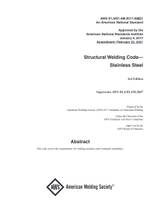

AWS D1.6/D1.6M:2017-AMD1 Structural Welding Code—Stainless Steel
AWS D1.6/D1.6M:2017-AMD1 Third Edition covers structural stainless steel welding, WPSs, qualification, fabrication, inspection and stud welding.
Wrong edition, wrong file, or a file that won’t open? We replace or refund — contact us within 7 days.
Buy now is for one copy. Buying for a team? Get a quote
About this publication
Product Description
AWS D1.6/D1.6M:2017-AMD1, Structural Welding Code—Stainless Steel, Third Edition, establishes requirements for welding structural assemblies and weldments where at least one of the materials being joined is stainless steel.
The current publication incorporates Amendment 1 approved February 22, 2021 and is identified by AWS as the second printing, April 2021.
AWS D1.6 provides a structural welding framework developed specifically for stainless steel rather than requiring engineers, fabricators and inspectors to rely solely on structural welding provisions written primarily for carbon and low-alloy steel.
Current Edition
AWS continues to identify AWS D1.6/D1.6M:2017-AMD1 as its current Structural Welding Code—Stainless Steel publication.
The Third Edition supersedes AWS D1.6/D1.6M:2007. The first edition of AWS D1.6 was published in 1999.
Third Edition
The 2017 Third Edition represents a substantial reorganization and technical update of the previous 2007 Code.
Important changes included new clauses for normative references and terminology, major restructuring of design, prequalification and fabrication provisions, revised qualification rules, reorganized inspection requirements, updated stud-welding provisions and new prequalified stainless steel joint details.
Scope
The Code contains welding requirements for the fabrication, assembly and erection of welded structures and weldments subject to design stress where at least one material being joined is stainless steel.
The Code is intended for base metals having a minimum thickness of 1/16 in [1.5 mm] or 16 gage.
It is intended to be used together with any complementary code or specification governing the design or construction of the stainless steel structure or weldment.
Pressure Vessels and Pressure Piping
AWS D1.6 specifically addresses structural stainless steel welding and does not serve as the governing welding code for stainless steel pressure vessels or pressure piping.
Pressure-containing applications are subject to the applicable pressure-vessel or piping construction code and its welding requirements.
Why a Dedicated Stainless Steel Structural Welding Code Is Needed
Stainless steels differ from conventional structural carbon steels in metallurgy, thermal behavior, corrosion performance, filler-metal selection and welding practice.
AWS developed D1.6 because the carbon and low-alloy structural steel provisions of AWS D1.1 do not explicitly address all of the material and fabrication considerations unique to stainless steel wrought and cast shapes and plate.
Code Organization
The mandatory body of AWS D1.6 is organized into nine principal clauses:
- Clause 1 — General Requirements
- Clause 2 — Normative References
- Clause 3 — Terms and Definitions
- Clause 4 — Design of Welded Connections
- Clause 5 — Prequalification
- Clause 6 — Qualification
- Clause 7 — Fabrication
- Clause 8 — Inspection
- Clause 9 — Stud Welding
Clause 1 — General Requirements
Clause 1 establishes the scope, units of measurement, safety information, Code limitations, responsibilities, approvals and welding-symbol requirements.
The Third Edition significantly restructured this clause to provide a clearer overview of the Code and to add explicit safety, health and limitation provisions.
Responsibilities
The Code establishes responsibilities for the Engineer, Contractor and inspection personnel involved in structural stainless steel welding.
When AWS D1.6 is invoked by contract documents, its applicable provisions become part of the contractual technical requirements unless specifically modified or exempted by the Engineer or contract documents.
Welding Symbols
AWS D1.6 coordinates welding-symbol usage with AWS A2.4.
Engineering drawings and contract documents can therefore communicate stainless steel welding requirements using the standardized AWS symbolic system while D1.6 provides the technical welding requirements governing fabrication and inspection.
Clause 2 — Normative References
Clause 2 is a dedicated list of standards and technical documents required for implementation of AWS D1.6.
This clause was introduced in the Third Edition, replacing material that had previously appeared in Subclause 1.9 and an annex.
Clause 3 — Terms and Definitions
Clause 3 provides terminology specific to AWS D1.6.
The dedicated terminology clause was added in the Third Edition to separate Code-specific definitions from the broader AWS welding terminology contained in AWS A3.0.
Clause 4 — Design of Welded Connections
Clause 4 establishes requirements for structural design of welded stainless steel connections.
The Third Edition reorganized this material to better parallel AWS D1.1 where technically appropriate while retaining provisions necessary for stainless steel structural welding.
Coordination With Structural Stainless Steel Design
The Third Edition added reference to AISC/SCI Design Guide 27, Structural Stainless Steel.
AWS D1.6 provides welding-specific requirements, while structural design documents and complementary specifications establish overall structural strength, member design and connection requirements.
Base Metals
Structural stainless steel welding requires proper identification of base-metal alloy and product form.
Base-metal composition and metallurgical family can influence weldability, filler-metal selection, heat input, distortion and corrosion performance.
Austenitic Stainless Steels
Austenitic stainless steels are widely used because of their corrosion resistance, formability and weldability.
Welding procedures must nevertheless account for filler-metal compatibility, thermal expansion, distortion, sensitization considerations and service requirements.
Ferritic and Martensitic Stainless Steels
Ferritic and martensitic stainless steels have welding characteristics that can differ significantly from common austenitic grades.
Material-specific considerations can include preheat, interpass temperature, cooling rate, hardness and filler-metal selection.
Duplex Stainless Steels
Duplex stainless steels combine austenitic and ferritic microstructures and can provide high strength together with useful corrosion resistance.
Welding procedures for duplex alloys require appropriate control of filler metal, heat input and thermal history to maintain suitable weld and heat-affected-zone properties.
Clause 5 — Prequalification
Clause 5 establishes requirements under which a Welding Procedure Specification can be accepted as prequalified without procedure qualification testing.
Prequalification requires compliance with applicable limitations on welding process, base metal, filler metal, joint configuration, welding position, preheat and interpass temperature and other variables.
Prequalified Welding Procedure Specifications
A prequalified WPS, or PWPS, can be used without a separate procedure qualification test only when every applicable Code requirement for prequalification is satisfied.
Procedures falling outside the prequalification limits must be qualified by testing under Clause 6 or another qualification route permitted by the Code.
2017 Prequalification Reorganization
The Third Edition significantly reorganized Clause 5 to separate prequalification requirements from fabrication requirements that had been intermixed in the previous edition.
The restructuring follows the broader AWS D1 Code format and makes the sequence of requirements easier to apply.
Flare-V and Flare-Bevel Groove Welds
The Third Edition added prequalified joint details for flare-V-groove and flare-bevel-groove welds.
These additions addressed industry needs and prior Code interpretations and brought D1.6 closer to the organization used in AWS D1.1.
Fillet Weld Requirements
Clause 5 contains prequalification requirements for fillet welds, including applicable joint and procedure limitations.
Fillet welds are widely used in structural stainless steel fabrication for lap, tee and corner connections.
Plug and Slot Welds
The prequalification provisions include requirements for plug and slot weld configurations.
These welds can be used for transferring load between overlapping components or for specific connection details where conventional fillet or groove weld arrangements are not suitable.
Partial Joint Penetration Groove Welds
The Code contains requirements for prequalified partial joint penetration groove welds.
Design and fabrication must ensure that the effective weld size and joint geometry correspond to the assumptions used by the structural designer.
Complete Joint Penetration Groove Welds
Complete joint penetration groove welds are designed to develop the applicable strength through the full thickness of the joint.
AWS D1.6 includes prequalified joint details and fabrication conditions applicable to qualifying stainless steel CJP groove welds.
Tubular Connections
Clause 5 also addresses applicable prequalification requirements for tubular connections.
Tubular stainless steel structures can present unique fit-up, access and joint-geometry challenges requiring appropriate weld-detail selection.
Amendment 1 — February 22, 2021
Amendment 1 modifies Subclause 5.7.1 by deleting former item (4).
The deleted requirement had stated that prequalified GMAW in spray transfer mode was limited to welds in the flat position and fillet welds in the horizontal position.
Removing this restriction is the substantive change incorporated by Amendment 1 into the current AMD1 publication.
Second Printing — April 2021
AWS identifies the current amended document as the second printing, April 2021.
The publication designation is AWS D1.6/D1.6M:2017-AMD1 and the title page identifies the Amendment 1 approval date as February 22, 2021.
Clause 6 — Qualification
Clause 6 establishes requirements for qualification of Welding Procedure Specifications and welding personnel by testing.
The clause addresses procedure qualification, essential variables, base-metal qualification, thickness ranges, groove welds, fillet welds, mechanical testing, visual examination, retests and performance qualification.
Major 2017 Qualification Revision
The Third Edition substantially rewrote the qualification clause.
One of its most important changes is that it permits qualification directly to AWS B2.1/B2.1M, Specification for Welding Procedure and Performance Qualification, without requiring specific Engineer approval, while retaining the option of qualification directly under D1.6.
Procedure Qualification
When a WPS is not prequalified, testing can be required to demonstrate that the welding procedure produces acceptable weld properties.
Procedure Qualification Records document the actual variables and test results used to support the qualified WPS.
Essential Variables
Essential variables establish the limits within which a qualified procedure can be changed without additional qualification.
Changes outside the qualified range can require additional testing before the revised procedure is used in production.
Base Metal Qualification
Clause 6 defines how procedure tests qualify base-metal groups and applicable ranges.
This helps ensure that procedure qualification reflects the metallurgical and welding characteristics of the stainless steel being joined.
Qualification Thickness Limitations
Procedure and performance qualification testing establishes permitted material-thickness ranges.
Qualification ranges help prevent test results obtained on one thickness from being applied without limit to substantially different joint conditions.
Groove Weld Qualification
The Code establishes groove-weld procedure and performance qualification requirements.
Applicable tests can include visual examination, mechanical tests and other evaluations necessary to demonstrate weld soundness and required properties.
Fillet Weld Qualification
Fillet-weld qualification provisions address situations where qualification specifically for fillet-weld production is required.
The Third Edition also contains an alternate fillet-weld WPS qualification route.
Mechanical Testing
Procedure qualification can require mechanical testing of test weldments.
Test requirements and acceptance criteria depend on the type of qualification and applicable welding procedure.
Performance Qualification
Performance qualification establishes the ability of welders and welding operators to produce acceptable welds within defined ranges of variables.
The Code distinguishes procedure qualification from personnel performance qualification because demonstrating a sound procedure does not by itself demonstrate the ability of an individual welding operator to execute it correctly.
Weld Cladding
Clause 6 includes qualification provisions applicable to weld cladding.
Cladding can be used to provide corrosion-resistant surfaces or other performance characteristics different from the underlying structural base metal.
Clause 7 — Fabrication
Clause 7 establishes fabrication, assembly and erection requirements for welded stainless steel structures governed by AWS D1.6.
It addresses base metals, welding consumables, preparation, repairs, assembly, joint tolerances, backing, preheat and interpass temperatures, welding environment, welding procedures, tack welds, distortion, welding technique, arc strikes, cleaning and weld repairs.
Base Metal Preparation
Surface condition and preparation can materially affect stainless steel weld quality and corrosion performance.
Clause 7 addresses mill-induced discontinuities, cleaning and surface preparation before welding.
Stainless Steel Cleanliness
Stainless steel fabrication requires care to avoid contamination from carbon steel particles, inappropriate tools, grease, dirt or other foreign material.
Contamination can affect surface appearance and, in some environments, corrosion resistance.
Welding Consumables
Welding consumables and electrodes must be compatible with the base metal, welding process and specified service requirements.
Filler-metal selection can influence strength, corrosion behavior, ferrite content, cracking susceptibility and final weld properties.
Preheat and Interpass Temperature
The Code contains preheat and interpass-temperature requirements applicable to qualifying stainless steel welding procedures.
Temperature control helps manage metallurgical behavior, cracking susceptibility and heat input during fabrication.
Welding Environment
Structural welding must be performed under environmental conditions that permit production of acceptable welds.
Protection from wind, moisture, contamination and other adverse conditions can be necessary depending on the welding process and work location.
Distortion Control
Stainless steels generally have thermal-expansion characteristics that can make distortion control particularly important during welding.
Fabrication planning, sequence, restraint and heat input can all influence the final dimensional condition of the structure.
Tack Welds and Temporary Welds
Tack and temporary welds are subject to controls because they can become stress concentrations or sources of unacceptable discontinuities if improperly made or removed.
The Code establishes applicable workmanship and repair requirements for these welds.
Arc Strikes
Arc strikes outside the intended weld area can alter the stainless steel surface and create local metallurgical or surface-quality concerns.
AWS D1.6 includes requirements addressing arc strikes and appropriate corrective action.
Weld Cleaning
Cleaning completed stainless steel welds is important for workmanship and, depending on service, corrosion performance.
Fabrication procedures should avoid contamination and use cleaning methods appropriate to the stainless steel alloy and specified finish.
Weld Repairs
Unacceptable welds or base-metal conditions can require repair.
The repair method must be compatible with the Code, qualified welding procedures and the structural and service requirements of the component.
Clause 8 — Inspection
Clause 8 establishes inspector qualifications and responsibilities, acceptance criteria for discontinuities and nondestructive testing procedures.
The Third Edition reorganized inspection material so visual Inspector and NDE personnel qualification requirements are grouped together for easier use.
Table 8.1 — Visual Inspection Acceptance Criteria
A major 2017 change moved visual inspection acceptance criteria from scattered text requirements into a dedicated Table 8.1, following the general organizational approach used by AWS D1.1.
This makes production-weld acceptance criteria easier for inspectors and fabrication personnel to locate and apply.
Visual Inspection
Visual inspection is the primary examination method applied to completed structural welds.
Inspectors evaluate weld dimensions, profile, cracks, fusion, undercut, overlap and other applicable surface conditions against the Code's acceptance criteria.
Nondestructive Testing
Where required by the Code or contract documents, nondestructive testing supplements visual inspection.
Applicable methods can be used to identify surface or internal discontinuities that cannot be adequately evaluated by visual examination alone.
NDE Personnel Qualification
The 2017 edition consolidated requirements affecting visual inspectors and NDE personnel qualification.
This makes personnel qualification and inspection responsibilities easier to administer within quality-control and quality-assurance programs.
Ultrasonic Testing
The Code contains provisions and supporting annex material related to ultrasonic examination where required.
AWS also makes associated D1.6 forms available for ultrasonic unit certification and qualification documentation.
Radiographic Examination
Radiographic examination can be applied where specified to evaluate internal weld discontinuities.
Examination technique and acceptance must conform to the applicable D1.6 provisions and contract requirements.
Clause 9 — Stud Welding
Clause 9 establishes requirements for welding studs to structures where at least one material being joined is stainless steel.
The Third Edition revised the stud-welding clause to incorporate improvements previously developed in AWS D1.1 and the AASHTO/AWS Bridge Welding Code.
Stud Base Qualification
Manufacturer stud-base qualification requirements that had appeared in a separate annex in the prior edition were moved directly into Clause 9.
This places the qualification requirements closer to the primary stud-welding provisions that depend on them.
Normative and Informative Annexes
AWS D1.6 includes supporting annexes containing mandatory and informational material associated with Code implementation.
The Third Edition reorganized annex content and moved some subjects into the primary clauses where the committee determined they were more appropriately located.
Annexes A and B
Annexes A and B were revised to better parallel AWS D1.1 and to correct terminology for fillet-weld size in accordance with AWS A3.0 and AWS A2.4.
Informative References
A new informative-reference annex was added in the Third Edition.
This gives users additional technical resources without making those references mandatory Code requirements unless separately invoked.
Welding Forms
AWS provides downloadable forms associated with the current D1.6 edition.
These include forms for Welding Procedure Specifications, Procedure Qualification Records, welder and welding-operator qualification, stud-welding qualification and ultrasonic equipment certification.
Relationship to AWS D1.1
AWS D1.1 governs structural welding of commonly used carbon and low-alloy constructional steels.
AWS D1.6 follows a broadly similar D1 structural welding framework but is specifically adapted for stainless steel metallurgy, materials and fabrication requirements.
Relationship to AWS B2.1
AWS B2.1/B2.1M establishes general requirements for welding procedure and performance qualification.
The Third Edition of D1.6 expressly permits direct qualification to AWS B2.1/B2.1M without requiring Engineer approval, while also retaining D1.6's own qualification pathway.
Relationship to AWS A3.0
AWS A3.0 provides standardized welding terminology and definitions used throughout AWS publications.
D1.6 supplements those general terms with definitions specific to structural stainless steel welding.
Relationship to AWS A2.4
AWS A2.4 establishes standard symbols for welding, brazing and nondestructive examination.
D1.6 uses that symbolic framework for engineering and fabrication documentation while supplying the technical structural welding requirements.
Relationship to Stainless Steel Structural Design Standards
AWS D1.6 is a welding code rather than a complete structural design specification.
It is intended to be used with the applicable structural design code, project specification and other documents establishing member strength, loads and connection design.
Corrosion Considerations
Stainless steel is frequently selected for corrosion resistance, but welding can influence local metallurgy, surface condition and corrosion behavior.
Correct alloy and filler-metal selection, heat input and postweld surface condition can therefore matter for service performance in addition to structural strength.
Dissimilar Metal Welding
Some structures require stainless steel to be joined to other qualifying metals.
Where such joints fall within the Code scope, the welding procedure must address material compatibility, filler-metal selection and the structural and service requirements of the completed connection.
Field Welding
AWS D1.6 can be applied to both shop and field fabrication where structural stainless steel welding is performed within the Code scope.
Field welding requires particular attention to environmental protection, surface cleanliness, fit-up and inspection because working conditions can differ substantially from controlled shop fabrication.
Contract Documents
Contract documents play an important role in invoking AWS D1.6 and specifying project-specific requirements.
The Engineer can impose additional requirements or modify Code provisions where permitted and appropriate to the design and service conditions.
Current Amendment and Errata Status
The current AWS bookstore and D1 Committee resources identify AWS D1.6/D1.6M:2017-AMD1 as the active edition and identify Amendment 1 as incorporated in the second printing.
AWS also maintains an errata resource for D1.6. Because this product title specifically states incorporation of Amendment 1 but does not state that every separately issued erratum is incorporated, users should verify the revision status of the specific copy being used for controlled engineering work.
Who Should Use AWS D1.6/D1.6M:2017-AMD1
- structural engineers;
- welding engineers;
- stainless steel fabricators;
- welding supervisors;
- welders and welding operators;
- AWS Certified Welding Inspectors;
- special inspectors;
- quality assurance and quality control personnel;
- WPS and PQR administrators;
- nondestructive examination personnel;
- steel detailers and drafting professionals;
- architectural stainless steel fabricators;
- contractors and erectors;
- engineering and fabrication firms;
- technical schools and welding training programs.
Major Changes From AWS D1.6/D1.6M:2007
- Clause 1 restructured with new safety, health and Code limitation information;
- new Clause 2 for normative references;
- new Clause 3 for Code-specific terms and definitions;
- design requirements reorganized to more closely parallel AWS D1.1 where appropriate;
- AISC/SCI Design Guide 27 added as a structural stainless steel design reference;
- prequalification and fabrication requirements reorganized into the appropriate clauses;
- new prequalified flare-V and flare-bevel groove weld details;
- qualification clause substantially rewritten;
- direct qualification to AWS B2.1/B2.1M permitted without Engineer approval;
- visual Inspector and NDE personnel qualification requirements consolidated;
- visual inspection acceptance criteria moved to new Table 8.1;
- stud-welding requirements updated;
- manufacturer stud-base qualification requirements moved into Clause 9;
- annex terminology revised for consistency with AWS A3.0 and AWS A2.4;
- new informative-reference annex;
- Amendment 1 deletes former Subclause 5.7.1(4) restricting prequalified GMAW spray transfer by welding position.
Product Features
- current AWS D1.6 structural stainless steel welding code;
- Third Edition;
- second printing, April 2021;
- incorporates Amendment 1 approved February 22, 2021;
- 346 pages;
- ANSI approved;
- covers structural stainless steel weldments;
- applies where at least one material being joined is stainless steel;
- minimum base-metal thickness generally 1/16 in [1.5 mm] or 16 gage;
- covers welded connection design;
- covers prequalified WPSs;
- covers procedure qualification;
- covers welder and welding-operator qualification;
- covers stainless steel fabrication and workmanship;
- covers visual inspection and NDT;
- covers stud welding;
- includes flare-V and flare-bevel groove prequalified details;
- permits applicable AWS B2.1/B2.1M qualification;
- includes visual acceptance criteria in Table 8.1;
- includes AWS welding and qualification forms;
- supersedes AWS D1.6/D1.6M:2007.
Product Details
- Standard: AWS D1.6/D1.6M:2017-AMD1
- Title: Structural Welding Code—Stainless Steel
- Edition: Third Edition
- Publisher: American Welding Society
- Original Publication Year: 2017
- ANSI Approval: January 9, 2017
- Amendment 1: February 22, 2021
- Printing: Second Printing, April 2021
- Print ISBN: 978-0-87171-906-5
- Page Count: 346
- Previous Edition: AWS D1.6/D1.6M:2007
- Prepared By: AWS D1 Committee on Structural Welding
- Specialized Committee: AWS D1K Subcommittee on Stainless Steel
- Language: English
- Publication Type: Structural Welding Code
Edition Status Note
AWS D1.6/D1.6M:2017-AMD1 remains the current edition as of October 2026. Amendment 1 was approved February 22, 2021 and incorporated into the second printing dated April 2021. The amendment deletes former Subclause 5.7.1(4), removing the stated position limitation on prequalified GMAW spray transfer. AWS continues to list a separate errata resource for this standard; users should verify the revision status of controlled copies where formal Code compliance is required.