
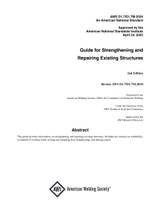

AWS D1.7/D1.7M:2024 Guide for Strengthening and Repairing Existing Structures
AWS D1.7/D1.7M:2024 covers evaluation, weldability, testing, repair design, heat straightening, fatigue enhancement and inspection.
Wrong edition, wrong file, or a file that won’t open? We replace or refund — contact us within 7 days.
Buy now is for one copy. Buying for a team? Get a quote
About this publication
Product Description
AWS D1.7/D1.7M:2024, Guide for Strengthening and Repairing Existing Structures, provides detailed engineering guidance for evaluating, strengthening and repairing existing structures. The guide is intended primarily for Engineers and Contractors responsible for developing and implementing repair plans involving existing structural members, welded connections and damaged or deficient components.
The 2024 publication is the second edition of AWS D1.7/D1.7M and extensively revises the original 2010 edition. It provides a broader and more systematic approach to existing-structure evaluation, engineering analysis, material testing, weldability assessment, repair design, heat-assisted straightening, fatigue-life enhancement, fabrication and inspection.
Scope
The guide contains information pertinent to strengthening and repairing existing structures, including welded repairs, heat-assisted straightening, fatigue improvements and related nonwelded repairs such as partial or complete member replacement.
It is intended to apply to existing structures constructed from carbon or low-alloy steel with a minimum specified yield strength of 100 ksi [690 MPa] or less, cast iron and wrought iron.
Strengthening and repair can include modifications required to satisfy new serviceability or strength requirements as well as repairs to conditions considered unsuitable for continued service.
Role of the Engineer
AWS D1.7/D1.7M places significant emphasis on the Engineer's responsibility for establishing an appropriate repair or strengthening plan. The Engineer should prepare contract documents addressing design, applicable base and weld metals, workmanship, inspection, field conditions and documentation.
Field requirements can include issues such as traffic routes, temporary support, hazards, utilities and other conditions that influence how repair work can safely and effectively be performed on an existing structure.
Relationship to AWS D1.1/D1.1M
The guide provides background information useful to Engineers responsible for addressing strengthening and repair provisions under AWS D1.1/D1.1M, Structural Welding Code—Steel, or under comparable contract requirements.
AWS D1.7/D1.7M does not replace the applicable structural welding code. Rather, it provides information that can be used to develop repair strategies and welding procedures that are then qualified and implemented in accordance with applicable AWS D1 codes and project requirements.
Guide Rather Than Prescriptive Construction Code
AWS D1.7/D1.7M is written primarily as a guide and does not attempt to provide exhaustive mandatory requirements for every strengthening or repair situation.
Mandatory language can nevertheless appear where failure to follow a particular instruction or procedure could produce an inferior, misleading or unsafe result. Users must therefore distinguish general guidance from specific provisions whose wording establishes a required action.
General Requirements
Clause 1 establishes the general framework for use of the guide. Topics include scope, limitations, approval, units of measurement and safety.
The limitations recognize that repair of existing structures is highly project dependent. The guide assists with evaluation and development of appropriate repair procedures but does not attempt to provide exhaustive coverage of every structural material, damage mechanism, loading condition or field circumstance.
Normative References
Clause 2 identifies documents referenced by the guide. These supporting standards provide technical requirements or test methods needed when applying particular evaluation, welding, testing or repair practices.
Terms and Definitions
Clause 3 establishes terminology used throughout the document. Consistent definitions are especially important in repair work because evaluation, damage characterization, strengthening, heat straightening and inspection can involve personnel from several engineering and construction disciplines.
Evaluation of Existing Structures
Clause 4 addresses evaluation of the existing structure before strengthening or repair work is designed. The evaluation process includes review of available documentation and assessment of the actual condition of the structure.
Existing structures can differ substantially from their original drawings because of prior repairs, undocumented modifications, corrosion, damage, fatigue, fabrication tolerances or changes in loading. The guide therefore emphasizes establishing the existing condition rather than assuming that historic documents perfectly represent the structure in the field.
Document Review
Clause 4.2 addresses review of available documents. Relevant information can include original drawings, specifications, material records, fabrication records, inspection reports, repair histories and other documents that help establish the structure's configuration and materials.
Document review helps the Engineer identify missing information and determine where field verification, testing or sampling may be required.
Condition Evaluation
Clause 4.3 addresses condition evaluation. Existing welds, structural members, connections and areas of damage or deterioration must be assessed so that the repair strategy reflects the actual condition of the structure.
Condition evaluation can include visual examination, dimensional measurements, nondestructive testing, material identification and other investigative techniques appropriate to the structure and suspected condition.
Analysis and Design
Clause 5 covers analysis and design associated with strengthening and repair. The Engineer must consider both the existing structural condition and the effects of the proposed repair or strengthening work.
Structural Analysis
Structural analysis is used to evaluate the existing member or system and determine the demand placed on structural elements before, during and after repair.
Analysis can be necessary to determine whether existing members have adequate residual capacity, whether temporary support is required and what strengthening or repair measures are necessary.
Engineering Analysis
Clause 5.3 addresses broader engineering analysis considerations. The guide includes information useful when evaluating stress range, fatigue behavior and other conditions affecting repair design.
S-N curves are included to support evaluation of fatigue-related behavior where cyclic loading and existing welded details must be considered.
Repair Design
Clause 5.4 addresses development of the repair design. A repair must account for existing loads, structural configuration, material properties, accessibility, sequence of operations, welding effects and the intended future service of the structure.
The objective is not merely to cover visible damage with new material but to develop a technically appropriate repair that restores or improves required structural performance.
Testing and Sampling
Clause 6 provides guidance for developing testing and sampling programs for existing structures. Testing becomes particularly important when original material records are unavailable, incomplete or questionable.
Sampling Plan
The guide addresses development of a sampling plan so that the type, location and number of samples are appropriate to the engineering information required.
Sampling should be coordinated with structural considerations because removing material from an existing member can itself affect the component and may require repair after specimens are extracted.
Nondestructive Testing
Clause 6.3 addresses nondestructive testing. NDT can be used to evaluate existing welds, locate discontinuities and obtain information concerning structural condition without removing significant amounts of material.
The appropriate NDT method depends on the material, joint configuration, type of discontinuity being investigated, accessibility and applicable acceptance requirements.
Destructive Testing
Clause 6.4 covers destructive testing and sampling where physical specimens are necessary to establish material properties or other engineering information.
Destructive testing can provide information that cannot be obtained reliably through visual examination or nondestructive methods alone, particularly when the material grade or mechanical properties of an older structure are uncertain.
Weldability
Clause 7 provides extensive guidance for evaluating the weldability of existing structural materials. Weldability can be a major concern when modifying older structures because steel composition, production method and historical material specifications can differ significantly from modern construction steels.
Effects of Alloying Elements
The guide discusses how alloying elements in steel affect weldability. Chemical composition influences hardenability, cracking susceptibility and the welding precautions that may be required during repair.
Steel Production Methods
Historical steel production methods can affect material chemistry, cleanliness, mechanical properties and welding behavior. Clause 7.3 addresses the significance of production methods when evaluating older steels for welding.
Grain Size
Grain size is addressed as another metallurgical consideration that can influence material behavior and weldability.
Carbon Equivalency
Clause 7.5 addresses carbon equivalency as a tool for assessing weldability. The guide includes recommended limits on carbon equivalent and discusses how composition can be used to evaluate potential welding concerns.
Carbon-equivalent calculations are only one part of weldability assessment. The Engineer must also consider actual material condition, thickness, restraint, hydrogen control, welding process and applicable code requirements.
Base Metal Classification
Clause 7.6 addresses classification of existing base metals. Identifying the material is fundamental to selecting appropriate welding procedures, filler metals, preheat requirements and repair techniques.
Methods to Determine Weldability
Clause 7.7 provides methods for determining weldability where available documentation or material identification is insufficient to establish the required welding approach.
Repair Techniques
Clause 8 addresses repair techniques that may be used once the existing condition, material and engineering requirements have been evaluated.
General Repair Techniques
The guide provides information concerning general repair practices and illustrates typical geometry for excavation of defective or damaged material.
Repair technique selection must account for the nature of the defect or damage, structural loading, access, material weldability and the effect of welding heat and residual stress on the existing member.
Welding Procedure Specifications
Clause 8.3 specifically addresses Welding Procedure Specifications. Repair welding should be performed using procedures appropriate to the existing material and applicable structural welding code.
For older or unidentified materials, WPS development can require additional material evaluation and weldability assessment before welding begins.
Heat-Assisted Straightening
Clause 9 contains extensive guidance on heat-assisted straightening, one of the most detailed subjects in the guide. Heat straightening uses controlled localized heating to produce predictable movement in distorted structural members.
Theory of Heat Shaping
The guide explains the basic theory behind heat shaping and the relationship between restrained thermal expansion, yielding and contraction during cooling.
Understanding these principles is essential because uncontrolled heating can damage material properties or introduce additional distortion rather than correcting the existing condition.
Fundamentals and Precautions
Clause 9.3 addresses fundamental precautions associated with heat-assisted straightening. The guide includes recommended upper temperature limits and discusses the effect of temperature on steel properties.
Heating Patterns
The document illustrates basic heating patterns used to obtain controlled movement. Patterns include localized spot heating and V-shaped arrangements applied to plates and structural shapes.
Externally Restrained Members
The guide discusses externally restrained plate and beam configurations and how restraint influences movement during heating and cooling.
Plate Straightening
Multiple figures illustrate techniques for straightening or shaping plate using spot, line and V-shaped heating patterns.
Structural Shape Straightening
The guide includes specific heating arrangements for channels, beams, angles and T sections. Different heating locations are used depending on the desired direction of movement and structural geometry.
Pipe and Round Stock
Heat-assisted procedures are also illustrated for heavy-wall pipe and round stock, including techniques for reducing diameter and correcting curvature using V-shaped and serpentine heating paths.
Fatigue Life Enhancement
Clause 10 addresses methods for improving fatigue performance of existing welded details.
Fatigue enhancement can be relevant when strengthening or rehabilitating structures subjected to significant cyclic loading, particularly where existing weld profiles or local stress concentrations reduce fatigue resistance.
Reasons for Fatigue Enhancement
The guide explains why fatigue enhancement may be considered and how local weld geometry can influence fatigue behavior.
Grinding and Weld Toe Improvement
Illustrated methods include reinforcement removal, grinding groove welds flush, weld-toe grinding and toe dressing with a burr grinder.
The figures show locations and profiles used to reduce local stress concentration at welded details where an engineered fatigue-improvement procedure is appropriate.
Fabrication
Clause 11 addresses fabrication considerations encountered while carrying out strengthening and repair work on existing structures.
Welder and Welding Operator Qualification
Repair welding requires appropriately qualified welders and welding operators in accordance with the applicable code and repair specification.
Qualification and Mockups
The guide recognizes the value of qualification and mockups where unusual repair configurations, restricted access or difficult field conditions require verification of the planned procedure before work is performed on the structure.
Coatings
Clause 11.4 addresses coatings because existing paint, protective systems and other surface materials can affect welding preparation, safety and repair execution.
Temperature Effects
Temperature effects are considered during fabrication because welding and repair operations can alter thermal conditions within an existing member and affect material response.
Hydrogen Contamination
Clause 11.6 specifically addresses hydrogen contamination. Control of diffusible hydrogen is particularly important when repairing older steels or highly restrained members susceptible to hydrogen-assisted cracking.
Distortion Control
Clause 11.7 addresses distortion control during repair fabrication. Repair sequences, welding heat, restraint and temporary support must be planned so that corrective work does not introduce unacceptable new distortion.
Inspection
Clause 12 addresses inspection of strengthening and repair work. Inspection provides confirmation that repair preparation, welding, fabrication and completed work satisfy the requirements established by the Engineer and applicable contract documents.
Nondestructive Testing Methods
Clause 12.2 discusses nondestructive testing methods applicable to repair work. NDT selection should be appropriate to the weld configuration, material, expected discontinuities and required acceptance criteria.
Inspection requirements should be established as part of the repair plan rather than improvised after welding has been completed.
Informative Annex A — References
Annex A provides informative references supporting the technical guidance in the document and directing users to additional resources on structural repair, welding, heat straightening, materials and related subjects.
Informative Annex B — Official Interpretations
Annex B explains the procedure for requesting an official AWS interpretation when clarification of the guide is required.
Related AWS Structural Welding Documents
The guide includes a list of AWS documents on structural welding. These references help users identify related welding codes and standards that may govern procedure qualification, fabrication and inspection requirements for a particular repair project.
Major 2024 Edition Development
The first AWS D1.7/D1.7M was issued in 2010. AWS states that the second edition has been extensively revised to further assist Engineers and Contractors involved in strengthening and repairing existing structures.
The second edition expands the guide into 12 principal clauses covering evaluation, engineering analysis and repair design, testing and sampling, weldability, repair techniques, heat-assisted straightening, fatigue enhancement, fabrication and inspection.
Who Should Use AWS D1.7/D1.7M:2024
- structural engineers responsible for existing structures;
- welding engineers and welding coordinators;
- bridge and infrastructure engineers;
- structural steel repair contractors;
- fabricators performing field or shop repair work;
- Certified Welding Inspectors and NDT personnel;
- owners and operators of aging structural assets;
- engineering consultants evaluating damaged or deteriorated structures;
- transportation agencies and infrastructure authorities;
- personnel developing welding repair procedures;
- professionals responsible for heat-straightening operations;
- engineers evaluating fatigue-sensitive welded details.
Why This Guide Matters
Repairing an existing welded structure is fundamentally different from designing a new one. The Engineer may have incomplete material records, undocumented modifications, uncertain weld quality, accumulated fatigue damage, corrosion, distortion or damage caused by impact, overload or fire.
AWS D1.7/D1.7M provides a structured approach for investigating those conditions before selecting a repair. It links evaluation and material testing with structural analysis, weldability assessment, repair design, controlled fabrication, heat-assisted straightening, fatigue enhancement and final inspection.
Product Features
- Second edition of AWS D1.7/D1.7M
- American National Standard
- Extensively revised from the 2010 first edition
- 96 pages
- Covers carbon and low-alloy steel up to 100 ksi [690 MPa] specified yield strength
- Includes guidance for cast iron and wrought iron structures
- Addresses document review and existing-condition evaluation
- Covers structural and engineering analysis
- Addresses repair design
- Covers sampling and material testing
- Includes nondestructive and destructive testing guidance
- Provides extensive weldability guidance
- Covers alloying elements, historical steel production and carbon equivalency
- Addresses base-metal identification and classification
- Covers general weld repair techniques and WPS development
- Provides extensive heat-assisted straightening procedures
- Includes recommended temperature limits and heating patterns
- Addresses fatigue-life enhancement
- Covers welder qualification, coatings, hydrogen and distortion control
- Includes inspection and NDT guidance
Product Details
- Standard: AWS D1.7/D1.7M:2024
- Title: Guide for Strengthening and Repairing Existing Structures
- Publisher: American Welding Society
- Edition: 2nd Edition
- Publication Year: 2024
- Print ISBN: 978-1-64322-259-2
- Page Count: 96
- ANSI Status: American National Standard
- ANSI Approval Date: April 24, 2023
- Technical Committee: AWS D1 Committee on Structural Welding
- Specialist Subcommittee: AWS D1F Subcommittee on Strengthening and Repair
- Previous Edition: AWS D1.7/D1.7M:2010
- Language: English
- Publication Type: Guide
Edition Status Note
AWS D1.7/D1.7M:2024 is the current second edition of Guide for Strengthening and Repairing Existing Structures and supersedes AWS D1.7/D1.7M:2010. AWS continues to list the 2024 edition in its current Structural Welding publications catalog. ANSI identifies it as the most recent edition and currently lists no amendments or corrections.