
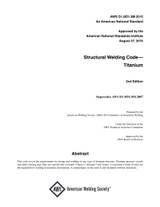

AWS D1.9/D1.9M:2015 Structural Welding Code—Titanium
AWS D1.9/D1.9M:2015 covers structural titanium design, WPS and welder qualification, fabrication, inspection and nondestructive testing.
Wrong edition, wrong file, or a file that won’t open? We replace or refund — contact us within 7 days.
Buy now is for one copy. Buying for a team? Get a quote
About this publication
Product Description
AWS D1.9/D1.9M:2015, Structural Welding Code—Titanium, establishes requirements for the design, qualification, fabrication and inspection of welded titanium structures. The code was developed specifically for structural titanium construction and adapts the general framework familiar to users of the AWS D1 structural welding family to the metallurgical, fabrication and quality-control requirements associated with titanium.
The 2015 publication is the second edition of AWS D1.9/D1.9M and supersedes AWS D1.9/D1.9M:2007. It provides requirements for welded connections, Welding Procedure Specification qualification, welding personnel qualification, titanium fabrication practices, inspection, nondestructive testing and acceptance of production welds.
Scope
The code applies to the designing, fabricating and inspecting of titanium structures when AWS D1.9/D1.9M is invoked by the contract documents.
Clauses 1 through 5 provide the principal requirements governing structural titanium welding. Normative Annex A adds requirements for ballistic testing and welding of titanium armor structures.
Important Scope Exclusions
AWS D1.9/D1.9M is not intended for pressure vessels or pressure piping, structures using base metals other than titanium, or aerospace structures. Those applications require other applicable codes, specifications or engineering requirements.
Structural Titanium Applications
The code provides a dedicated structural welding framework for titanium rather than attempting to apply steel welding rules directly to titanium. Titanium fabrication presents different requirements involving base-metal selection, filler metals, shielding, cleanliness, heat input, contamination control and inspection.
The document is therefore particularly useful where titanium is selected for structural service because of corrosion resistance, strength-to-weight considerations or specialized service conditions.
General Requirements
Clause 1 establishes the overall requirements for application of the code. It covers scope, limitations, terminology, responsibilities, approvals, welding symbols, safety, units of measurement and reference documents.
The clause also defines responsibilities of the Owner, Engineer and Contractor so authority for design decisions, approvals, fabrication and inspection can be clearly established through the contract documents.
Design of Welded Connections
Clause 2 establishes requirements for designing welded titanium connections. The design provisions include general requirements, drawings and design data, allowable stresses, effective weld lengths and areas, structural details and provisions for cyclically loaded structures.
Allowable Stresses
The code provides allowable-stress requirements for structural titanium welded connections. Design values must be applied within the limitations and structural conditions established by the code and applicable contract documents.
Groove Welds
Requirements are provided for groove weld effective dimensions and their use in structural connection design. Groove welds can be used in complete or partial joint penetration configurations as permitted by the applicable design and qualification requirements.
Fillet Welds
The design clause addresses fillet welds, including effective weld dimensions and structural details affecting their application.
Plug and Slot Welds
Plug and slot weld provisions provide requirements for these connection types where they are used in structural titanium fabrication.
Structural Details
Specific structural-detail provisions address filler plates, backing and temporary welds, lap joints, transitions in butt joints, connections and splices in compression members, combinations of weld types and skewed T-joints.
Cyclically Loaded Structures
Clause 2 includes dedicated provisions for cyclically loaded titanium structures. These requirements address applicability and allowable stresses where repeated loading makes fatigue behavior a significant design consideration.
The code includes fatigue stress provisions and related design information for welded titanium connections exposed to cyclic service.
Qualification Requirements
Clause 3 establishes qualification requirements for Welding Procedure Specifications and welding personnel. This section covers test types, examination methods, acceptance criteria, essential variables, qualified positions, test weldments and retests.
No Prequalified Welding Procedures
A significant difference between AWS D1.9/D1.9M and AWS D1.1/D1.1M is that D1.9 does not provide prequalified Welding Procedure Specifications. AWS explains that all WPSs used for fabrication governed by D1.9 must be qualified by testing.
This requirement provides documented evidence that the fabricator can successfully weld the titanium alloy and joint configuration within the variables established by the qualification test.
Welding Procedure Specification Qualification
WPS qualification requirements address the applicable test welds, positions, essential variables, test specimens, examinations and qualification ranges.
The code specifies limitations associated with base materials, thicknesses, welding positions and other variables that determine the range over which a qualified WPS can be used.
Welder, Welding Operator and Tack Welder Qualification
Performance qualification requirements apply to welders, welding operators and tack welders performing code work. The qualification provisions establish the test configurations, positions, essential variables and test methods used to demonstrate personnel capability.
The standard includes qualification limitations for plate, pipe and other applicable test configurations and establishes the range of production welding supported by the completed qualification.
Qualification Test Methods
The code provides multiple methods for evaluating WPS and personnel qualification test welds. These include visual examination, radiographic examination, macro examination, micro examination, tension testing, guided bend testing and chemical analysis where required.
Visual Examination
Visual examination is used as part of the qualification process to determine whether test welds satisfy applicable surface and workmanship requirements before additional destructive or nondestructive testing is performed.
Radiographic Examination
Radiographic examination can be used within the qualification framework to evaluate internal weld soundness in accordance with the code's applicable procedures and acceptance requirements.
Macro and Micro Examination
Macrographic and micrographic examination methods are included for evaluation of weld structure, fusion and other metallurgical characteristics where specified.
Tension Testing
Groove-weld tension tests are used to evaluate mechanical performance of qualification weldments. The code contains specimen configurations and requirements for plate and pipe applications.
Guided Bend Testing
Face, root, side and longitudinal bend specimen configurations are included for qualification testing. Bend tests provide a destructive means of examining weld and heat-affected-zone behavior after substantial deformation.
Fabrication
Clause 4 establishes requirements for preparation, assembly and workmanship of welded titanium structures. The fabrication provisions address welding processes, base metals, filler metals, tungsten electrodes, shielding gases, equipment, backing, temperature controls, welding environment, joint preparation, assembly, weld profile, repairs and other production considerations.
Welding Processes
The code establishes requirements governing welding processes used for structural titanium fabrication. The selected process must be supported by a qualified WPS and appropriate equipment, shielding and consumable controls.
Titanium Base Metals
Clause 4 identifies requirements for titanium base metals used in code construction. The standard includes information on strengths of welded titanium alloys and products available for structural applications.
Correct base-metal identification is essential because alloy composition and product form influence filler-metal selection, WPS qualification and welding behavior.
Filler Metals
Filler-metal requirements are included for structural titanium welding. The code provides recommended titanium-alloy filler metals for welding applicable titanium alloys.
Selection must be consistent with the base material, WPS qualification and engineering requirements for the completed structure.
Tungsten Electrodes
The fabrication requirements separately address tungsten electrodes used in applicable arc welding processes. Electrode selection and condition are important to stable arc performance and contamination control during titanium welding.
Shielding Gases
Shielding gas requirements are especially significant for titanium because hot titanium is highly reactive with atmospheric gases. Proper shielding helps protect the weld pool and heated titanium from contamination that can degrade weld quality and mechanical properties.
Welding Environment
The code addresses environmental conditions affecting structural titanium welding. Welding must be performed under conditions that allow the required shielding, cleanliness and workmanship to be maintained.
Base-Metal Preparation and Assembly
Clause 4 covers preparation of base metal and assembly of welded joints. Preparation practices must support fit-up, cleanliness, joint geometry and welding conditions consistent with the qualified WPS and design requirements.
Tack Welds and Temporary Welds
Tack and temporary welds are controlled because they become part of, or can affect, the final structural member. Their use must comply with the fabrication and workmanship requirements applicable to the titanium structure.
Preheat and Interpass Temperature
The code includes provisions addressing preheat and interpass temperatures as part of fabrication control. Temperature management must be consistent with the qualified procedure and the metallurgical requirements of the titanium alloy being welded.
Distortion and Shrinkage Control
Clause 4 includes requirements for controlling distortion and shrinkage during fabrication. Welding sequence, restraint, heat input and assembly practices can influence dimensional accuracy of the finished titanium structure.
Postweld Cleaning and Weld Appearance
Postweld cleaning is specifically addressed because surface condition and discoloration can provide useful information concerning the effectiveness of shielding during titanium welding.
The code includes weld-profile requirements and color acceptance criteria that support evaluation of completed titanium welds.
Repairs
Repair provisions establish requirements for correcting unacceptable welds or fabrication conditions. Repairs must be carried out under appropriate engineering, procedure and inspection controls rather than through undocumented production rework.
Inspection
Clause 5 addresses inspection requirements for structural titanium fabrication. It covers inspection responsibilities, materials, Welding Procedure Specifications, welding equipment, personnel qualifications, production work, records and nondestructive testing.
Inspection of WPSs and Welding Personnel
Inspectors must verify that applicable Welding Procedure Specifications and the qualifications of welders, welding operators and tack welders satisfy the code and contract requirements before or during production work.
Visual Inspection
Visual examination is a principal production inspection method under D1.9/D1.9M. The code establishes visual acceptance criteria for completed welds and requires evaluation of workmanship and weld profile.
Penetrant Testing
Liquid penetrant testing is specifically included for detecting surface-breaking discontinuities in titanium welds and associated areas. The code provides procedural and acceptance requirements for its application.
Radiographic Testing
Clause 5 establishes detailed radiographic inspection requirements, including radiographic procedures, coverage, acceptance, examination of radiographs and reporting.
The code provides radiographic acceptance criteria for complete and partial joint penetration welds and includes image-quality indicator requirements and placement guidance.
Ultrasonic Testing
Ultrasonic testing provisions address operator requirements and testing procedures where UT is used for examination of structural titanium welds.
Other Examination Methods
The inspection clause allows other examination methods where appropriately specified and includes provisions concerning radiation imaging systems.
Acceptance Criteria
Production weld acceptance requirements address visual examination, penetrant testing, radiographic testing and ultrasonic testing. These criteria provide the basis for determining whether examined welds conform to the structural welding code.
Titanium Armor Structures
Normative Annex A provides specialized requirements for welding titanium armor structures. The annex includes ballistic test requirements, armor welder qualification and documentation associated with welded armor evaluation.
The annex contains test plate requirements, radiographic sampling provisions and forms for recording welded armor, armor plate and radiographic information.
Reference Documents
Normative Annex B identifies reference documents used in applying the code. These references supplement specific requirements for materials, welding, inspection, testing and related technical activities.
Sample Welding Forms
Informative Annex D provides sample forms for documenting welding procedure qualification and personnel qualification activities.
The forms include examples for Welding Procedure Specifications and Procedure Qualification Records, welder and welding operator qualification, radiographic examination and penetrant examination.
Metallurgical Sample Preparation
Informative Annex E provides guidance on preparing titanium metallographic specimens. Proper sample preparation is necessary when macro or micro examination is used to assess weld or material characteristics.
Technical Inquiries
Informative Annex F provides guidance for preparing technical inquiries for consideration by the AWS Structural Welding Committee.
Commentary
The publication contains a substantial commentary explaining the background and intent of code provisions. Commentary assists engineers, fabricators and inspectors in understanding how various structural titanium requirements were developed and how they relate to practical fabrication.
Major Changes in the Second Edition
AWS states that the second edition contains editorial revisions for clarity and substantive changes throughout the code based on user feedback.
The 2015 edition also incorporates the revised Table 5.1 that had originally been issued as an addendum to the 2007 edition in 2011.
Who Should Use AWS D1.9/D1.9M:2015
- structural engineers designing titanium structures;
- welding engineers and welding coordinators;
- fabricators performing structural titanium welding;
- Certified Welding Inspectors and quality-control personnel;
- nondestructive testing personnel;
- WPS and PQR qualification personnel;
- welder and welding operator qualification facilities;
- defense and armor fabrication organizations;
- owners and contractors specifying structural titanium construction;
- materials and metallurgical engineers working with titanium weldments.
Why This Code Matters
Titanium cannot simply be treated as another version of structural steel. Its welding metallurgy, sensitivity to atmospheric contamination, shielding requirements and fabrication practices demand specialized controls.
AWS D1.9/D1.9M provides a dedicated structural framework combining engineering design, mandatory WPS qualification, personnel qualification, fabrication controls and inspection requirements specifically for titanium construction.
Product Features
- Second edition of AWS D1.9/D1.9M
- American National Standard
- Current AWS structural titanium welding code
- Covers structural titanium design, fabrication and inspection
- Includes allowable-stress and cyclic-loading provisions
- Requires Welding Procedure Specifications to be qualified by testing
- Covers welder, welding operator and tack welder qualification
- Includes visual, radiographic, macro, micro, tension and bend qualification tests
- Addresses titanium base and filler metals
- Covers tungsten electrodes and shielding gases
- Includes preparation, assembly and workmanship requirements
- Addresses postweld cleaning, distortion, weld profiles and repairs
- Includes visual, penetrant, radiographic and ultrasonic inspection
- Provides production weld acceptance criteria
- Includes normative titanium armor welding requirements
- Includes sample welding and inspection forms
- Includes metallographic sample preparation guidance
- Includes detailed commentary
Product Details
- Standard: AWS D1.9/D1.9M:2015
- Title: Structural Welding Code—Titanium
- Publisher: American Welding Society
- Edition: 2nd Edition
- Publication Year: 2015
- Print ISBN: 978-0-87171-852-5
- Page Count: 156
- AWS Order Code: D1.9
- ANSI Status: American National Standard
- ANSI Approval Date: August 27, 2015
- Technical Committee: AWS D1 Committee on Structural Welding
- Specialist Committee: AWS D1N Subcommittee on Titanium Structures
- Previous Edition: AWS D1.9/D1.9M:2007
- Language: English
- Publication Type: Structural Welding Code
Edition Status Note
AWS D1.9/D1.9M:2015 remains the current edition of Structural Welding Code—Titanium. AWS continues to list the 2015 document in its current Structural Welding and Titanium publication catalogs, and ANSI identifies it as the most recent edition with no amendments or corrections currently listed. It supersedes AWS D1.9/D1.9M:2007.