
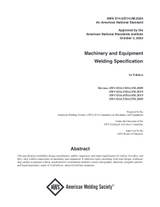

AWS D14.0/D14.0M:2024 Machinery and Equipment Welding Specification
AWS D14.0/D14.0M:2024 1st Edition covers design, welding, qualification, fabrication, inspection and repair of machinery and equipment weldments.
Wrong edition, wrong file, or a file that won’t open? We replace or refund — contact us within 7 days.
Buy now is for one copy. Buying for a team? Get a quote
About this publication
Product Description
AWS D14.0/D14.0M:2024, Machinery and Equipment Welding Specification, First Edition, establishes requirements for welded machinery and equipment manufactured from carbon, low-alloy and alloy steels.
The specification addresses design, manufacture, quality, inspection, modification, strengthening and repair of welded connections and provides a unified AWS framework for several machinery and equipment sectors that were previously covered by separate D14 documents.
Current First Edition
AWS D14.0/D14.0M:2024 is the current published edition as of October 2026.
It was approved as an American National Standard on October 3, 2023 and published as the 2024 First Edition.
Major Consolidation of Four Earlier AWS D14 Standards
The First Edition represents a major restructuring of AWS machinery and equipment welding requirements.
AWS states that D14.0/D14.0M combines and replaces the following earlier documents:
- AWS D14.1/D14.1M — Specification for Welding of Industrial and Mill Cranes and Other Material Handling Equipment;
- AWS D14.3/D14.3M — Specification for Welding Earthmoving, Construction, Agricultural, and Ground-Based Material Handling Equipment;
- AWS D14.4/D14.4M — Specification for the Design of Welded Joints in Machinery and Equipment;
- AWS D14.5/D14.5M — Specification for Welding of Presses and Press Components.
Why AWS Created D14.0
The AWS D14 Committee determined that substantial overlap had developed among the separate machinery and equipment standards created over several decades.
D14.0 was developed to harmonize those requirements and provide a common machinery and equipment welding specification while retaining specialized provisions needed for particular equipment categories.
Scope
The specification establishes requirements for welded connections used in machinery and equipment.
Principal subjects include weld joint design, workmanship, quality acceptance criteria, nondestructive examination, repair of weld defects and postweld heat treatment.
The document also covers modification and strengthening of qualifying machinery and equipment.
Materials Covered
AWS D14.0/D14.0M was specifically developed for machinery and equipment using carbon steels, low-alloy steels and alloy steels.
Base-metal selection, properties, weldability and welding-procedure qualification are addressed within the specification.
Materials Outside the Primary Scope
AWS advises the Design Authority to consider other AWS standards where the application involves materials or construction types outside the principal D14.0 scope.
The specification specifically points users toward AWS D1.2 for aluminum, AWS D1.3 for qualifying sheet steel, AWS D1.6 for stainless steel, AWS D1.7 for applicable strengthening and repair applications, and AWS D1.9 for titanium.
Industrial and Mill Cranes
The scope includes cranes used in industrial, mill, powerhouse and nuclear facilities.
It can also apply to other overhead material-handling machinery and equipment that support and transport loads vertically or horizontally within their design rating during normal operations.
Abnormal operating or environmental loading, including seismic loading, can also be addressed when agreed upon between the Owner and Manufacturing Authority.
Earthmoving and Construction Equipment
AWS D14.0 covers on- and off-highway earthmoving and construction machinery and associated implements.
Examples identified by AWS include crawlers, tractors, graders, loaders, off-highway trucks, power shovels, backhoes, mobile cranes, draglines and similar equipment.
Agricultural Equipment
Agricultural machinery is included within the combined D14.0 scope.
This reflects the consolidation of requirements previously contained in AWS D14.3/D14.3M for earthmoving, construction, agricultural and ground-based material-handling equipment.
Ground-Based Material Handling Equipment
The specification includes ground-based material handling machinery such as forklifts, power trucks, skid steers and support equipment such as conveyors.
This allows many machinery manufacturers to apply one common specification across multiple equipment families.
Presses and Press Components
The scope includes presses and press components formerly covered by AWS D14.5/D14.5M.
AWS specifically identifies stamping presses, brake presses and arbor presses among the products covered.
Other Machinery and Equipment
D14.0 may also be applied to other machinery and equipment when agreed upon between the Owner and Manufacturing Authority.
This provides a mechanism for using the specification beyond the explicitly listed machinery categories where the responsible parties determine that its requirements are suitable.
No Restriction on Welding Technology
AWS states that the specification does not restrict the use of a particular welding process or procedure provided the welding procedure is qualified in accordance with D14.0.
The intent is to establish qualification and quality requirements without unnecessarily limiting continued development of welding technology used in machinery manufacture and repair.
Clause 1 — General Requirements
Clause 1 addresses scope, limitations, responsibilities, qualifications, units of measure, safety, welding symbols and international usage.
The specification recognizes separate Design, Manufacturing and Inspection Authorities and requires the division of responsibilities or deviations from the standard arrangement to be identified in contract documents.
Design Authority
The Design Authority is responsible for defining engineering requirements such as weld type, size and length and identifying the required base metals.
The Design Authority also has an important role in determining whether D14.0 is appropriate for an application that falls outside its principal intended scope.
Normative References and Terminology
Clause 2 identifies normative references required for application of the specification, while Clause 3 establishes terms and definitions.
Standardized terminology supports consistent communication among equipment designers, manufacturers, welding engineers and inspection organizations.
Clause 4 — Base Metals
Clause 4 covers base-metal specifications, properties, weldability and welding-procedure qualification considerations.
The material requirements help ensure that the welding procedure and engineering design are appropriate for the steel being used in the machinery or equipment.
Clause 5 — Welding Processes and Consumables
Clause 5 establishes requirements for welding processes and welding consumables.
Filler-metal and consumable selection must be compatible with the base material, qualified procedure, design requirements and applicable service conditions.
Clause 6 — General Design Requirements
Clause 6 establishes general engineering requirements for welded machinery and equipment.
Subjects include weldment classifications, weld classifications, loading classifications, combined unit stresses, low-temperature service, high-temperature service, corrosion, filler metals, visual inspection and nondestructive testing, base-metal selection and special joint considerations.
Weldment Classifications
The specification classifies weldments so engineering, fabrication and inspection requirements can be applied according to the significance and service demands of the welded assembly.
Weld classification works together with loading and inspection requirements to determine appropriate controls for the finished equipment.
Loading Classification
D14.0 recognizes that machinery weldments can experience substantially different service conditions.
The design framework includes loading classifications and specific treatment of cyclic loading, which is especially important for machinery subjected to repeated operational stresses.
Low- and High-Temperature Service
General design provisions address both low-temperature and high-temperature service.
Temperature can influence material selection, fracture behavior, filler-metal selection and the suitability of the welded connection for its intended operating environment.
Clause 7 — Welded Connection Design
Clause 7 contains detailed welded-connection design provisions.
Subjects include joint details, weld details, tubular connections, welds used with rivets and bolts, cyclic loading and prohibited joints.
Allowable Stresses and Fatigue
The specification includes allowable-stress provisions and detailed fatigue design parameters for cyclically loaded machinery.
Tables and figures provide allowable fatigue stress ranges and design information for different welded details.
Complete and Partial Joint Penetration Welds
D14.0 includes design requirements and joint details for complete-joint-penetration and partial-joint-penetration groove welds.
Normative joint-detail annex material provides prequalified configurations for both nontubular and tubular applications.
Fillet Welds
Fillet-weld requirements include minimum sizes, effective dimensions, joint details and profile considerations.
The specification includes design information for both statically and cyclically loaded welded machinery.
Tubular Connections
Clause 7 includes specific provisions for tubular connections.
The normative joint-detail annex contains PJP and CJP details for tubular T-, Y- and K-connections, including profiles intended for different thickness and fatigue conditions.
Prohibited Joints
The specification identifies joint and weld configurations that are prohibited in applicable principal structural weldments.
Normative Annex D provides illustrated examples, including requirements associated with cyclically loaded principal structural weldments.
Clause 8 — Welding Procedure Qualification
Clause 8 establishes requirements for qualification of Welding Procedure Specifications.
D14.0 provides three principal qualification approaches:
- Method I — Prototype Testing;
- Method II — Welding Procedure Qualification by Standard Testing Methods;
- Method III — Prequalified Welding Procedures.
Prototype Testing
Method I allows procedure qualification using prototype testing in accordance with the requirements established by the specification.
This approach can be useful where the production configuration or loading conditions make representative component testing appropriate.
Standard Procedure Qualification Testing
Method II provides conventional procedure qualification using defined test methods.
The resulting qualification supports preparation of a WPS within the permitted ranges established by the qualification record and applicable requirements.
Prequalified Welding Procedures
Method III provides requirements for welding procedures that qualify for prequalified status.
The specification includes weldability classifications, base-metal and filler-metal relationships, preheat and interpass temperatures, filler-metal requirements, prequalified joint dimensions and WPS variables.
Preheat and Interpass Temperature
Table 8.4 establishes minimum preheat and interpass-temperature requirements for qualifying prequalified procedures.
Temperature control is important for managing weldability and reducing cracking risk in carbon, low-alloy and alloy steels.
Clause 9 — Welding Personnel Qualification
Clause 9 addresses qualification of personnel who perform welding.
It includes welder performance qualification, welding-operator qualification, operators of automatic welding equipment and qualification of tack welders.
Welder and Welding Operator Qualification
The specification defines qualification requirements and limitations according to weld type and position.
Personnel qualification demonstrates that the individual or operator can produce acceptable work within the applicable qualified range.
Clause 10 — Fabrication
Clause 10 establishes production fabrication requirements.
Subjects include equipment, preparation of materials, preparation methods, dimensional tolerances, assembly, repair, distortion control, stress relief, peening and vibratory weld conditioning.
Dimensional Tolerances
Fabrication requirements include dimensional tolerances for groove-weld joint preparation and assembly.
Proper fit-up is important for ensuring that production welding remains within the conditions supported by the design and qualified welding procedure.
Repair of Welded Machinery
D14.0 contains requirements for repair of weld defects and other applicable welded conditions.
Repair work must be performed using appropriate procedures and must satisfy applicable inspection and quality requirements after completion.
Distortion Control
Welding can produce significant dimensional distortion in large machinery and equipment weldments.
The fabrication clause addresses distortion control as part of producing equipment that satisfies required dimensional and service conditions.
Postweld Heat Treatment
The fabrication requirements include stress relief and postweld heat treatment provisions.
PWHT may be used or required depending on material, thickness, service requirements and applicable engineering requirements.
Clause 11 — Inspection and Acceptance Criteria
Clause 11 establishes inspection and acceptance requirements for welded machinery and equipment.
It includes qualification of inspection personnel, weld-quality requirements, visual examination and multiple nondestructive examination methods.
Visual Inspection
Visual inspection requirements are provided together with specific visual acceptance criteria.
The specification contains tables and figures illustrating acceptable and unacceptable weld profiles and other weld conditions.
Radiographic Testing
Clause 11 contains requirements for radiographic examination of qualifying welds.
The specification includes image-quality indicator requirements, radiographic placement figures and acceptance information for rounded indications and other relevant conditions.
Ultrasonic Testing
Ultrasonic testing requirements include examination procedures, scanning patterns and application to complete-joint-penetration groove welds.
Supporting figures show transducer positions and scanning methods for butt, corner and T-joint configurations.
Magnetic Particle Testing
Magnetic particle testing is included as an NDE method for applicable ferromagnetic machinery and equipment welds.
The method can be used to identify qualifying surface and near-surface discontinuities where specified.
Liquid Penetrant Testing
Liquid penetrant testing is also recognized for applicable examination requirements.
The method is particularly useful for identifying surface-breaking discontinuities in suitable nonporous materials.
Normative Annex A — Cranes and Material Handling Equipment
Normative Annex A contains additional requirements specifically addressing welding of industrial and mill cranes and other material-handling equipment.
This preserves specialized crane-related provisions within the unified D14.0 framework.
Normative Annex B — Weld Joint Details
Normative Annex B contains extensive weld-joint details.
It includes typical CJP and PJP groove-welded joints, prequalified fillet-weld details, tubular joint configurations and skewed T-joint details.
WPS Development Roadmap
Informative Annex F provides a roadmap for development of Welding Procedure Specifications.
The roadmap helps users navigate the qualification pathways and determine which requirements apply when establishing production welding procedures.
Suggested WPS and Qualification Forms
Informative Annex G provides suggested Welding Procedure Specification and qualification test record forms.
These forms support consistent documentation of procedure variables and qualification results.
Electrode and Flux Storage
Informative Annex H provides recommended practices for storage and treatment of electrodes and fluxes.
Proper consumable storage helps control moisture exposure and supports reliable low-hydrogen welding practice where required.
OEM Welding Procedures
Informative Annex I provides a suggested format for demonstration of an OEM Welding Procedure Specification.
This recognizes the established role of manufacturer-developed welding practices in machinery and equipment production.
Weld Break Testing
Informative Annex J includes weld-break test samples and evaluation figures.
The annex provides practical test configurations for fillet and flare-groove weld evaluation.
Ultrasonic Calibration
Informative Annex K addresses qualification and calibration of ultrasonic units using other approved reference blocks.
This supports implementation of the detailed UT requirements contained in Clause 11.
Commentary
The publication includes Commentary beginning after the normative and informative annexes.
The Commentary provides explanatory information supporting application and understanding of selected D14.0 provisions.
Current Amendment and Errata Status
Current ANSI records list no amendments or corrections for AWS D14.0/D14.0M:2024.
The First Edition therefore remains the active published version without a separate AMD or errata designation as of October 2026.
Future Revision in Development
AWS has begun development of the next revision of D14.0/D14.0M and placed a revised draft into public review during 2026.
That project has not yet replaced AWS D14.0/D14.0M:2024, which remains the current published standard.
Who Should Use AWS D14.0/D14.0M:2024
- machinery and equipment manufacturers;
- welding engineers;
- mechanical engineers;
- equipment design engineers;
- industrial crane manufacturers;
- material handling equipment manufacturers;
- earthmoving and construction equipment manufacturers;
- agricultural equipment manufacturers;
- press manufacturers;
- fabrication engineers;
- welding supervisors;
- quality assurance and quality control personnel;
- welding inspectors;
- NDE personnel;
- maintenance and repair organizations;
- owners and operators of machinery and equipment;
- WPS and qualification administrators.
Product Features
- current AWS D14.0/D14.0M First Edition;
- 2024 edition;
- ANSI approved;
- 238 pages;
- print ISBN 978-1-64322-291-2;
- consolidates four earlier AWS D14 machinery standards;
- covers carbon, low-alloy and alloy steel machinery weldments;
- covers industrial and mill cranes;
- covers material handling equipment;
- covers earthmoving and construction equipment;
- covers agricultural equipment;
- covers presses and press components;
- covers other machinery by agreement;
- covers weldment and loading classification;
- covers welded connection design and fatigue;
- provides three WPS qualification methods;
- covers welder, welding operator and tack-welder qualification;
- covers fabrication, repair and distortion control;
- covers postweld heat treatment;
- covers VT, RT, UT, MT and PT inspection;
- includes acceptance criteria and Commentary;
- current ANSI records list no amendments or corrections.
Product Details
- Standard: AWS D14.0/D14.0M:2024
- Title: Machinery and Equipment Welding Specification
- Edition: First Edition
- Publisher: American Welding Society
- Publication Year: 2024
- ANSI Approval: October 3, 2023
- Print ISBN: 978-1-64322-291-2
- PDF ISBN: 978-1-64322-292-9
- Page Count: 238
- Prepared By: AWS D14 Committee on Machinery and Equipment
- Replaces: AWS D14.1/D14.1M:2005, AWS D14.3/D14.3M:2019, AWS D14.4/D14.4M:2019 and AWS D14.5/D14.5M:2009
- Current Amendments/Corrections: None listed as of October 2026
- Language: English
- Publication Type: Machinery and Equipment Welding Specification
Edition Status Note
AWS D14.0/D14.0M:2024 is the current published Machinery and Equipment Welding Specification as of October 2026. It is the First Edition and consolidates the former D14.1, D14.3, D14.4 and D14.5 standards into one machinery and equipment welding specification. AWS has begun public review of a future revision, but that project has not yet replaced the 2024 edition. Current ANSI records list no amendments or corrections for D14.0/D14.0M:2024.