
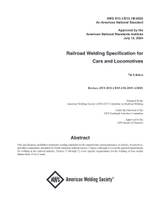

AWS D15.1/D15.1M:2025 Railroad Welding Specification for Cars and Locomotives
AWS D15.1/D15.1M:2025 7th Edition covers welding of railcars, locomotives, WPS qualification, NDE and acceptance. Includes May 2026 errata.
Wrong edition, wrong file, or a file that won’t open? We replace or refund — contact us within 7 days.
Buy now is for one copy. Buying for a team? Get a quote
About this publication
Product Description
AWS D15.1/D15.1M:2025, Railroad Welding Specification for Cars and Locomotives, Seventh Edition, establishes minimum welding standards for the manufacture and maintenance of railcars, locomotives and their components intended for North American railroad service.
The specification provides a comprehensive railroad-industry framework covering welding procedures, personnel qualification, joint design, workmanship, inspection, nondestructive examination, acceptance criteria and welding of thin sheet materials.
This product includes the official AWS Errata Notice dated May 13, 2026.
Current Seventh Edition
AWS D15.1/D15.1M:2025 is the current published edition as of October 2026.
The Seventh Edition revises and supersedes AWS D15.1/D15.1M:2019-AMD1.
The American National Standards Institute approved the Seventh Edition on July 12, 2024.
Railroad Industry Scope
The specification applies to railcars, locomotives and their components intended for North American railroad service.
It was developed by the AWS D15 Committee on Railroad Welding to provide a single comprehensive source of welding requirements for the railroad industry.
Tank Car Tanks
AWS D15.1 does not independently govern welding of tank car tanks.
For tank car tank welding, the specification directs users to the Association of American Railroads Manual of Standards and Recommended Practices, Section C-III, Specifications for Tank Cars, Specification M-1002.
General Welding Requirements
Clauses 4 through 16 establish the general requirements for railroad welding covered by the specification.
These requirements address materials, procedures, joint design, technique, workmanship, qualification, inspection, nondestructive examination and acceptance criteria.
Sheet Metal Welding Requirements
Clauses 17 through 22 contain dedicated requirements for welding base metals thinner than 1/8 in [3 mm].
This separate treatment recognizes the different joint configurations, procedure variables and workmanship considerations associated with thin sheet material.
General Information
Clause 4 addresses base metals, material coatings, material thickness, weld-quality responsibility, engineering judgment, requirements hierarchy, approvals, applications, engines, AAR requirements and fatigue design.
Base Metals
The specification contains requirements applicable to qualifying railroad steels and aluminum alloys.
Material identification and compatibility with the applicable welding procedure are fundamental to successful railroad fabrication and repair.
Material Coatings
Railroad components can be supplied or maintained with protective coatings.
D15.1 addresses material coatings because coatings can affect weld preparation, welding technique and final weld quality.
Weld Quality Responsibility
The specification establishes responsibility for weld quality and provides a framework for engineering approvals and inspection.
Manufacturers and responsible engineering organizations must ensure that welding complies with applicable D15.1 requirements and any additional contractual or regulatory requirements.
Fatigue Design
Railroad rolling stock is subjected to repeated service loading, making fatigue an important design consideration.
Clause 4 specifically identifies fatigue design among the general requirements applicable to welded railroad equipment.
Clause 5 — Requirements for All Welding
Clause 5 establishes requirements applying broadly to welding performed under D15.1.
Topics include WPS data, approved processes, welding procedure qualification, welder and welding-operator qualification, welded-joint design, consumables and preparation for welding.
Welding Procedure Specifications
A Welding Procedure Specification defines the controlled variables and instructions used to produce production welds.
D15.1 distinguishes between prequalified procedures and procedures that require qualification testing.
Welding Processes
The specification provides requirements for welding processes used in railroad manufacture and maintenance.
Applicable procedure and personnel qualification requirements depend on the process, material, joint configuration and production conditions.
Welding Procedure Qualification
Where a procedure cannot be used as a prequalified procedure, qualification testing establishes whether the proposed welding variables can produce acceptable welds.
Procedure Qualification Records document the actual test variables and results supporting the production WPS.
Welder and Welding Operator Qualification
Personnel performing railroad welding must be qualified within the applicable ranges established by the specification.
D15.1 contains separate requirements for welders, welding operators and tack welders.
Design of Welded Joints
The specification establishes requirements for welded-joint design and allowable weld stresses.
Design provisions address both steel and aluminum applications within the standard's scope.
Welding Consumables
Clause 5 addresses electrodes, filler metals and related welding consumables.
Consumables must satisfy applicable material, strength, classification and handling requirements.
Low-Hydrogen Electrodes
The specification includes requirements concerning allowable atmospheric exposure of low-hydrogen electrodes.
Consumable control is important in railroad steel welding because excessive moisture exposure can increase hydrogen-related cracking risk.
Preparation for Welding
Preparation requirements establish conditions needed before production welding begins.
Proper joint preparation, cleanliness, fit-up and material condition help ensure welding is performed within the limits of the qualified or prequalified procedure.
Clause 6 — Technique and Workmanship
Clause 6 establishes production technique and workmanship requirements.
Subjects include base-metal preparation, steel and aluminum assembly criteria, weld profiles, repairs, arc strikes, cleaning, protective coatings, weld termination, backing, heat input, postweld heat treatment, peening, stud welding and welding of air brake pipe.
Steel and Aluminum Assembly
The specification includes assembly criteria for both steel and aluminum railroad components.
Fit-up and dimensional control are important because improper assembly can affect penetration, weld profile, distortion and final acceptance.
Weld Profiles
Completed welds must satisfy applicable profile and workmanship requirements.
Inspection provisions later in the specification determine whether observable conditions remain within permissible limits.
Repairs After Welding
D15.1 addresses repair of unacceptable weld conditions discovered after welding.
Repair work must restore the weldment to a condition satisfying the applicable workmanship and acceptance requirements.
Arc Strikes
Arc strikes outside the intended weld area are addressed as part of workmanship control.
Unintended arc contact can locally affect material condition and therefore requires evaluation under applicable railroad welding requirements.
Heat Input Control
The specification includes dedicated heat-input controls for quenched and tempered steel.
Controlling thermal input helps protect the mechanical properties and metallurgical condition of heat-sensitive materials.
Postweld Heat Treatment
Clause 6 contains requirements for stress relief and postweld heat treatment where applicable.
PWHT requirements depend on the material, procedure and engineering requirements governing the railroad component.
Air Brake Pipe Welding
D15.1 contains specific workmanship requirements for welding railroad air brake pipe.
This specialized content reflects the standard's focus on actual railroad equipment rather than generic structural welding alone.
Clause 7 — Prequalified WPS Joint Design Details
Clause 7 provides joint-design requirements for prequalified Welding Procedure Specifications.
It covers groove weld size, joint designs, fillet welds, plug and slot welds, complete-joint-penetration groove welds and partial-joint-penetration groove welds.
Complete Joint Penetration Groove Welds
Prequalified CJP joint details are provided for qualifying production applications.
The selected joint configuration must satisfy the dimensional and process limitations identified by D15.1.
Partial Joint Penetration Groove Welds
The specification also provides prequalified PJP joint configurations and minimum weld-size requirements.
Effective weld size and joint geometry must correspond to the engineering design assumptions used for the component.
Fillet Welds
D15.1 contains minimum fillet-weld size and joint-detail requirements.
Fillet welds are widely used throughout railroad car and locomotive fabrication and repair.
Plug and Slot Welds
Plug and slot weld requirements include limits on dimensions and joint configuration.
These connection types can be used where load transfer or component geometry makes conventional groove or fillet welding unsuitable.
Clause 8 — Technique for Prequalified WPSs
Clause 8 establishes technique requirements for prequalified procedures.
It covers base-metal and filler-metal combinations, preheat and interpass temperature, PWHT, SMAW, SAW, GMAW, FCAW, plug and slot welds, and wear plates and wear liners.
Base Metal and Filler Metal Matching
Table 8.1 identifies prequalified base-metal and filler-metal combinations for matching-strength applications.
The May 2026 errata includes corrections to several entries in this important table.
Preheat and Interpass Temperature
Table 8.2 establishes prequalified minimum preheat and interpass-temperature requirements for steel.
Temperature control supports suitable weldability and reduces susceptibility to cracking.
Wear Plates and Wear Liners
The specification includes dedicated welding provisions for wear plates and wear liners.
Such components are common in railroad service where abrasion and repeated mechanical contact can occur.
Clause 9 — General Requirements for Qualification
Clause 9 establishes the overall qualification framework.
It distinguishes prequalified procedures, qualified procedures and qualification of welders, welding operators and tack welders, and assigns responsibility for qualification.
Clause 10 — Procedure Qualification
Clause 10 contains detailed WPS qualification requirements.
Subjects include essential variables, test purposes, base-metal preparation, test position, joint WPS requirements, test specimens, special test conditions, testing methods, required results, records, retests and flash welding.
Procedure Qualification Essential Variables
Table 10.1 identifies PQR essential-variable changes requiring WPS requalification for applicable welding processes.
Changes beyond the permitted qualification range can require a new procedure qualification test.
Notch Toughness
D15.1 includes supplemental position-related essential variables when notch toughness is required.
These requirements help ensure that qualification reflects the mechanical-property requirements of the production application.
Clause 11 — Welder Qualification
Clause 11 establishes detailed welder qualification requirements.
It covers essential-variable limitations, qualification tests, groove and fillet weld tests, welding positions, base metal, specimens, testing methods, acceptance, retests, qualification continuity and records.
Clause 12 — Welding Operator Qualification
Mechanized and automatic welding personnel are addressed separately under Clause 12.
The clause establishes test requirements, qualification variables, acceptance, retests, period of effectiveness, records and flash welding operator qualification.
Clause 13 — Tack Welder Qualification
Tack welders are subject to dedicated qualification requirements.
Tack welds can affect the final welded joint and therefore require appropriate personnel qualification and workmanship control.
Clause 14 — Inspection
Clause 14 establishes general inspection requirements.
It addresses manufacturer responsibility, the designated inspector, fabrication inspection and verification inspection.
Clause 15 — Nondestructive Examination
Clause 15 addresses nondestructive examination and NDE personnel qualification.
Methods specifically addressed include radiographic testing, ultrasonic testing, liquid penetrant testing and magnetic particle testing.
Radiographic Testing
Radiographic testing provisions apply to qualifying groove welds.
RT can be used to evaluate internal weld conditions where specified by the standard or project requirements.
Ultrasonic Testing
Ultrasonic testing requirements apply to qualifying groove welds and provide a volumetric examination method using high-frequency sound.
Acceptance is determined using the rejection criteria established in the specification.
Liquid Penetrant Testing
Liquid penetrant testing is included for detection of surface-breaking discontinuities in suitable nonporous materials.
Magnetic Particle Testing
Magnetic particle testing is included for applicable ferromagnetic railroad materials and welds.
Clause 16 — Acceptance Criteria
Clause 16 establishes acceptance criteria for temporary welds and for visual, radiographic, ultrasonic, liquid penetrant and magnetic particle inspection.
It includes specific limits addressing weld craters, undercut and porosity and ultrasonic rejection criteria.
Sheet Metal — Clause 17
Clause 17 establishes procedure and joint requirements for welding sheet metal within the D15.1 scope.
It includes essential and nonessential WPS variables and procedure qualification tests for FCAW, GMAW, GTAW and SMAW.
Sheet Metal Personnel Qualification
Clause 18 covers welder, welding-operator and tack-welder qualification for sheet metals.
Qualification-variable and test requirements are tailored to thin-material welding.
Sheet Metal Technique and Workmanship
Clause 19 establishes technique and workmanship requirements specific to sheet-metal welding.
Sheet Metal Inspection
Clause 20 addresses inspection of procedure qualification and equipment used for sheet-metal welding.
Sheet Metal Weld Details
Clause 21 contains sheet-metal weld details including groove and fillet weld configurations.
Sheet Metal Visual Acceptance Criteria
Clause 22 establishes visual inspection acceptance criteria specifically for sheet-metal weld quality.
Normative Annex A
Normative Annex A contains alternate steel base-material specifications and numerical indexing information.
Filler Metal Information
Informative Annex B contains filler-metal classification information supporting application of the standard.
Effective Weld Size
Informative Annex C provides additional information concerning special cases affecting effective weld size.
Sample Report Forms
Informative Annex D provides sample forms for documenting welding procedure and personnel qualification information.
Sheet Metal Gage and Aluminum Filler Alloy Information
Informative Annex E contains sheet-metal gage thickness information and an aluminum filler-alloy selection guide.
Macroetch Procedures
Informative Annex F provides macroetch procedures for evaluation of applicable qualification specimens.
May 13, 2026 Errata — Included
This product includes the official AWS errata dated May 13, 2026.
The errata identifies corrections that AWS states will be incorporated into the next reprinting of D15.1/D15.1M:2025.
Errata — Table 5.3
The errata corrects a cross-reference in Table 5.3 so the applicable entry refers to both Tables 5.4 and 5.5 rather than Table 5.4 alone.
Errata — Prequalified Joint Details
Several Clause 7 joint-detail figures are corrected.
The corrections include dimensions and notation in Figures 7.1A, 7.1D, 7.1E, 7.1F and 7.1L.
Errata — Table 8.1
The May 2026 errata corrects several base-metal and filler-metal entries in Table 8.1.
Corrections include placement of ASTM A381 grades, FCAW classification information, deletion of a duplicated EH36 reference and correction of AWS electrode-specification references from A5.5/A5.5M to A5.28/A5.28M for specified entries.
Errata — Procedure Qualification
The errata also corrects text in 10.9.2.1 and several entries in Table 10.5.
Table 10.5 corrections include deletion of incorrect superscript references and correction of an H position designation to V.
Because your product includes this errata, these May 13, 2026 corrections are supplied with the Seventh Edition rather than requiring the purchaser to obtain a separate correction sheet.
Revision From the 2019 Edition
AWS states that several significant modifications were made for the 2025 edition and identifies revised material through change markings in the published standard.
The Seventh Edition also reorganizes the inspection portion of the specification: NDE methods are contained within Clause 15 and acceptance criteria are contained in Clause 16, with the sheet-metal requirements following in Clauses 17 through 22.
Current Edition Status
AWS continues to list D15.1/D15.1M:2025 as the active published Railroad Welding Specification for Cars and Locomotives.
The AWS D15 Committee has initiated development work toward a future revision, but no newer edition has replaced the 2025 Seventh Edition as of October 2026.
Who Should Use AWS D15.1/D15.1M:2025
- railcar manufacturers;
- locomotive manufacturers;
- railroad maintenance and repair facilities;
- welding engineers;
- railroad mechanical engineers;
- fabrication engineers;
- welding supervisors;
- welders and welding operators;
- tack welders;
- welding inspectors;
- NDE personnel;
- quality assurance and quality control personnel;
- WPS and PQR administrators;
- railroad owners and operators;
- rail equipment suppliers and contractors.
Product Features
- current Seventh Edition;
- 2025 edition;
- ANSI approved;
- 238 pages;
- includes May 13, 2026 AWS errata;
- covers railcars, locomotives and their components;
- covers manufacture and maintenance welding;
- covers steel and aluminum applications;
- covers WPS development and procedure qualification;
- covers prequalified welding procedures;
- covers welder, welding-operator and tack-welder qualification;
- covers joint design and consumables;
- covers workmanship, repair and PWHT;
- covers RT, UT, PT and MT;
- contains specific acceptance criteria;
- contains dedicated sheet-metal welding requirements;
- includes sample qualification forms and macroetch procedures;
- revises AWS D15.1/D15.1M:2019-AMD1.
Product Details
- Standard: AWS D15.1/D15.1M:2025
- Title: Railroad Welding Specification for Cars and Locomotives
- Edition: Seventh Edition
- Publisher: American Welding Society
- Publication: January 2025
- ANSI Approval: July 12, 2024
- Print ISBN: 978-1-64322-330-8
- Page Count: 238
- Errata: May 13, 2026 — Included
- Previous Edition: AWS D15.1/D15.1M:2019-AMD1
- Prepared By: AWS D15 Committee on Railroad Welding
- Cars and Locomotives Subcommittee: AWS D15A
- Language: English
- Publication Type: Railroad Welding Specification
Edition Status Note
AWS D15.1/D15.1M:2025 remains the current Seventh Edition as of October 2026. It revises AWS D15.1/D15.1M:2019-AMD1 and establishes minimum welding requirements for railcars, locomotives and their components intended for North American railroad service. This product includes the official AWS errata dated May 13, 2026, including corrections to Tables 5.3, 8.1 and 10.5 and several Clause 7 prequalified joint-detail figures.