
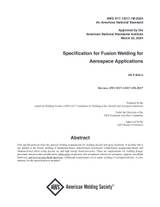

AWS D17.1/D17.1M:2024 Specification for Fusion Welding for Aerospace Applications
AWS D17.1/D17.1M:2024 4th Edition covers fusion welding, qualification, fabrication, NDE, repair and crewed spaceflight aerospace hardware.
Wrong edition, wrong file, or a file that won’t open? We replace or refund — contact us within 7 days.
Buy now is for one copy. Buying for a team? Get a quote
About this publication
Product Description
AWS D17.1/D17.1M:2024, Specification for Fusion Welding for Aerospace Applications, Fourth Edition, establishes general requirements for fusion welding and nondestructive examination of aircraft and aerospace hardware.
The specification is intended for aerospace flight hardware as well as qualifying nonflight hardware and includes additional requirements for crewed spaceflight hardware and launch vehicles.
Current Fourth Edition
The 2024 Fourth Edition supersedes AWS D17.1/D17.1M:2017.
It was approved as an American National Standard on March 25, 2024 and represents a substantial revision of the previous edition.
Aerospace Welding Scope
The specification provides requirements for commonly used fusion welding processes, materials and production-weld acceptance criteria used in aircraft and space hardware.
It also allows materials, processes and acceptance criteria not specifically listed in the document when approved by the Engineering Authority under the applicable provisions.
Materials Covered
AWS D17.1/D17.1M:2024 includes, but is not limited to, fusion welding of:
- aluminum-based alloys;
- nickel-based alloys;
- iron-based alloys;
- cobalt-based alloys;
- magnesium-based alloys;
- titanium-based alloys.
This broad material coverage makes the specification applicable to many aircraft, propulsion, launch-vehicle and spacecraft manufacturing environments.
Fusion Welding Processes
The specification addresses fusion welding performed with electric arc and high-energy beam processes.
Its fabrication requirements include process-specific provisions for shielding and welding variables associated with processes such as GTAW, GMAW and PAW, together with requirements applicable to other qualified fusion welding methods within the specification scope.
Flight Hardware
The principal purpose of AWS D17.1 is to provide requirements for fusion welding of aerospace flight hardware.
The specification establishes requirements for welding procedures, personnel qualification, fabrication, inspection and production-weld acceptance for hardware whose performance can directly affect an aircraft or space system.
FAA-Regulated Aircraft, Rotorcraft and Engines
The scope contains specific direction for welding used in aircraft, rotorcraft and engines subject to Federal Aviation Administration regulation.
The Engineering Authority is responsible for performing appropriate design analyses and establishing process controls necessary to satisfy applicable requirements of Title 14 of the Code of Federal Regulations.
Nonflight Hardware
Clause 9 establishes requirements for nonflight hardware.
This can include tooling, ground support equipment and related nonconventional aerospace facilities where the project invokes AWS D17.1 requirements but the item is not itself flight hardware.
Crewed Spaceflight Hardware — New Clause 10
One of the most important additions to the Fourth Edition is Clause 10, Crewed Spaceflight Hardware.
The clause establishes additional requirements beyond the baseline flight-hardware welding provisions for fabrication and inspection of crewed spaceflight hardware and launch vehicles.
The Engineering Authority can also direct use of Clause 10 for an uncrewed mission where the additional controls are considered appropriate.
Crewed Spaceflight Welding Processes
Clause 10 contains dedicated requirements concerning welding processes used on crewed spaceflight hardware.
These requirements supplement rather than replace the baseline requirements applying to aerospace flight hardware elsewhere in the specification.
Engineering Authority Approval
The Engineering Authority has an important role throughout AWS D17.1 and particularly in applications involving specialized aerospace materials, processes and mission requirements.
Clause 10 expressly addresses Engineering Authority approval as part of the crewed-spaceflight framework.
Crewed Spaceflight WPS and Qualification Requirements
The new Clause 10 establishes supplemental Welding Procedure Specification and qualification requirements applicable to crewed spaceflight hardware.
These additional controls recognize the particularly demanding reliability and mission-consequence requirements associated with human spaceflight systems.
Material Review Board
Clause 10 includes provisions addressing the Material Review Board.
This provides a formal framework for evaluation and disposition of applicable material, fabrication or weld conditions associated with crewed spaceflight hardware.
Titanium Welding in Crewed Spaceflight
The new crewed-spaceflight clause includes a dedicated section addressing titanium welding.
Titanium requires rigorous contamination and shielding control during welding, making specialized requirements particularly relevant in high-reliability aerospace and spaceflight applications.
Clause 1 — General Requirements
Clause 1 establishes the scope and fundamental provisions of the specification.
It addresses units of measure, safety, classification, approval, mandatory provisions and authority, design definitions and requirements, and exclusions.
Classification
AWS D17.1 contains classification requirements that allow welding and inspection controls to be applied according to the applicable hardware and weld requirements.
The classification framework is an important part of determining the design, qualification and inspection provisions applicable to production welding.
Clause 2 — Normative References
Clause 2 identifies documents required for application of the specification.
These references form part of the technical framework used for welding qualification, materials, examination and other aerospace welding requirements.
Clause 3 — Terms and Definitions
Clause 3 provides technical terminology and definitions of particular importance to aerospace fusion welding under D17.1.
Consistent terminology supports communication among Engineering Authorities, welding engineers, quality organizations, inspectors, manufacturers and suppliers.
Clause 4 — Design of Welded Connections
Clause 4 establishes requirements and guidance for design of welded connections.
Its principal subjects include weldment design data and general drawing requirements used to communicate the engineering basis for aerospace welded assemblies.
Weldment Design Data
The specification requires appropriate design information to be defined so that manufacturing and inspection personnel understand the requirements governing the welded assembly.
Design data must support the intended structural and service performance of the aerospace hardware.
Drawing Requirements
General drawing requirements provide a controlled means of communicating weld configuration, engineering requirements and other fabrication information.
Clear engineering documentation is especially important in aerospace manufacturing where process control and traceability can be critical to hardware acceptance.
Clause 5 — Welding Procedure and Performance Qualification
Clause 5 establishes qualification requirements for welding procedures, welders, welding operators and tack welders.
This clause received one of the most substantial reorganizations in the Fourth Edition.
Major Fourth Edition Qualification Reorganization
AWS separated welding-procedure qualification criteria from welder and welding-operator qualification criteria to prevent requirements from being mixed together.
This restructuring is intended to make it easier to determine which provisions apply to a procedure and which apply to the individual performing the production welding.
Reworked Tables 5.1 Through 5.7
Tables 5.1 through 5.7 were reorganized in the Fourth Edition.
AWS states that the tables were reworked so individual qualification requirements are isolated more clearly and the overall qualification system is easier to apply.
Qualification Coupon Figures
The Fourth Edition adds figures for qualification-coupon configurations.
These figures integrate more of the qualification criteria directly into AWS D17.1 and reduce reliance on external documents such as AWS B2.1 for determining test-coupon configuration.
Welding Procedure Qualification
Clause 5.2 addresses welding procedure data and qualification.
A qualified procedure establishes the controlled variables and technical conditions under which an aerospace production weld can be made.
Welder and Welding Operator Qualification
Performance qualification demonstrates the ability of a welder or welding operator to produce acceptable welds within defined ranges of variables.
The Fourth Edition separates general performance-qualification requirements from detailed requirements to improve clarity.
Tack Welder Qualification
AWS D17.1 also addresses qualification of tack welders where their work falls within the applicable aerospace welding requirements.
Tack weld quality is important because tack welds can become part of the completed joint or affect final weld integrity.
Clause 6 — Fabrication
Clause 6 establishes requirements for preparation, assembly and workmanship when welding aerospace hardware.
The clause addresses welding consumables, equipment, machine-welding parameters, cleaning, joint preparation, fit-up, temperature control, tack welding, shielding, filler materials, postweld processing and identification.
Welding Consumables
Welding consumables must be appropriate for the qualified process, base material and engineering requirements.
Control of filler material is particularly important in aerospace fabrication because alloy compatibility and traceability can affect mechanical properties, corrosion performance and final hardware acceptance.
Welding Equipment
Clause 6 contains requirements applicable to welding equipment used for production aerospace welding.
Equipment capability and control must be suitable for maintaining the welding parameters established by the qualified procedure.
Machine Welding Parameters
The specification addresses control of machine welding parameters for mechanized or automated production.
This is particularly relevant to aerospace manufacturing where repeatability and documented process control are often essential.
Preweld Cleaning
Clause 6 contains requirements for preweld cleaning and preparation.
Removal of oxides, oils, moisture, machining residue and other contamination can be critical to producing sound welds in aluminum, titanium, nickel and other aerospace alloys.
Joint Preparation and Fit-up
The specification establishes requirements for preweld joint preparation and fit-up.
Joint geometry and alignment can directly affect penetration, fusion, distortion and compliance with aerospace production-weld acceptance criteria.
Preheat and Interpass Temperature
Clause 6 addresses control of preheat and interpass temperature.
Temperature requirements depend on the material, welding process, qualified procedure and engineering requirements for the specific aerospace application.
Weld Shielding
The fabrication requirements include weld-shielding provisions for GTAW, GMAW and PAW.
Shielding is particularly critical for reactive alloys such as titanium, where atmospheric contamination during welding can seriously affect weld quality.
Tungsten Electrodes
The specification contains requirements for tungsten electrodes used with applicable welding processes.
Electrode selection and condition form part of maintaining controlled and repeatable aerospace welding operations.
Interpass and Postweld Cleaning
AWS D17.1 addresses both interpass and postweld cleaning.
Cleaning practices must be compatible with the alloy and must not introduce contamination or surface damage that could compromise the finished hardware.
Postweld Processing
Clause 6 includes requirements for applicable postweld processing.
Postweld operations can affect final dimensional condition, surface quality, metallurgical condition or acceptance of aerospace components.
Weld Identification and Traceability
The specification includes weld identification requirements.
Identification and documentation support manufacturing traceability and allow production welds to be associated with applicable procedures, personnel and inspection records.
Acceptance Inspection
Clause 6 includes acceptance-inspection requirements as part of the fabrication sequence.
Completed hardware must satisfy the inspection and acceptance requirements applicable to its classification and engineering documentation.
Rework and Repair
The fabrication clause distinguishes applicable rework and repair activities.
Aerospace hardware frequently requires formal engineering control of corrective work because additional thermal cycles, material removal or weld deposition can affect hardware performance.
Clause 7 — Inspection
Clause 7 establishes requirements for inspector qualification, visual examination, nondestructive examination and acceptance criteria.
Inspection provides the verification framework for determining whether production welds conform to the specified aerospace welding requirements.
Inspector Qualification
The specification establishes qualification criteria for inspection personnel responsible for evaluating aerospace welds.
Qualified inspection personnel are necessary because application of the acceptance requirements can involve specialized welding processes, materials and NDE methods.
Visual Weld Inspection
Visual inspection is used to evaluate visible weld condition, dimensions, workmanship and applicable surface discontinuities.
Visual examination is complemented by other NDE methods where required by the specification or engineering documentation.
Nondestructive Examination
AWS D17.1 contains standard requirements for nondestructive examination of aerospace welds.
The selected examination method depends on the hardware, weld classification, material, joint configuration and applicable engineering requirements.
Acceptance Criteria
Clause 7 includes acceptance criteria for production welds.
These criteria provide the technical basis for accepting, rejecting, reworking or referring weld conditions for engineering disposition.
Clause 8 — Repair of Existing Structures
Clause 8 addresses repair welding of existing aerospace flight hardware.
The requirements cover repair design, welding procedures, welder and welding-operator qualification, welding equipment, repair inspection, grounding and bonding and repair documentation.
Repair Design
Repair welding of existing aerospace hardware requires engineering evaluation because repair can alter load paths, material condition and local structural performance.
Clause 8 therefore includes dedicated design requirements rather than treating repair as ordinary production welding.
Repair Documentation
The specification requires documentation associated with qualifying aerospace weld repairs.
Repair documentation supports configuration control, traceability and future evaluation of the hardware.
Clause 9 — Nonflight Hardware
Clause 9 establishes requirements and permitted exceptions for nonflight aerospace hardware.
Examples include tooling, ground support equipment and related nonconventional aerospace facilities.
Nonflight Fluid Service — Fourth Edition Change
A significant Fourth Edition change redirects applicable fluid-service inspection criteria for nonflight hardware to ASME B31.3.
This change improves coordination between aerospace welding requirements and the established process-piping inspection framework for qualifying fluid-service applications.
Clause 10 — Crewed Spaceflight Hardware
The Fourth Edition adds an entirely new clause addressing the unique requirements of crewed spaceflight hardware.
The clause includes scope, general provisions, welding processes, Engineering Authority approval, WPS and qualification requirements, Material Review Board requirements and titanium welding provisions.
Commentary
A Commentary accompanies AWS D17.1/D17.1M:2024.
The Commentary provides explanatory information and background that can assist engineers, welding personnel and inspectors in understanding the technical intent of selected requirements.
Relationship to AWS B2.1
AWS B2.1 provides general welding procedure and performance qualification requirements used across numerous industries.
The Fourth Edition of D17.1 adds qualification-coupon figures and reorganizes qualification requirements so more of the aerospace-specific qualification framework is contained directly in D17.1, reducing dependence on external qualification documents.
Relationship to ASME B31.3
The Fourth Edition specifically redirects qualifying nonflight fluid-service inspection criteria to ASME B31.3, Process Piping.
This applies within the limited nonflight-hardware context identified by Clause 9 and does not convert D17.1 itself into a piping design code.
Relationship to AWS D17.2
AWS D17.2/D17.2M covers resistance welding for aerospace applications.
D17.1 addresses fusion welding, while D17.2 provides the companion framework for aerospace resistance spot, seam and related resistance welding applications.
Relationship to AWS D17.3
AWS D17.3/D17.3M covers friction stir welding of aluminum alloys for aerospace applications.
Organizations using multiple aerospace joining processes may therefore require D17.1, D17.2 or D17.3 depending on the joining process used for the hardware.
Major Changes From AWS D17.1/D17.1M:2017
- qualification criteria in Clause 5 separated for greater clarity;
- welding procedure qualification and personnel qualification requirements reorganized to prevent mixing of requirements;
- Tables 5.1 through 5.7 reworked and reorganized;
- qualification requirements isolated more clearly into individual elements;
- new qualification-coupon configuration figures added;
- more qualification criteria incorporated directly into D17.1;
- reduced dependence on external documents such as AWS B2.1 for qualification-coupon configuration;
- nonflight fluid-service inspection criteria redirected to ASME B31.3;
- new Clause 10 added for Crewed Spaceflight Hardware;
- additional requirements established for crewed launch vehicles and spaceflight hardware.
Who Should Use AWS D17.1/D17.1M:2024
- aerospace welding engineers;
- aircraft manufacturers;
- spacecraft manufacturers;
- launch-vehicle manufacturers;
- aircraft engine manufacturers;
- FAA-regulated aerospace organizations;
- NASA and government aerospace contractors;
- welding procedure engineers;
- aerospace welders and welding operators;
- welding inspectors;
- nondestructive examination personnel;
- quality assurance and quality control personnel;
- Material Review Board personnel;
- repair engineering organizations;
- ground-support-equipment manufacturers;
- aerospace suppliers and subcontractors.
Product Features
- current Fourth Edition of AWS D17.1/D17.1M;
- ANSI approved;
- 126 pages;
- covers aircraft and space flight hardware;
- covers nonflight aerospace hardware;
- new dedicated requirements for crewed spaceflight hardware;
- covers aluminum-, nickel-, iron-, cobalt-, magnesium- and titanium-based alloys;
- covers electric arc and high-energy beam fusion welding;
- covers welded connection design;
- covers welding procedure qualification;
- covers welder, welding-operator and tack-welder qualification;
- covers fabrication and workmanship;
- covers visual inspection and NDE;
- includes production-weld acceptance criteria;
- covers repair of existing aerospace flight hardware;
- includes weld identification and documentation requirements;
- includes Commentary;
- reorganized Clause 5 qualification requirements;
- new qualification-coupon figures;
- new Clause 10 for crewed spaceflight applications.
Product Details
- Standard: AWS D17.1/D17.1M:2024
- Title: Specification for Fusion Welding for Aerospace Applications
- Edition: Fourth Edition
- Publisher: American Welding Society
- Publication Year: 2024
- ANSI Approval: March 25, 2024
- Print ISBN: 978-1-64322-301-8
- PDF ISBN: 978-1-64322-302-5
- Page Count: 126
- Previous Edition: AWS D17.1/D17.1M:2017
- Current Amendments/Corrections: None listed as of October 2026
- Prepared By: AWS D17 Committee on Welding in the Aircraft and Aerospace Industries
- Language: English
- Publication Type: Aerospace Welding Specification
Edition Status Note
AWS D17.1/D17.1M:2024 remains the current Fourth Edition as of October 2026 and supersedes AWS D17.1/D17.1M:2017. Current ANSI catalog records list no amendments or corrections for the 2024 edition. The Fourth Edition substantially reorganizes qualification requirements, redirects qualifying nonflight fluid-service inspection requirements to ASME B31.3 and adds a new Clause 10 for crewed spaceflight hardware and launch vehicles.