
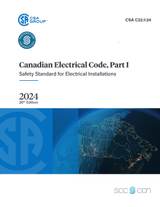


CSA C22.1:24 Canadian Electrical Code, Part I — 26th Edition — Safety Standard for Electrical Installations
CSA C22.1:24 Canadian Electrical Code, Part I, 26th Edition covering electrical installations, wiring, safety, EV charging, solar and energy storage.
About this publication
Product Description
CSA C22.1:24, Canadian Electrical Code, Part I, Safety Standard for Electrical Installations, is the 26th edition of Canada's principal electrical installation safety code. Commonly referred to as the Canadian Electrical Code, Part I or CE Code, Part I, it establishes requirements intended to support safe electrical installations in buildings, structures and premises throughout Canada.
The Code addresses electrical equipment and wiring systems across residential, commercial, institutional, industrial and other installations. It is used extensively by electricians, electrical contractors, electrical engineers and designers, inspectors, authorities having jurisdiction, utilities, facility personnel, educators and apprentices.
26th Edition
The 2024 publication is the twenty-sixth edition of the Canadian Electrical Code, Part I. It supersedes CSA C22.1:21, the 25th edition published in 2021.
The 26th edition was approved by the Committee on the Canadian Electrical Code, Part I and the Regulatory Authority Committee at their June 2023 meetings. CSA identifies this edition as a National Standard of Canada.
National Electrical Installation Code
The Canadian Electrical Code, Part I is intended for adoption and enforcement by regulatory authorities. Provincial and territorial authorities determine when and how a particular edition becomes legally applicable and can adopt amendments, interpretations or supplementary requirements.
Users should therefore consult the electrical safety authority having jurisdiction for the location of the installation. A province or territory can modify individual Code requirements when adopting CSA C22.1:24.
Relationship to IEC 60364
CSA states that the Canadian Electrical Code, Part I meets the fundamental safety principles of IEC 60364-1, Low-voltage electrical installations. The Canadian Code nevertheless remains its own national code with Canadian requirements, terminology, equipment standards and regulatory framework.
General Code Arrangement
The Code is divided into numbered Sections covering major areas of electrical installation work. Sections 0 through 16 and Section 26 are considered general Sections. Other Sections supplement or amend those general rules for particular equipment, occupancies, locations or installation types.
This structure requires users to apply the general requirements together with any specialized Section that applies to the installation under consideration.
Section 0 — Object, Scope and Definitions
Section 0 establishes the object and scope of the Code and defines terminology used throughout the document. Accurate use of these definitions is important because many technical requirements depend on terms having the specific meanings assigned by the Code.
The 2024 edition revises definitions associated with dc circuit voltage classifications, including the treatment of extra-low-voltage dc circuits.
Section 2 — General Rules
Section 2 provides general administrative and technical rules that apply broadly to electrical installations. Its requirements address installation and use of approved electrical equipment, protection of persons and property, maintenance, guarding, enclosures and other fundamental safety subjects.
The 2024 edition adds requirements concerning reduction of arcing-fault clearing times and clarifies application of ingress-protection designations.
Section 4 — Conductors
Section 4 addresses conductor selection and ampacity, termination temperatures, neutral conductors and conductor identification.
A major 2024 modernization is recognition of conductor sizes expressed in square millimetres (mm²) in addition to traditional AWG and kcmil sizes. CSA introduced supporting table information to accommodate this conductor-sizing approach.
Section 6 — Services and Service Equipment
Section 6 establishes requirements for consumer services and service equipment. Topics include service conductors, service boxes, control and protective equipment, wiring methods and metering equipment.
Service requirements are fundamental to determining how electrical power enters a building or premises and how the installation is disconnected, protected and distributed.
Section 8 — Circuit Loading and Demand Factors
Section 8 contains requirements for calculating electrical loads and applying demand factors to services and feeders.
The 2024 edition revises load calculations involving electric vehicle supply equipment. CSA also simplified these requirements through deletion of former Table 38 and revisions to the treatment of EV energy-management systems.
Electric Vehicle Energy Management
Where EV supply equipment loads are controlled by an electric vehicle energy management system, the Code establishes how the controlled EV load is accounted for in feeder and service calculations. These provisions can help designers incorporate vehicle charging while maintaining appropriate control over maximum electrical demand.
Grounding and Bonding
The Canadian Electrical Code establishes grounding and bonding requirements intended to limit hazardous voltage differences and provide effective paths for fault current. These requirements apply throughout the installation and interact with service equipment, raceways, enclosures, equipment and specialized occupancies.
Additional bonding requirements appear in specialized Sections where particular environments introduce additional shock or fault-current hazards.
Section 12 — Wiring Methods
Section 12 contains extensive requirements for conductors, cables, raceways and other wiring methods. It addresses both exposed and concealed wiring and establishes requirements intended to protect wiring systems against mechanical damage and environmental conditions.
The 2024 edition recognizes new products and introduces multiple wiring-method revisions, including updated sag and span requirements for overhead installations and new provisions concerning non-metallic-jacketed cable.
Section 14 — Protection and Control
Section 14 addresses overcurrent protection and control of electrical circuits and equipment. Requirements cover protective devices, their location and application, conductor protection and related control functions.
These provisions work together with equipment-specific Sections to ensure conductors and electrical equipment receive appropriate protection against overcurrent and fault conditions.
Section 16 — Class 1 and Class 2 Circuits
Section 16 establishes requirements for Class 1 and Class 2 circuits, including separation, wiring and installation practices. These circuits are commonly encountered in control, signaling, building automation and similar applications.
Section 18 — Hazardous Locations
Section 18 establishes electrical requirements for hazardous locations containing potentially explosive gas or dust atmospheres. It addresses classification, equipment selection, wiring methods, sealing and related installation requirements.
The 2024 edition includes substantial revisions to sealing requirements in Section 18 and corresponding Annex J18 material.
Hazardous Location Classification
CSA C22.1:24 requires hazardous locations to be classified according to the nature of the hazard, including explosive gas or explosive dust atmospheres. Classification also considers equipment groups and applicable ignition-temperature information.
The Code requires hazardous-location classification to be carried out and documented by qualified persons.
Section 20 — Specialized Hazardous Installations
Section 20 supplements the general hazardous-location rules for installations such as flammable-liquid and gasoline dispensing facilities, service stations, garages, bulk storage plants, finishing processes and aircraft hangars.
These installations can involve flammable vapours or other hazards that require specialized equipment, wiring and location-classification practices.
Section 22 — Corrosive and Wet Locations
Section 22 addresses locations where corrosive liquids, vapours or excessive moisture are likely to be present. It includes requirements affecting equipment, wiring methods, drainage, sealing, moisture exclusion, materials and bonding.
Specialized requirements also apply to installations such as sewage treatment facilities and farm buildings housing livestock.
Section 24 — Patient Care Areas
Section 24 establishes additional requirements for electrical installations in patient care areas. These installations can require specialized grounding, bonding, receptacle, circuit and essential-system arrangements because failure or electrical shock can present elevated risk to patients.
Section 26 — Installation of Electrical Equipment
Section 26 contains general installation requirements for numerous categories of electrical equipment. Subjects include switches, circuit breakers, fuses, capacitors, transformers, panelboards, surge-protective devices, branch circuits, receptacles, residential receptacles, heating and cooking appliances and other equipment.
Because Section 26 is one of the Code's general Sections, its requirements interact with many of the specialized Sections covering particular occupancies and installations.
Motors and Generators
The Code contains dedicated requirements for motors and generators, including wiring methods, overcurrent protection, overload protection, control, disconnecting means and refrigerant motor-compressors.
These provisions help coordinate motor equipment with branch circuits, feeders, protection and control systems.
Lighting Installations
Dedicated requirements apply to installation of lighting equipment, including luminaires, lampholders, lighting circuits and associated wiring.
Fire Alarm and Life-Safety Systems
The Code includes electrical requirements that support fire alarm and other life-safety systems. These rules operate together with building, fire and product standards applicable to the particular facility.
High-Voltage Installations
The Canadian Electrical Code includes specialized requirements for installations operating at higher voltages. The 2024 edition adds rules for installation of high-voltage couplers, devices designed to repeatedly connect and disconnect portable power cables.
Renewable Energy Systems
Section 64 receives some of the most substantial changes in the 2024 edition. It covers renewable energy systems, energy production systems, energy storage systems and batteries.
The revisions reflect rapidly expanding use of photovoltaic generation, battery storage and distributed energy systems in residential, commercial and industrial installations.
Energy Storage Systems
The 2024 Code adds major revisions for energy-storage systems, including a new subsection addressing residential occupancies. These requirements help coordinate electrical safety considerations associated with modern battery storage systems installed in or around homes.
Installers and designers working with energy storage should review Section 64 together with applicable equipment standards, manufacturer instructions and jurisdictional requirements.
Photovoltaic Systems
Section 64 also includes updated requirements for photovoltaic systems. Solar installations involve dc circuits, inverters, disconnecting equipment, wiring methods and other equipment that require specialized treatment beyond ordinary building circuits.
The 2024 revisions incorporate changes intended to address evolving photovoltaic technology and installation practices.
Temporary Installations and Outdoor Events
Section 66 covers amusement parks, midways, carnivals, film and television sets, remote broadcasting locations and travelling shows.
A significant 2024 change requires ground-fault circuit-interrupter protection for cords connected to receptacles used in temporary installations such as tents for outdoor functions.
Pools, Tubs and Spas
Section 68 contains requirements for pools, tubs and spas, where the combination of electrical equipment, conductive materials and water requires specialized shock-protection and bonding provisions.
The 2024 edition introduces important changes including new requirements for disconnecting means and for bonding conductive pool infrastructure.
Electric Vehicle Charging Systems
The Code contains a dedicated Section for electric vehicle charging systems. Requirements address EV supply equipment, indoor and outdoor charging locations, ventilation where required, supply circuits and related installation considerations.
The 2024 revisions to Section 8 also affect service and feeder calculations for EV charging, making the Code relevant both to installation of individual charging equipment and to evaluation of overall electrical-system capacity.
Appendices and Supporting Information
CSA C22.1 includes appendices providing explanatory, reference and supplementary information supporting application of Code Rules.
The 2024 edition reinstates Annexes A.1 and A.2 of Appendix A and the Index. CSA also deleted former Appendix K.
Tables 11A and 11B
Another organizational change in the 26th edition is the restructuring of former Table 11 into Tables 11A and 11B. CSA reformatted these tables using a layout similar to Table 19 to improve usability.
Ampacity Terminology
The 2024 edition removes the word allowable from the phrase 'allowable ampacities' throughout most of the Code. The change modernizes terminology while retaining the Code's technical requirements for determining conductor ampacity.
Major 2024 Edition Changes
CSA identifies the following among the significant revisions introduced in the 26th edition:
revised dc voltage definitions in Section 0;
new requirements addressing reduction of arcing-fault clearing times;
clarification of ingress-protection designations;
recognition of conductor sizes expressed in mm²;
revised load calculations for electric vehicle supply equipment;
deletion of former Table 38;
new products and revised wiring methods in Section 12;
revised overhead conductor sag and span requirements;
new rules for non-metallic-jacketed cable;
substantially revised hazardous-location sealing requirements;
new high-voltage coupler installation rules;
reorganization of former Table 11 into Tables 11A and 11B;
major changes for energy storage and renewable-energy systems;
a new residential energy-storage subsection;
updated photovoltaic-system requirements;
new GFCI requirements for certain temporary installations;
new pool and spa disconnecting and bonding requirements;
reinstatement of Annexes A.1 and A.2 and the Index;
deletion of Appendix K.
Provincial and Territorial Adoption
The Canadian Electrical Code is a model safety code intended for adoption by regulatory authorities. Adoption dates and amendments vary by province and territory.
For example, different Canadian jurisdictions have brought the 2024 edition into force on different schedules and can modify individual Rules when adopting the Code. Users should therefore determine the legally applicable edition and amendments for the location where work is performed.
Who Should Use CSA C22.1:24
construction electricians;
industrial electricians;
electrical contractors;
electrical engineers and designers;
electrical inspectors;
authorities having jurisdiction;
electrical safety officers;
facility engineers and maintenance personnel;
utilities and electrical service organizations;
renewable-energy and photovoltaic installers;
energy-storage-system designers and installers;
electric vehicle charging contractors;
apprentices and electrical training programs;
consulting engineers;
architectural and engineering firms;
industrial, institutional and commercial facility operators.
Why the 2024 Canadian Electrical Code Matters
Electrical technology is changing rapidly. Modern installations increasingly combine conventional utility power with solar generation, battery storage, electric vehicle charging, sophisticated power electronics and energy-management systems. At the same time, traditional electrical hazards involving shock, fire, overcurrent, arc energy, grounding and equipment failure remain.
CSA C22.1:24 updates Canada's primary electrical installation Code to address both established electrical practices and these newer technologies. Its expanded treatment of energy storage, photovoltaics and EV loads makes the 26th edition particularly important for contractors, designers and inspectors working on installations that combine traditional building wiring with distributed energy resources.
Product Features
26th edition of the Canadian Electrical Code, Part I
National Standard of Canada
Current CSA C22.1 edition as of 2026
Supersedes CSA C22.1:21
Covers electrical installations in buildings, structures and premises
Addresses services, feeders and branch circuits
Covers conductors, ampacity and conductor sizing
Includes grounding and bonding requirements
Covers wiring methods and electrical equipment installation
Addresses overcurrent protection and control
Includes hazardous and corrosive-location requirements
Covers patient care and specialized installations
Includes renewable energy and photovoltaic requirements
Includes extensive energy-storage-system requirements
Adds residential energy-storage provisions
Covers electric vehicle charging systems
Includes revised EV load-calculation requirements
Addresses pools, tubs and spas
Includes high-voltage and specialized installation requirements
Includes appendices, reference tables and supporting application information
Product Details
Standard: CSA C22.1:24
Title: Canadian Electrical Code, Part I — Safety Standard for Electrical Installations
Edition: 26th Edition
Publisher: CSA Group
Publication Year: 2024
Catalog Release Date: February 20, 2024
Publication Marking: March 2024
Print ISBN: 978-1-4883-4250-9
English PDF SKU: 2429968
English Paper SKU: 2022461
Page Count: 973 pages per current CSA catalog
Language: English
National Status: National Standard of Canada
Previous Edition: CSA C22.1:21, 25th Edition
Publication Type: Electrical Installation Safety Code
Edition Status Note
CSA C22.1:24 is the current and newest edition of the Canadian Electrical Code, Part I as of October 2026 and supersedes the 2021 edition. CSA's current product catalog identifies C22.1:24 as the newest edition, while proposed future changes continue through CSA's public-review process.
CSA C22.1 is a living code and jurisdictions can also adopt their own amendments, interpretations and effective dates. Users should verify the electrical code and local amendments legally in force for the province, territory or authority having jurisdiction where the installation is located.