
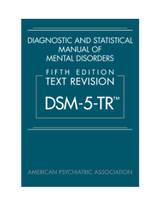
Diagnostic and Statistical Manual of Mental Disorders, Fifth Edition, Text Revision (DSM-5-TR®)
Buy the DSM-5-TR® Diagnostic and Statistical Manual of Mental Disorders, Fifth Edition, Text Revision, the current 1,120-page APA reference for mental-health diagnostic criteria, ICD-10-CM coding, cla
About this publication
The Diagnostic and Statistical Manual of Mental Disorders, Fifth Edition, Text Revision (DSM-5-TR®) is the American Psychiatric Association’s authoritative reference for the classification and diagnosis of mental disorders and the current edition of the DSM used by mental health professionals, clinicians, researchers, educators, students, healthcare organizations, and other professionals working in behavioral and mental health.
Published by the American Psychiatric Association, DSM-5-TR provides standardized diagnostic criteria and terminology intended to support consistent communication and diagnosis across psychiatry, psychology, social work, counseling, medicine, research, and related professional fields. APA describes the DSM as the handbook used by healthcare professionals in the United States and much of the world for diagnosing and classifying mental disorders.
The Text Revision is substantially more than a simple reprint of DSM-5. APA assembled more than 200 subject-matter experts to review and revise the text, references, diagnostic information, and coding material. Four cross-cutting review groups focused on culture, sex and gender, suicide, and forensic issues, while additional work addressed ethnoracial equity, inclusion, discrimination, and the use of non-stigmatizing language.
DSM-5-TR includes fully revised descriptive text and references for the disorders contained in DSM-5, incorporating scientific literature and clinical knowledge developed since the original Fifth Edition was released in 2013. The revisions affect areas including diagnostic features, associated features, prevalence, development and course, risk and prognostic factors, cultural considerations, sex- and gender-related diagnostic issues, differential diagnosis, and functional consequences.
One of the most significant changes is the addition of Prolonged Grief Disorder as a new diagnosis. DSM-5-TR also introduced symptom codes that allow clinicians to document the presence or history of suicidal behavior and nonsuicidal self-injury, reflecting areas of major clinical importance that extend across multiple diagnostic categories.
The manual also incorporates updated diagnostic criteria and ICD-10-CM codes that changed after publication of the original DSM-5. This makes DSM-5-TR considerably more useful for current clinical documentation, coding, research, teaching, and diagnostic reference work than relying on the 2013 text alone.
DSM-5-TR organizes mental disorders into major diagnostic groupings covering areas such as neurodevelopmental disorders, schizophrenia spectrum and other psychotic disorders, bipolar and related disorders, depressive disorders, anxiety disorders, obsessive-compulsive and related disorders, trauma- and stressor-related disorders, dissociative disorders, feeding and eating disorders, sleep-wake disorders, substance-related and addictive disorders, neurocognitive disorders, personality disorders, and other conditions that may be a focus of clinical attention.
The descriptive material accompanying individual disorders provides considerably more context than diagnostic criteria alone. APA states that the manual includes information involving symptoms, associated features, prevalence, development and course, risk factors, culture-related diagnostic issues, diagnostic markers, functional consequences, differential diagnosis, and other clinically relevant considerations.
DSM-5-TR also contains material designed to improve cultural awareness and diagnostic accuracy. APA’s development process included specialists in cultural psychiatry, psychology, and anthropology who reviewed disorder descriptions for cultural influences and helped expand discussion of factors such as racism, discrimination, cultural context, and non-stigmatizing diagnostic language.
Importantly, the DSM is a diagnostic and classification manual, not a treatment manual. APA explicitly states that DSM-5-TR does not provide treatment guidelines for individual disorders. Its purpose is to support assessment, diagnosis, classification, clinical communication, research, and related professional activities.
At 1,120 pages, DSM-5-TR is a substantial professional reference designed for regular clinical, academic, institutional, and research use. It provides the standardized diagnostic language that allows clinicians and researchers from different disciplines and settings to communicate more consistently about mental disorders.
For mental health professionals, healthcare organizations, universities, libraries, and students in advanced behavioral-health programs, DSM-5-TR remains one of the central references in modern psychiatric and psychological practice.
Why This Book Matters
The DSM-5-TR® is an essential professional reference for people involved in mental-health diagnosis, education, research, and clinical documentation, including:
Psychiatrists
Psychologists
Physicians and healthcare professionals
Licensed clinical social workers
Professional counselors and therapists
Psychiatric nurses and advanced-practice clinicians
Mental-health researchers
Behavioral-health organizations
University and medical-school faculty
Graduate students in mental-health disciplines
Clinical training programs
Healthcare and academic libraries
Product Features
Official DSM-5-TR®
Current Fifth Edition, Text Revision
Published by the American Psychiatric Association
Comprehensive 1,120-page diagnostic reference
Fully revised DSM-5 text and references
Updated diagnostic criteria
Updated ICD-10-CM codes
Adds Prolonged Grief Disorder
Adds coding for suicidal behavior
Adds coding for nonsuicidal self-injury
Includes extensive disorder-specific descriptive information
Covers associated features and prevalence
Covers development and course
Addresses risk and prognostic factors
Expands culture-related diagnostic information
Includes updated sex- and gender-related material
Includes differential diagnosis guidance
Includes functional-consequence information
Developed with input from more than 200 subject-matter experts
Updated terminology intended to improve clarity and reduce stigmatizing language
Used for clinical diagnosis, education, research, and professional communication
Product Details
Title: Diagnostic and Statistical Manual of Mental Disorders, Fifth Edition, Text Revision (DSM-5-TR®)
Author: American Psychiatric Association
Publisher: American Psychiatric Association Publishing
Edition: Fifth Edition, Text Revision
Published: March 18, 2022
Language: English
Number of Pages: 1,120
Subject: Psychiatry / Psychology / Mental Health / Diagnostic Classification
Current Edition Note
DSM-5-TR® remains the current edition of the Diagnostic and Statistical Manual of Mental Disorders.
The American Psychiatric Association periodically publishes official DSM-5-TR updates covering criteria, text, and coding changes issued after the original 2022 publication. Professionals using DSM-5-TR for current clinical or coding work should also consult applicable APA update supplements.