
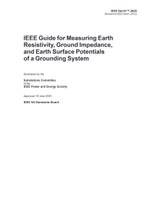
IEEE 81-2025 IEEE Guide for Measuring Earth Resistivity, Ground Impedance, and Earth Surface Potentials of a Grounding System
Buy IEEE 81-2025, the current IEEE guide for measuring earth resistivity, ground impedance, ground resistance, step and touch voltages, surge impedance, and grounding-system performance.
About this publication
The IEEE 81-2025 IEEE Guide for Measuring Earth Resistivity, Ground Impedance, and Earth Surface Potentials of a Grounding System is a major technical reference for electrical engineers, substation engineers, grounding specialists, utilities, testing organizations, commissioning teams, consultants, and safety professionals responsible for evaluating the condition, effectiveness, and electrical performance of grounding systems.
Published by IEEE and developed under the IEEE Power & Energy Society Substations Committee, this guide presents practical test methods and measurement techniques for determining key electrical characteristics of grounding systems. It is specifically intended to help professionals measure soil resistivity, grounding-system impedance, ground resistance, transient performance, and earth-surface potentials using recognized and repeatable testing practices.
A central purpose of IEEE 81 is to provide practical methods for determining earth electrical resistivity before or during grounding-system design and for evaluating completed grounding systems after installation. Soil resistivity directly affects grounding-grid performance, electrode design, ground potential rise, and the ability of a grounding system to safely dissipate fault and surge currents. Accurate field measurements therefore play an important role in both system design and safety verification.
The guide also addresses measurement of the power-frequency resistance or impedance of a grounding system to remote earth. These measurements are critical when evaluating substations, industrial electrical facilities, generating facilities, transmission installations, and other locations where grounding-system performance can directly affect personnel safety and equipment protection.
Another major area covered by IEEE 81-2025 is the measurement of step and touch voltages. During an electrical fault, voltage gradients can develop across the surface of the earth around grounding systems. Measuring these potentials helps engineers determine whether personnel may be exposed to hazardous voltage differences while standing near grounded equipment or simultaneously touching grounded structures.
The standard also provides guidance for measuring transient or surge impedance, helping professionals evaluate how a grounding system behaves during rapidly changing conditions such as lightning impulses and other transient events. This makes IEEE 81 valuable not only for conventional grounding studies but also for facilities where lightning protection, surge behavior, and transient grounding performance are significant engineering concerns.
IEEE 81-2025 goes beyond simply describing individual test methods. It also addresses safe testing conditions, grounding-system integrity verification, instrumentation characteristics and limitations, common ground-testing procedures, and factors that can distort measurement results. These issues matter enormously in field work, where nearby energized systems, interconnected conductors, buried metallic structures, overhead ground wires, soil conditions, test lead placement, and instrument limitations can all influence results.
The 2025 revision replaces IEEE 81-2012, making it the current IEEE guide for this subject. For utilities and engineering firms still relying on the previous edition, IEEE 81-2025 provides the current reference for developing test procedures, training personnel, conducting commissioning tests, investigating grounding problems, and documenting grounding-system performance.
At approximately 169 pages, IEEE 81-2025 is a substantial working guide rather than a brief overview. For organizations responsible for substations, power distribution systems, industrial electrical installations, or high-voltage equipment, it belongs alongside grounding-system design standards as an important field-measurement and verification reference.
Why This Standard Matters
IEEE 81-2025 is particularly valuable for professionals who need to verify that grounding systems actually perform as intended in the field. It is especially relevant for:
Electrical and power-system engineers
Substation engineers and designers
Grounding and lightning-protection specialists
Electric utilities and generating facilities
Industrial electrical facilities
Field-testing and commissioning organizations
Electrical safety and compliance professionals
Engineering consultants
Maintenance and reliability teams
Technical and utility standards libraries
Product Features
Current IEEE 81-2025 active standard
Supersedes IEEE 81-2012
Presents practical methods for grounding-system testing and measurement
Covers measurement of earth electrical resistivity
Addresses ground resistance and ground impedance to remote earth
Covers power-frequency grounding-system impedance
Includes methods for measuring transient and surge impedance
Addresses step and touch voltage measurements
Supports evaluation of ground potential and personnel exposure
Includes procedures for verifying grounding-system integrity
Reviews common methods for performing field ground testing
Discusses instrumentation characteristics and limitations
Addresses factors that may distort or influence test measurements
Includes important testing safety considerations
Applicable to substation, utility, industrial, and other electrical grounding systems
Developed under the IEEE Power & Energy Society Substations Committee
Product Details
Title: IEEE 81-2025 IEEE Guide for Measuring Earth Resistivity, Ground Impedance, and Earth Surface Potentials of a Grounding System
Publisher: IEEE
Standard: IEEE 81-2025
Status: Active Standard
Published: July 15, 2026
Number of Pages: 169
Standard Committee: IEEE Power & Energy Society — Substations Committee
Working Group: Grounding System Measurements in Substations
Supersedes: IEEE 81-2012