
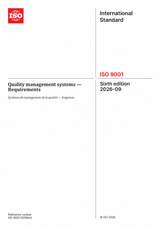
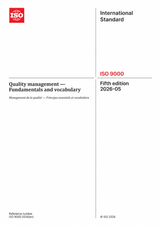
ISO 9001:2026 + ISO 9000:2026 Quality Management Bundle
Buy ISO 9001:2026 + ISO 9000:2026 bundle for current QMS requirements, fundamentals, vocabulary, leadership, risk and improvement.
Wrong edition, wrong file, or a file that won’t open? We replace or refund — contact us within 7 days.
Buy now is for one copy. Buying for a team? Get a quote
About this publication
The ISO 9001:2026 + ISO 9000:2026 Quality Management Bundle combines the two foundational standards at the heart of the ISO 9000 quality management family: ISO 9001:2026 Quality management systems — Requirements and ISO 9000:2026 Quality management — Fundamentals and vocabulary.
Together, these newly revised 2026 editions provide organizations with both sides of modern quality management: ISO 9000 explains the principles, concepts, and terminology of quality management, while ISO 9001 establishes the requirements for implementing, maintaining, evaluating, and continually improving a Quality Management System (QMS). ISO specifically describes ISO 9000 as establishing the common language and framework that supports understanding and application of ISO 9001.
This makes the bundle particularly valuable for organizations transitioning from the 2015 editions, companies preparing for ISO 9001 certification, auditors interpreting requirements, consultants developing quality systems, and professionals who need more than the requirements document alone.
Both standards are now fully updated for the 2026 ISO quality-management framework.
ISO 9000:2026 was published on May 27, 2026 as the 5th Edition, replacing ISO 9000:2015. It contains 53 pages and updates the terminology, definitions, concepts, and fundamentals used throughout the ISO 9000 family to reflect modern business practices, technology, stakeholder needs, and the revised ISO 9001 framework.
ISO 9001:2026 followed on September 16, 2026 as the 6th Edition, replacing ISO 9001:2015 and ISO 9001:2015/Amd 1:2024. It contains 36 pages and is now the current ISO requirements standard for quality management systems.
Together, the two standards provide approximately 89 pages of coordinated quality-management guidance and requirements.
The strength of this bundle is that it helps eliminate one of the most common problems when implementing ISO 9001: misunderstanding what its terminology actually means.
Terms such as quality, requirement, process, system, interested party, customer, audit, documented information, effectiveness, improvement, and other QMS concepts are not simply everyday words inside ISO standards. ISO 9000 establishes standardized terminology and concept relationships so organizations, auditors, consultants, certification bodies, suppliers, and customers can interpret quality-management requirements more consistently.
ISO 9000:2026 organizes its terminology into major categories dealing with organizations, management, processes, systems, requirements, actions, results, data and information, customers, characteristics, determination, and auditing. It also includes the fundamentals of quality management and graphical representations of concept relationships.
The 2026 edition continues to explain the quality management principles underlying the ISO 9000 family. These principles provide the conceptual foundation behind ISO 9001 rather than merely telling organizations which clauses must be satisfied.
ISO 9001:2026 then takes those concepts and turns them into practical management-system requirements.
The new edition continues to address the familiar QMS framework involving:
Context of the organization
Leadership
Planning
Support
Operation
Performance evaluation
Improvement
But the 2026 revision strengthens several important areas.
ISO highlights a greater emphasis on leadership, quality culture, accountability, risks and opportunities, people, and strategic alignment, while preserving customer focus, the process approach, risk-based thinking, and continual improvement as central principles.
A particularly important change is the clearer treatment of risks and opportunities. ISO 9001:2026 distinguishes more clearly between controlling undesirable outcomes and actively identifying and pursuing beneficial opportunities. This encourages organizations to use quality management not only as a compliance system but as a tool for improvement and strategic decision-making.
The revised standard also places stronger emphasis on quality culture and ethical behaviour. Quality is increasingly treated as an organizational responsibility involving leadership and people rather than merely a collection of documented procedures maintained by a quality department.
Management of change, organizational knowledge, digitalization, resilience, evolving supply chains, and modern business conditions are also better reflected in the revised framework.
Climate-related considerations introduced through the 2024 amendment to ISO 9001:2015 are now incorporated into the 2026 framework rather than remaining dependent on a separate amendment.
The revised ISO 9001 also uses the latest ISO management-system structure, improving compatibility with other ISO management standards and making it easier for organizations to combine quality management with environmental, information-security, occupational-safety, and other management systems.
This is where having ISO 9000:2026 alongside ISO 9001:2026 becomes particularly useful. As ISO updates concepts and terminology, the fundamentals-and-vocabulary standard gives users the reference needed to interpret the requirements using ISO's intended definitions rather than informal assumptions.
ISO explicitly states that ISO 9000 itself is not a certification standard. Instead, it supports implementation and understanding of ISO 9001. ISO 9001 is the standard within the ISO 9000 family against which organizations may be certified.
For organizations preparing for certification or transitioning an existing QMS, that distinction makes the pair unusually practical:
ISO 9000 tells you what the quality-management concepts mean.
ISO 9001 tells you what the quality-management system must do.
This combination is useful throughout the complete QMS lifecycle, including initial implementation, gap analysis, documentation development, employee training, internal auditing, management review, certification preparation, supplier qualification, corrective action, continual improvement, and ongoing system maintenance.
The standards are applicable across organizations of all sizes and sectors. ISO 9001 is used globally across manufacturing, engineering, construction, professional services, healthcare, education, government, technology, logistics, supply chains, and countless other fields. ISO reports more than one million ISO 9001 certificates across organizations in 189 countries.
For quality professionals who want the complete foundation behind the new 2026 QMS framework, this bundle is considerably more useful than purchasing ISO 9001 alone.
What’s Included
1. ISO 9001:2026 Quality Management Systems — Requirements
The current ISO requirements standard for establishing, implementing, maintaining, and continually improving a Quality Management System.
Major coverage includes:
Context of the organization
Interested parties
Leadership and commitment
Customer focus
Quality policy
Quality culture
Ethical behaviour
Risks and opportunities
Quality objectives
Management of change
Resources
Competence
Awareness
Communication
Documented information
Organizational knowledge
Operational planning and control
Customer requirements
Design and development
External providers
Production and service provision
Nonconforming outputs
Monitoring and measurement
Customer satisfaction
Internal auditing
Management review
Corrective action
Continual improvement
Publisher: International Organization for Standardization
Edition: 6th
Publication Date: September 16, 2026
Pages: 36
Technical Committee: ISO/TC 176/SC 2
Status: Current
Supersedes: ISO 9001:2015 and ISO 9001:2015/Amd 1:2024
2. ISO 9000:2026 Quality Management — Fundamentals and Vocabulary
The current foundation and terminology standard for the ISO 9000 family.
Major coverage includes:
Quality-management fundamentals
Quality-management principles
Core QMS concepts
Organizational terminology
Management terminology
Process terminology
System terminology
Requirements terminology
Actions
Results
Data, information and documented information
Customer terminology
Characteristics
Determination
Auditing terminology
Development of a QMS
Concept relationships and diagrams
Publisher: International Organization for Standardization
Edition: 5th
Publication Date: May 27, 2026
Pages: 53
Technical Committee: ISO/TC 176/SC 1
Status: Current
Supersedes: ISO 9000:2015
How ISO 9000 and ISO 9001 Work Together
ISO 9000:2026
Provides the foundation and common language.
Use it to understand:
Quality-management principles
ISO terminology
Definitions
QMS concepts
Relationships between concepts
The intent behind commonly used quality terms
ISO 9001:2026
Provides the requirements.
Use it to establish and evaluate:
QMS processes
Leadership responsibilities
Planning
Risk and opportunity management
Operational controls
Performance evaluation
Internal audits
Management review
Corrective action
Continual improvement
The Practical Difference
ISO 9000 = Fundamentals + Vocabulary
ISO 9001 = Requirements + Certification Framework
ISO itself states that ISO 9000 supports understanding and implementation of ISO 9001, while ISO 9001 is the certifiable requirements standard.
Why This Bundle Matters
The ISO 9001:2026 + ISO 9000:2026 Quality Management Bundle is especially useful for:
Quality managers
Quality engineers
QMS coordinators
Internal auditors
Lead auditors
ISO consultants
Certification professionals
Compliance managers
Operations managers
Senior management
Process owners
Manufacturing companies
Engineering organizations
Construction companies
Technology businesses
Service organizations
Healthcare organizations
Supply-chain professionals
Procurement departments
Training organizations
Companies preparing for ISO 9001 certification
Organizations transitioning from the 2015 editions
Bundle Features
Includes both newly released 2026 quality-management standards
Includes ISO 9001:2026
Includes ISO 9000:2026
Approximately 89 combined pages
Both previous 2015 editions replaced
Provides QMS requirements plus supporting terminology
Covers quality-management principles
Covers current ISO definitions and concepts
Covers leadership and quality culture
Covers ethical behaviour
Covers customer focus
Covers risks and opportunities
Covers management of change
Covers organizational knowledge
Covers documented information
Covers operational processes
Covers internal auditing
Covers management review
Covers corrective action
Covers continual improvement
Supports implementation and transition
Supports certification preparation
Supports auditor and employee training
Helps organizations interpret ISO 9001 terminology consistently
Provides a stronger QMS reference library than ISO 9001 alone
2015 vs. 2026 Editions
Previous Quality Management Framework
ISO 9000:2015
Previous fundamentals and vocabulary standard
ISO 9001:2015
Previous QMS requirements standard
ISO 9001:2015/Amd 1:2024
Added climate-change considerations
Current Quality Management Framework
ISO 9000:2026
Updated terminology
Updated definitions
Updated quality concepts
Modernized QMS fundamentals
Aligned with ISO 9001:2026
ISO 9001:2026
Stronger leadership focus
Greater quality-culture emphasis
Greater ethical-behaviour awareness
Clearer distinction between risks and opportunities
Greater emphasis on actively pursuing opportunities
Updated modern-business context
Climate considerations incorporated
Improved alignment with other ISO management standards
Expanded Annex A explanatory support
The new editions therefore give organizations a coordinated 2026 foundation for both understanding and implementing quality management systems.
Product Details
Bundle Title: ISO 9001:2026 + ISO 9000:2026 Quality Management Bundle
Publisher: International Organization for Standardization (ISO)
Standards Included: 2
Combined Pages: 89
Language: English
Subject: Quality Management / QMS / ISO Certification / Quality Assurance / Auditing / Continual Improvement
ISO 9001:2026
Title: Quality management systems — Requirements
Edition: 6th
Publication Date: September 16, 2026
Pages: 36
Technical Committee: ISO/TC 176/SC 2
Status: Current / Published
Supersedes: ISO 9001:2015 and ISO 9001:2015/Amd 1:2024
ISO 9000:2026
Title: Quality management — Fundamentals and vocabulary
Edition: 5th
Publication Date: May 27, 2026
Pages: 53
Technical Committee: ISO/TC 176/SC 1
Status: Current / Published
Supersedes: ISO 9000:2015
Certification Note
ISO 9001:2026 is the certifiable standard in this bundle.
ISO 9000:2026 is not itself a certification standard. It provides the fundamentals, principles, concepts, and vocabulary that support understanding and implementation of ISO 9001.
Organizations transitioning an existing ISO 9001 certification should follow the applicable transition requirements and guidance provided by their certification body.