
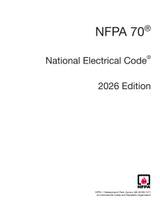
NFPA 70:2026 National Electrical Code (NEC)
NFPA 70:2026 NEC provides current electrical installation rules for wiring, grounding, protection, PV, energy storage, EV systems and inspections.
Wrong edition, wrong file, or a file that won’t open? We replace or refund — contact us within 7 days.
Buy now is for one copy. Buying for a team? Get a quote
About this publication
Product Description
NFPA 70®, National Electrical Code® (NEC®), 2026 Edition establishes requirements for electrical design, installation and inspection intended to protect people and property from electrical hazards. Published by the National Fire Protection Association, the NEC is one of the most widely used electrical installation codes and provides requirements for residential, commercial, industrial and other electrical installations.
The 2026 edition replaces NFPA 70:2023 and incorporates extensive revisions addressing emerging electrical technologies, system voltages, grounding and bonding, load calculations, renewable-energy systems, energy storage, electric vehicles, limited-energy systems, special occupancies and the continuing structural reorganization of the Code.
Current Edition
NFPA identifies the 2026 NEC as the current active edition of NFPA 70. The Code is revised on a three-year cycle to address changes in electrical technology, installation methods, products, hazards and industry practices.
The 2026 edition continues the restructuring effort that began with the 2023 NEC and is expected to continue through the 2029 edition.
Purpose
The purpose of the NEC is the practical safeguarding of persons and property from hazards arising from the use of electricity.
The Code provides installation requirements rather than functioning as a design specification or instruction manual for untrained persons. Proper application requires knowledge of electrical systems, applicable laws, equipment listings and local adoption requirements.
Electrical Installations
NFPA 70 covers electrical conductors, equipment, raceways, signaling and communications systems and related installations within the scope established by the Code.
Requirements address electrical systems in homes, apartment buildings, offices, stores, industrial facilities, institutional occupancies, agricultural buildings, hazardous locations and many other environments.
General Requirements
Chapter 1 provides fundamental provisions applicable throughout the NEC. These requirements include definitions, examination and approval of equipment, installation and use, conductor terminations, interrupting ratings, equipment identification, working space and other basic electrical safety provisions.
Definitions
Article 100 contains definitions used throughout the NEC. Consistent definitions are essential because many electrical requirements depend on precise distinctions among equipment, systems, occupancies, wiring methods and installation conditions.
Wiring and Protection
Chapter 2 addresses wiring and protection requirements. Subjects include branch circuits, feeders, services, overcurrent protection, grounding and bonding and other fundamental system requirements.
Branch Circuits
Branch-circuit provisions address ratings, conductor sizing, required circuits, permitted loads, receptacle and outlet requirements and protection applicable to electrical utilization equipment.
Requirements vary according to occupancy, circuit rating, load type and installation conditions.
Feeders
The NEC establishes requirements for feeder conductor sizing, ampacity, overcurrent protection, load calculations and related installation considerations.
Feeder requirements interact with branch-circuit loads, demand factors, service calculations and grounding and bonding provisions.
Services
Service requirements address service conductors, service equipment, disconnecting means, ratings, locations and grounding and bonding associated with the connection between utility-supplied electrical systems and premises wiring.
Overcurrent Protection
Article 240 establishes requirements for protecting conductors and equipment from overcurrent conditions.
Requirements address overcurrent protective device ratings, locations, conductor protection, circuit breakers, fuses, series ratings and related safety provisions.
Grounding and Bonding
Grounding and bonding remain central subjects within NFPA 70. The Code establishes requirements for grounding electrode systems, equipment grounding conductors, bonding conductors, grounded conductors and bonding of normally non-current-carrying conductive parts.
NFPA specifically highlights enhanced grounding and bonding requirements among the important safety aspects of the 2026 edition.
Load Calculations
The NEC provides methods for calculating electrical loads for branch circuits, feeders and services.
The 2026 edition adjusts selected load and demand factors to account for increased energy efficiency and changes in contemporary electrical utilization.
Systems Over 1000 Volts AC and 1500 Volts DC
The continuing NEC reorganization includes expanded and separated treatment of electrical installations operating over 1000 volts alternating current and 1500 volts direct current.
NFPA identifies this restructuring as part of the broader effort to organize medium- and higher-voltage installation requirements more clearly and consistently.
Wiring Methods and Materials
Chapter 3 covers wiring methods and materials used to route and protect electrical conductors.
The chapter includes requirements for conductors, cables, raceways, boxes, enclosures, fittings and other wiring-method components.
Conductors
The NEC establishes conductor requirements involving insulation types, ampacity, temperature ratings, identification, installation, protection and permitted uses.
Conductor selection must account for electrical load, ambient conditions, termination ratings, adjustment and correction factors and the wiring method used.
Cables and Raceways
Requirements address common cable and raceway systems including nonmetallic-sheathed cable, metal-clad cable, armored cable, electrical metallic tubing, rigid metal conduit, intermediate metal conduit, flexible raceways and other recognized wiring methods.
Boxes and Enclosures
Electrical boxes, cabinets and enclosures must satisfy requirements for sizing, conductor fill, support, accessibility, protection and use with applicable wiring methods and equipment.
Equipment for General Use
Chapter 4 addresses electrical equipment commonly used across occupancies and installations.
Subjects include flexible cords, switches, receptacles, panelboards, luminaires, appliances, electric heating equipment, motors, transformers and other general-use equipment.
Switches and Receptacles
NEC requirements address ratings, installation, grounding, location and protection of switches and receptacles.
Depending on the installation, receptacles can also be subject to ground-fault circuit-interrupter and arc-fault circuit-interrupter requirements.
Panelboards and Distribution Equipment
The Code includes requirements for panelboards, switchboards, switchgear and related electrical distribution equipment.
These provisions coordinate equipment ratings, overcurrent protection, available fault current, grounding, labeling and installation accessibility.
Motors and Motor Circuits
Motor requirements address conductors, overload protection, branch-circuit short-circuit and ground-fault protection, disconnecting means, controllers and related equipment.
The 2026 edition includes revisions affecting motor protection, including provisions modified through Tentative Interim Amendments.
Special Occupancies
Chapter 5 establishes additional requirements for occupancies and locations presenting special electrical hazards or operating conditions.
Examples include hazardous classified locations, commercial garages, aircraft facilities, health care facilities, assembly occupancies, agricultural buildings, marinas and other specialized environments.
Hazardous Classified Locations
The NEC provides detailed requirements for electrical installations where flammable gases, vapors, combustible dusts or ignitable fibers can create fire or explosion hazards.
The Code includes traditional Class/Division concepts as well as Zone-based classification systems.
Health Care Facilities
Electrical installations in health care facilities are subject to additional requirements involving patient care spaces, essential electrical systems, grounding, wiring methods and reliability.
Special Equipment
Chapter 6 addresses specialized electrical equipment and installations.
Subjects include elevators, electric vehicle power transfer systems, electric signs, swimming pools and similar installations, photovoltaic systems, energy storage equipment and other specialized systems.
Electric Vehicle Power Transfer Systems
The 2026 NEC includes updated requirements supporting safer integration of electric vehicle charging and power transfer technology.
Requirements address equipment, circuits, connections, load considerations and electrical protection associated with EV power transfer systems.
Photovoltaic Systems
Article 690 establishes requirements for solar photovoltaic electrical systems.
The 2026 edition includes updated PV provisions addressing electrical protection, rapid shutdown and integration of photovoltaic systems into premises wiring and interconnected power systems.
Energy Storage Systems
Energy storage systems are increasingly important in residential, commercial and utility-interactive applications.
NFPA specifically identifies updated energy-storage provisions as a major feature of the 2026 NEC, reflecting increased use of batteries and other energy-storage technologies.
Interconnected Electric Power Production Sources
Article 705 addresses interconnected electric power production sources and their connection to electrical distribution systems.
These provisions are important for photovoltaic generation, energy storage, generators and other distributed-energy resources that can operate in parallel with another power source.
Swimming Pools and Similar Installations
Article 680 establishes specialized requirements for swimming pools, spas, hot tubs, fountains and similar installations.
Particular attention is given to equipotential bonding, grounding, wiring methods, equipment locations and shock protection in environments where electricity and water are in close proximity.
Special Conditions
Chapter 7 addresses electrical systems operating under special conditions or performing specialized safety and reliability functions.
Subjects include emergency systems, legally required standby systems, optional standby systems, energy management and limited-energy installations.
Limited-Energy Systems
The NEC reorganization continues to consolidate and clarify limited-energy system requirements.
The 2026 edition adds Article 750, Grounding and Bonding of Limited-Energy Systems, providing a dedicated location for grounding and bonding requirements applicable to these systems.
Communications Systems
Chapter 8 addresses communications systems. A major organizational change in the 2026 NEC is removal of Chapter 8's former stand-alone status.
As a result, Chapters 1 through 4 now generally apply to Chapter 8 unless specifically modified or excluded, improving correlation between communications installations and general NEC requirements.
Tables
Chapter 9 provides tables used throughout the NEC for raceway dimensions, conductor properties, conductor fill and other engineering and installation calculations.
These tables support practical application of wiring-method and conductor requirements.
Informative Annexes
The NEC includes informative annexes providing supplementary information and examples. Informative annexes are not mandatory Code requirements unless specifically adopted or referenced by an authority having jurisdiction.
New Informative Annex L
The 2026 edition adds Informative Annex L, Proposed Organization of the 2029 National Electrical Code.
The annex helps NEC users prepare for the continuing restructuring expected in the 2029 edition and illustrates the anticipated future organization of Code material.
Continuing NEC Reorganization
NFPA's NEC Correlating Committee and Code-Making Panels are carrying out a multicycle reorganization intended to improve usability and provide a more logical structure for rapidly evolving electrical technologies.
The effort began in the 2023 edition, continues substantially in 2026 and is planned for further completion in the 2029 edition.
Major 2026 Edition Changes
- continued restructuring and relocation of NEC articles and sections;
- expanded treatment of systems over 1000 volts ac and 1500 volts dc;
- removal of redundant material and improved terminology correlation;
- removal of Chapter 8's former stand-alone status;
- revisions to selected demand factors and electrical load requirements;
- new Article 750 addressing grounding and bonding of limited-energy systems;
- updated requirements for photovoltaic installations;
- updated provisions for energy storage systems;
- updated requirements for electric vehicle power transfer systems;
- enhanced grounding and bonding provisions;
- new Informative Annex L illustrating the proposed 2029 NEC organization.
NFPA 70 and Authorities Having Jurisdiction
The NEC is a model electrical code. Legal enforceability depends on adoption by states, municipalities or other authorities having jurisdiction.
Adopted editions and local amendments can differ by jurisdiction, so electrical professionals must confirm which NEC edition and amendments apply to the specific project location.
Inspection and Code Compliance
The NEC provides the technical requirements used by electrical inspectors and authorities having jurisdiction when evaluating electrical installations.
Designers and installers use the same requirements to plan systems capable of passing inspection and providing the intended electrical safety protections.
Who Uses the NEC
- electricians;
- electrical contractors;
- electrical engineers and designers;
- electrical inspectors;
- authorities having jurisdiction;
- plan reviewers;
- building officials;
- facility and maintenance personnel;
- solar and photovoltaic installers;
- energy storage professionals;
- electric vehicle charging installers;
- electrical instructors, apprentices and examination candidates.
Tentative Interim Amendments
NFPA uses Tentative Interim Amendments, or TIAs, to make approved interim changes between regular Code editions.
NFPA's current development record lists TIA 26-1 through TIA 26-5 as issued amendments affecting the 2026 NEC. Additional TIA 26-6 and TIA 26-7 records state that their text was approved for incorporation before printing of the document.
Users applying NFPA 70 should therefore consult NFPA's current document-information page in addition to the printed Code to identify applicable interim amendments.
Errata
NFPA has issued multiple errata for the 2026 NEC. These correct printing, wording, cross-reference and other errors identified after publication.
Errata 70-26-1 corrects Section 240.86(C). Errata 70-26-2 corrects material in 680.24 and 680.26. Errata 70-26-3 corrects wording in 720.22(C)(1).
Errata 70-26-4 applies specifically to print copies and restores Table 430.22(H), Conductor Short Circuit Factors, which NFPA states was inadvertently omitted from the printed NEC. Electronic products and later pamphlet reprints may incorporate issued errata.
Proposed Future TIAs
As of November 20, 2026, NFPA is soliciting public comments on proposed TIA Nos. 1951 through 1954 involving plug-in photovoltaic systems and Article 705 provisions.
These proposals are not part of the published 2026 NEC unless and until they complete NFPA's approval process and are formally issued.
Print Formats
NFPA currently offers the 2026 NEC in softbound and spiral-bound print formats.
- Softbound: NFPA SKU 7026SB, print ISBN 978-1-4559-3220-7.
- Spiral-bound: NFPA SKU 7026SPL, print ISBN 978-1-4559-3221-4.
This catalog record uses the softbound NFPA product code and ISBN as the primary print metadata.
Product Details
- Standard: NFPA 70:2026
- Title: National Electrical Code (NEC)
- Edition: 2026 Edition
- Publisher: National Fire Protection Association
- Publication Year: 2025
- Page Count: 997
- Primary Print Format: Softbound
- Softbound Product Code: 7026SB
- Softbound Print ISBN: 978-1-4559-3220-7
- Spiral-Bound Product Code: 7026SPL
- Spiral-Bound Print ISBN: 978-1-4559-3221-4
- Previous Edition: NFPA 70:2023
- Status: Active / Current Edition
- Language: English
- Publication Type: Electrical Code / Standard
Edition Status Note
NFPA 70:2026 is the current active edition of the National Electrical Code and revises NFPA 70:2023. NFPA has issued Tentative Interim Amendments and errata affecting the 2026 edition, so users should consult NFPA's current document-information page when applying the Code. In particular, printed copies are subject to Errata 70-26-4 concerning omitted Table 430.22(H).